What does “compliant leather” even mean in 2026? Six months ago, it meant passing REACH and hitting your Martindale target. Today, it means navigating PFAS bans across six U.S. states, meeting GRS certification mandates from 70% of European brands, and matching a color palette that shifted from black gloss to grey matte almost overnight. The trends leather buyers tracked in 2025 — sustainability pledges, vegan alternatives — have hardened into procurement requirements with enforcement dates. Miss the window, and your container gets rejected at customs.
| 2026 Trend | Market Signal | B2B Impact |
|---|---|---|
| PFAS regulations | 6 US states ban PFAS in furniture | PVC/phthalate leather disqualified |
| Grey-matte color shift | OEMs favor neutral, matte interiors | Color matching requires Delta E ≤ 1.0 |
| Silicone leather growth | $536M market by 2030 (14% CAGR) | New capacity opens to mid-volume buyers |
Download 2026 Compliance Catalog
Trend 1: PFAS Bans Redefine “Compliant Leather”
On January 1, 2026, six U.S. states — Maine, Colorado, Connecticut, Minnesota, Vermont, and Washington — enacted or expanded PFAS restrictions on upholstered furniture and textile articles. California’s AB 2998 framework continues to tighten in parallel. For B2B buyers, this means any leather containing polyfluoroalkyl substances — including many stain-resistant PVC and treated PU formulations — is now non-compliant in those jurisdictions.
The practical impact is immediate. If your supplier’s technical data sheet lists any fluorinated compounds in the coating formulation, you need an alternative before your next shipment. Eco-friendly silicone leather is PFAS-free by chemistry — silicone polymers don’t use fluorochemicals in their backbone. We’ve verified non-detect for PFAS compounds and total fluorine across our entire product range, backed by third-party testing.

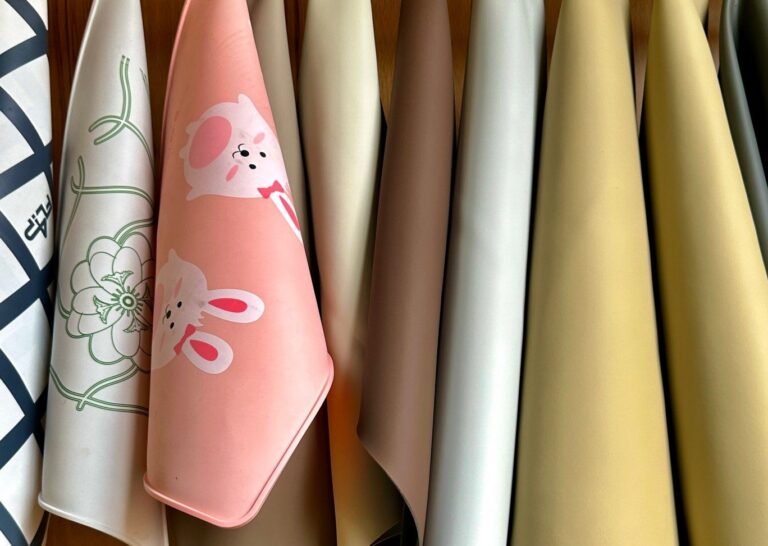
Full-color swatch racks let buyers verify color matching and matte finish quality before committing to bulk orders.
Trend 2: Grey-Matte Replaces Black Gloss in Automotive
The 2026 TFL Colour Trends report confirms what automotive designers have been signaling for two seasons: neutral greys, soft beiges, and matte textures are replacing the high-gloss black that dominated car interiors for a decade. Automakers like Genesis, Polestar, and Lucid are layering tonal greys with matte surfaces to create what designers call “sanctuary cabins” — and this shift cascades directly into material specifications for Tier 1 suppliers.
For automotive interior applications, matte finishes create a specific procurement challenge. Glossy PU leather can hide surface imperfections under reflection. Matte surfaces expose every texture inconsistency and color batch variation. That means Delta E ≤ 1.0 color accuracy — previously a premium spec — is now table stakes. In our experience supplying matte silicone leather to OEM programs, achieving this tolerance requires Pantone-matched color formulation and strict batch-to-batch QC, which is why many PU suppliers struggle with the matte shift.

2026 automotive interiors favor grey-matte tones over high-gloss black, requiring tighter color matching tolerances.
Trend 3: Silicone Crosses the $500M Market Threshold
The broader synthetic leather market sits at $48.84 billion in 2026 and is projected to reach $71.86 billion by 2031 at 8.03% CAGR. But within that market, silicone leather is growing at 14% CAGR — nearly double the category average — with a projected market size of $536 million by 2030. That growth rate signals something structural: buyers aren’t just switching from PVC to PU anymore. They’re jumping past PU entirely to silicone.
The silicone vs PU comparison tells the story: 10+ year service life vs 3–5 years, 200K Martindale vs 30K, -40°C to 250°C vs -20°C to 80°C. Five years ago, these specs came with a prohibitive price premium. As production capacity scales — our own facility now runs 500,000+ meters monthly — that gap has narrowed to where silicone’s total cost of ownership over a product lifecycle is lower than PU’s replacement cycle cost.

Scaled production capacity is bringing silicone leather pricing closer to PU, accelerating the crossover trend.
Market outlook overview covering silicone leather demand drivers, capacity expansion, and 2030 projections.
What B2B Buyers Should Do Before Q3
The 2026 leather industry trends aren’t theoretical — they’re reshaping procurement documents right now. Here’s what to do before the next sourcing cycle closes:
- Audit your material spec sheets for PFAS: Any fluorochemical additive in your current leather is a ticking compliance bomb in 6 US states. Request updated safety data sheets from every supplier this quarter.
- Request matte-finish color samples: If your product line serves automotive or premium furniture, order matte swatches now and verify Delta E consistency across 3+ production batches before committing.
- Calculate 5-year TCO, not unit price: A PU sofa that costs 30% less upfront but needs replacement in 3 years is more expensive than silicone leather that lasts 10+ years. Supply chain resilience in 2026 means planning for the full lifecycle, not the first invoice.
Is silicone leather really replacing PU leather in B2B markets?
Not entirely — PU still dominates volume-driven applications where 3–5 year lifespan is acceptable. But in segments requiring 10+ year durability, regulatory compliance, or premium positioning (automotive, medical, marine, contract furniture), silicone is displacing PU at 14% CAGR. The crossover point where silicone TCO beats PU TCO has already passed for high-wear applications.
How do I verify my leather supplier is PFAS-compliant?
Request a third-party PFAS test report (EPA Method 1633 or equivalent) showing non-detect results for the full analyte list. Safety data sheets alone are insufficient — they list intentionally added ingredients but not contaminants. A certified lab report with detection limits below 10 ppt is the current industry benchmark.
Request 2026 Trend Sample Pack
About TOPSUN
TOPSUN supplies PFAS-free, zero-VOC silicone leather to B2B buyers navigating 2026 regulatory and design shifts — with 500,000m monthly capacity serving automotive, furniture, medical, and marine applications.
Delta E ≤ 1.0 color accuracy · Pantone/RAL matching · Non-detect PFAS verified · 200K+ Martindale · 7–15 day lead time