The global custom leather printing market processes millions of square meters annually across fashion, automotive, and promotional product sectors. Yet procurement teams routinely choose between screen printing and digital printing based on unit price alone — ignoring that the wrong method can delaminate, fade, or crack within 18 months. When you print on leather for B2B production, the printing method determines not just appearance but longevity, and that difference shows up in warranty claims.
| Factor | Screen Printing | Digital Printing | Silicone In-Matrix |
|---|---|---|---|
| Precision | ±0.5mm | ±0.1mm | ±0.1mm |
| Color range | Spot colors (limited) | Full CMYK + gradients | Pantone + unlimited |
| MOQ | High (screen cost) | Low (no screens) | 500m |
| Abrasion survival | 2-3 years | 1-2 years | 10+ years |
| UV stability | Moderate | Poor (ink fades) | 1,000+ hours |
| Setup cost | High (screens) | Low (digital file) | Moderate (rollers) |
Screen Printing on Leather: Precision With a Price
Screen printing forces ink through a mesh stencil onto the leather surface. With mesh counts of 110-230, it delivers ±0.5mm precision — ideal for brand logos, geometric patterns, and solid-color designs. The ink sits on top of the surface as a separate layer, which means it wears independently from the substrate beneath.

Screen-printed leather sample showing precise pattern registration — the ink layer sits on the surface, not within it.
In our abrasion testing, screen-printed patterns on conventional PU leather show visible ink loss at 15,000-20,000 Martindale cycles. The ink doesn’t crack — it simply wears away, exposing the unprinted substrate beneath. For fashion and sports applications where the printed surface contacts skin, sweat accelerates this erosion. The solution isn’t better ink — it’s a different substrate entirely.
Digital Printing on Leather: Flexibility That Fades
Digital printing (direct-to-leather inkjet) eliminates screens entirely. CMYK inkjet heads reproduce photographic images, gradient transitions, and unlimited color combinations without setup costs. For small-batch and custom orders, it’s unbeatable on price. But UV-cured digital inks on leather face a fundamental chemistry problem: the ink polymer bonds to the surface coating, not the substrate. When the coating degrades, the print goes with it.

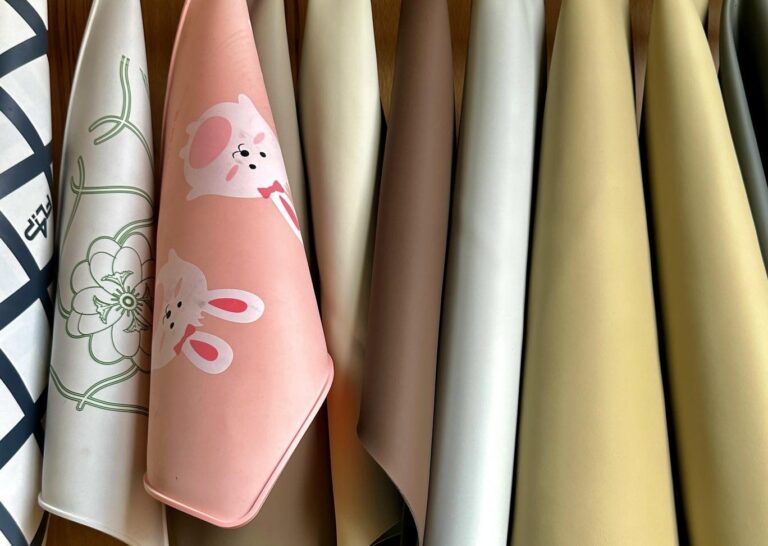
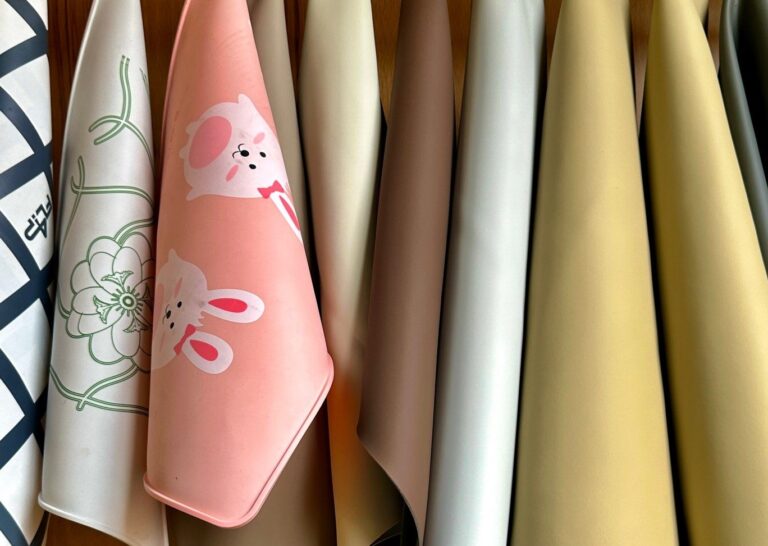
Printed leather swatches on display rack — digital printing enables unlimited patterns but ink adhesion remains a weakness.
UV exposure tests confirm the weakness. Digital prints on PU leather show measurable color shift (Delta E > 3.0) after 200 hours of accelerated weathering per ISO 105-B06. Screen prints fare slightly better due to heavier ink deposit, but both methods share the same structural flaw: the print is a surface treatment, not an integral property. Custom texture design through embossing solves this differently — by physically forming the pattern into the material itself.

Custom texture samples — embossing forms patterns into the material matrix, eliminating the delamination risk of surface printing.
The Third Option: In-Matrix Color and Pattern Integration
Silicone leather solves the print-on-leather durability problem through chemistry rather than application technique. Color pigments are integrated into the silicone polymer matrix during coating — the pattern and color exist throughout the material, not on its surface. Custom embossing rollers can create textured patterns in 7-10 days, and the pattern won’t wear off because it’s structurally formed, not ink-deposited.
Our UV resistance data shows zero color shift (Delta E < 1.0) after 1,000+ hours of accelerated weathering — 5x longer than screen printing and 5x longer than digital. Martindale abrasion exceeds 200,000 cycles with no pattern loss because there’s no ink layer to abrade. For B2B buyers specifying printed leather for multi-year applications, this changes the calculation from “how long until reprint” to “does reprint matter.”
Print on Leather: Which Method Fits Your Project?
- If you need photographic detail, gradients, or unlimited color in a single design → digital printing, but plan for reprinting within 2 years.
- If you need consistent spot-color logos at high volume with moderate longevity → screen printing, accepting ±0.5mm precision limits.
- If you need patterns that survive the full product lifespan without reprint → in-matrix silicone embossing, with custom rollers in 7-10 days.
- If you need Pantone-matched solid colors across large runs with zero batch variance → in-matrix silicone color with Delta E ≤ 1.0 consistency.
- If you need rapid prototyping before committing to production tooling → digital printing for samples, then transition to in-matrix for production.
Printing on leather isn’t just about putting color on a surface. It’s about whether that color stays there for the life of the product. Choose the method that matches your warranty period, not just your unit cost.
About TOPSUN
TOPSUN engineers silicone leather with in-matrix color integration and custom embossing capabilities for B2B clients requiring printed leather that outlasts conventional surface-printing methods.
Custom embossing rollers delivered in 7-10 days, Pantone matching with Delta E ≤ 1.0, 100+ texture options, and 1,000+ hour UV stability — verified by ISO 105-B06 testing across 10+ automated production lines.