The ISO 1419 Jungle Test places polyurethane leather in a chamber at 70°C and 95% relative humidity. After 7 days, standard PU leather shows visible cracking, peeling, and polymer degradation. After 14 days, the surface has delaminated from the fabric backing. After 28 days — the threshold for commercial-grade acceptance — most PU leather is unrecognizable. This is polyurethane leather durability in laboratory terms. In real-world terms, it explains why your PU sofa starts peeling at year three, your PU car seat cracks at year four, and your PU handbag delaminates after one humid summer. The chemistry is predictable. The testing is standardized. And the hidden problems with PU leather become visible faster than most procurement teams expect.
The Three Degradation Pathways That Destroy Polyurethane Leather
Polyurethane leather doesn’t fail randomly. It degrades through three well-documented chemical pathways, each accelerated by specific environmental conditions. Understanding these mechanisms is the difference between specifying a material that lasts 2 years and one that lasts 10.
Pathway 1: Hydrolysis. The dominant failure mode for PU leather. Water molecules — from ambient humidity, direct liquid contact, or human perspiration — penetrate the polyurethane polymer and cleave the ester bonds in the polymer chain. This chemical reaction breaks the polymer into smaller fragments, causing the surface to lose flexibility, become brittle, and eventually crack and peel. The reaction rate doubles for every 10°C increase in temperature, which is why PU leather in hot, humid environments (car interiors in summer, gym equipment, marine seating) fails dramatically faster than the same material in climate-controlled offices. For a detailed mechanism analysis, see our hydrolysis resistance guide.
Standardized Testing: What the Data Actually Shows
Polyurethane leather durability is measured through standardized accelerated aging tests. These tests compress years of real-world exposure into days or weeks of laboratory conditioning, providing predictive data for material selection. The three most relevant tests for B2B procurement are the ISO 1419 Jungle Test (hydrolysis), ASTM G154 (UV resistance), and ISO 12947-2 (Martindale abrasion).
Here’s how PU leather performs against silicone leather across these three standards. For manufacturing context on why PU degrades, see our PU leather manufacturing process analysis.
| Test Standard | Test Condition | PU Leather Result | Silicone Leather Result | Real-World Implication |
|---|---|---|---|---|
| ISO 1419 (Jungle Test) | 70°C, 95% RH | Cracks at 7 days, delaminates at 14 | No change at 28+ days | PU fails in humid environments within 2-3 years |
| ASTM G154 (UV) | UV fluorescent, 1,000 hrs | Cracks, fades, Grade 2 | No change, Grade 4-5 | PU cracks in sunlight within 1-2 years |
| ISO 12947-2 (Martindale) | Abrasion, cycles to failure | 25,000-40,000 cycles | 200,000+ cycles | PU surface wears through in 1-2 years of daily use |
| ISO 11507 (Hydrolysis) | Warm humidity, 6 weeks | Severe degradation | No degradation | PU cannot be used in moisture-exposed applications |
PU leather’s hydrolysis rate doubles for every 10°C increase in temperature. A car interior reaching 60°C in summer accelerates PU degradation 4× faster than the same material in a 40°C office. This is why PU automotive upholstery fails in 3-4 years while PU office furniture lasts 4-5 years.

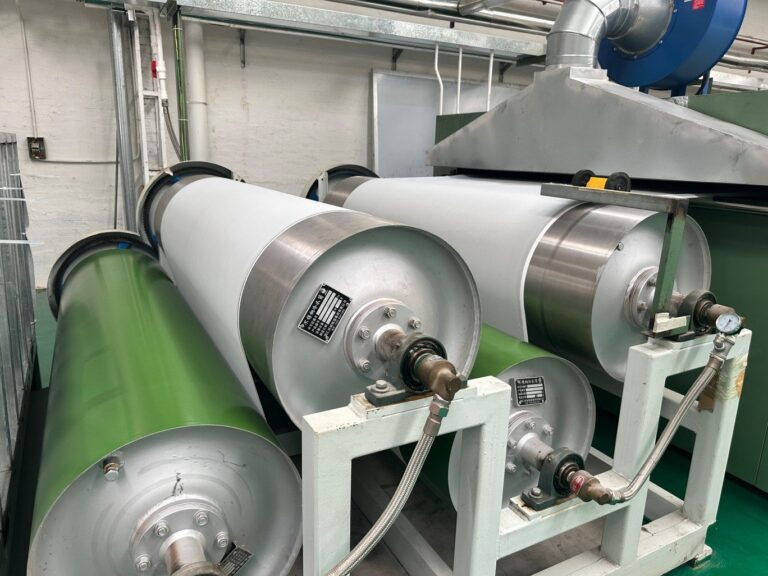
Physical testing laboratory — where polyurethane leather durability predictions become data, not guesses.
UV Degradation: The Second Failure Pathway
UV light doesn’t directly cause hydrolysis, but it weakens the PU polymer surface through photo-oxidation. Ultraviolet photons break polymer chains at the surface, creating micro-cracks that expose the underlying structure to moisture. This two-stage degradation — UV creates the entry points, humidity does the damage — is why PU leather in sunny environments fails faster than the sum of UV and hydrolysis testing would suggest individually.
Per ASTM G154 standardized UV testing, PU leather shows visible cracking and color fading within 1,000 hours of accelerated UV exposure. Silicone leather shows no change — Grade 4-5 color fastness — after the same exposure. The difference is molecular: silicone’s Si-O backbone is inherently UV-stable, while PU’s C-N bonds are susceptible to photolytic cleavage.
For more on synthetic leather PU failure patterns, the field data aligns with laboratory predictions: UV-exposed PU fails first, followed by humidity-exposed PU, followed by friction-worn PU.
Abrasion Failure: When the Surface Wears Through
The third degradation pathway is mechanical wear. Every time someone sits on a PU sofa, leans against a PU headrest, or adjusts position on a PU car seat, the surface experiences abrasion. ISO 12947-2 Martindale testing measures cycles-to-failure — the number of abrasion cycles before the surface coating wears through to the fabric backing.
Standard PU leather reaches failure at 25,000-40,000 cycles. In a high-traffic commercial environment — a restaurant booth, a hotel lobby, a cinema seat — that translates to 1-2 years of service before the surface begins to show through. Premium PU with polycarbonate-based resins can reach 50,000-80,000 cycles, extending service life to 3-4 years in the same environment.
Silicone leather’s 200,000+ Martindale cycles means the surface survives 5-8× longer under identical abrasion conditions. In commercial environments, that’s the difference between replacing upholstery every 18 months and replacing it every 8-10 years. For a comprehensive comparison, see our synthetic leather durability analysis.
Durability comparison — watch how silicone leather outperforms PU across standardized testing.
Why Silicone Doesn’t Degrade: A Chemistry Answer
The fundamental difference between polyurethane leather durability and silicone leather durability comes down to polymer backbone chemistry. PU uses carbon-nitrogen (C-N) and carbon-oxygen (C-O) bonds in its polymer chain. These bonds are susceptible to hydrolysis (water cleavage) and photo-oxidation (UV cleavage). Silicone uses silicon-oxygen (Si-O) bonds — the same bond structure found in glass and quartz. These bonds are significantly more thermally stable, UV-resistant, and chemically inert than carbon-based polymers.
This is not a marginal improvement. The Si-O bond energy is approximately 452 kJ/mol, compared to C-O at 360 kJ/mol and C-N at 305 kJ/mol. The higher bond energy means more energy is required to break the polymer chain — whether from heat, UV radiation, or chemical attack. Silicone leather’s 10+ year service life isn’t marketing. It’s thermodynamics. For the full chemistry breakdown, see our silicone vs PU comparison.
About TOPSUN
TOPSUN manufactures silicone leather that eliminates the three polyurethane degradation pathways — hydrolysis, UV photo-oxidation, and mechanical abrasion — through Si-O polymer backbone chemistry tested to ISO 1419, ASTM G154, and ISO 12947-2 standards.
200,000+ Martindale cycles, 1,000+ hours UV stability, 28+ days Jungle Test survival. ISO 10993-5 biocompatibility certified. SGS and Intertek verified. Free A4 swatches shipped worldwide via DHL/FedEx.
Frequently Asked Questions
Why does polyurethane leather peel instead of wearing out gradually?
PU leather peels because hydrolysis breaks the polymer chain at the molecular level, not the surface level. Unlike genuine leather, which develops a patina through surface-level wear, PU’s polymer coating loses its structural integrity as water molecules cleave the ester bonds. The coating separates from the fabric backing because the bond between coating and substrate degrades faster than the substrate itself. Once peeling begins, it accelerates — the exposed edges create more surface area for moisture penetration, spreading the failure across the surface.
Can polyurethane leather durability be improved with coatings or treatments?
Marginally, not fundamentally. UV-resistant topcoats can slow photo-oxidation, and polycarbonate-based PU resins offer better hydrolysis resistance than standard polyester-based PU. But these are incremental improvements — extending service life from 3 years to 4-5 years, not from 3 years to 10. The underlying C-N and C-O bond vulnerability remains. Only a different polymer chemistry — like silicone’s Si-O backbone — eliminates the degradation pathways rather than slowing them.
Polyurethane Leather Durability: Predictable, Not Mysterious
PU leather failure isn’t a quality control problem — it’s a chemistry problem. The same bonds that make PU flexible and affordable also make it vulnerable to hydrolysis, UV degradation, and mechanical wear. Accelerated aging tests predict the failure timeline with remarkable accuracy: 7 days in the Jungle Test, 1,000 hours under UV, 25,000-40,000 Martindale cycles. These numbers translate directly to 2-5 years of real-world service.
Silicone leather changes the equation not by improving PU, but by using a fundamentally different polymer backbone. The Si-O bond doesn’t hydrolyze. It doesn’t photo-oxidize. It doesn’t wear through at 40,000 cycles. The durability gap isn’t incremental — it’s an order of magnitude.