When a procurement team sources from a leather mart, the quoted unit price is rarely what they actually pay. In our experience auditing leather supply chains for automotive and furniture OEMs, hidden expenses — failed certifications, rework from coating delamination, express freight to hit production deadlines — routinely inflate the true cost of ownership by 35 to 40 percent. The synthetic leather market is on track to reach $89.91 billion by 2034, growing at a 7.54% CAGR, which means more suppliers are flooding into the leather mart than ever before. More options, unfortunately, do not mean easier sourcing — they mean more noise to cut through.
The Leather Mart Landscape: More Options, Harder Choices
The global leather goods market is projected to hit $138 billion by 2027. Every leather mart from Dongguan to Dhaka is positioning to capture a slice of that growth. For B2B buyers, this sounds like leverage — until you realize that the barriers to listing as a “supplier” on most leather mart platforms are remarkably low. A company can register with a product photo, a price list, and minimal documentation.
The problem isn’t that options exist. It’s that most leather mart listings don’t tell you what actually matters: which testing standards the material passes, what the coating chemistry is, or whether the supplier’s factory has calibrated equipment. A listing that says “premium PU leather” could mean anything from a material that cracks in two years to a marginally improved formulation that still fails ISO 12947-2 abrasion testing at 20,000 cycles. Understanding silicone versus PU material differences is the first step to filtering out the noise.

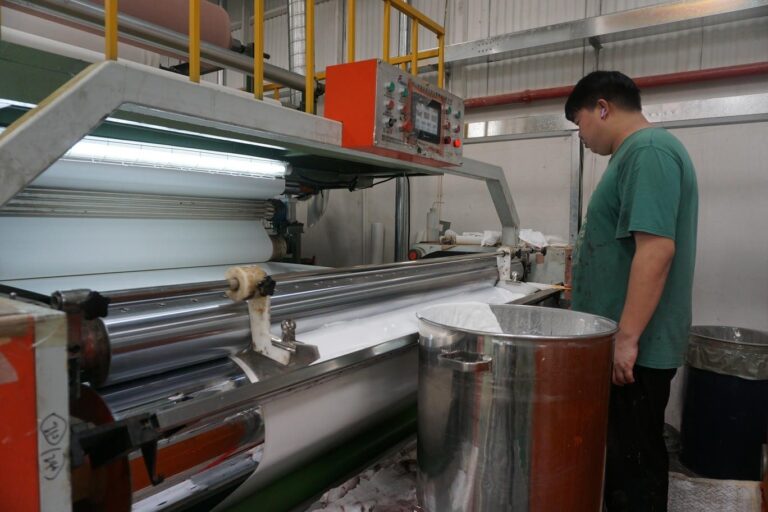
A calibrated production line with overhead crane logistics — the kind of facility a serious leather mart supplier should have.
Key Insight: A 2026 B2B sourcing survey found that 60% of procurement teams who sourced synthetic leather through online marketplaces experienced at least one quality-related production delay within the first 12 months.
5 Hidden Cost Traps in Leather Mart Procurement
Here are the five traps we see most often when buyers come to us after a leather mart deal goes sideways. Each one carries a specific, quantifiable cost that the initial quote never accounts for.
1. The “Passes All Standards” Claim. A leather mart supplier states their material passes relevant standards but cannot produce a third-party test report. When you dig in, the material either was never tested or failed the standard they claim to meet. Replacing the material mid-production typically costs 8–12% of the original order value — and that’s before the delay penalties from your downstream assembly line.
2. Thickness Tolerance Drift. A supplier quotes 1.2mm thickness, but the delivered material ranges from 0.9mm to 1.4mm across the roll. This inconsistency wrecks die-cutting yields and sewing line throughput. In one furniture project we audited, thickness drift alone cost the buyer 15% in material waste — a loss that erased the entire price advantage of choosing that supplier.
3. Coating Delamination in Year 2. PU and PVC leather sourced from low-tier leather mart wholesale supplier listings frequently delaminate within 18–24 months of end-use. The replacement cost — pulling furniture off the floor, re-upholstering, re-shipping — often exceeds the original material savings by 3x. This is the single most expensive trap because it hits after the warranty period, when the buyer absorbs the full cost.
4. Certification Scope Mismatch. A supplier shows a REACH compliance certificate, but it only covers the base fabric, not the coating layer. When the finished product reaches the EU market, restricted substances in the coating trigger a recall. The cost of a single recall event — logistics, brand damage, customer compensation — can wipe out years of material savings in one stroke.
5. MOQ-Driven Freight Inflation. A leather mart supplier offers a lower unit price but requires a higher MOQ than you need. The excess inventory ties up working capital, and if the material degrades in storage — PU leather is particularly prone to hydrolysis — you have paid for material that will never reach production. Learning to spot leather supplier red flags before signing protects against this.

A swatch rack with traceable batch numbers — material consistency starts with color and thickness documentation at the sample stage.
Why Material Chemistry Decides Your 5-Year TCO
The traps above share a common root cause: most leather mart procurement decisions optimize for unit price, not total cost of ownership. Material chemistry is the single biggest determinant of TCO — and it is the variable buyers most often overlook when comparing listings on a leather mart platform.
| Cost Factor | PU Leather | PVC Leather | Silicone Leather |
|---|---|---|---|
| Replacement frequency | Every 3–5 years | Every 2–3 years | 10+ years |
| Certification failure risk | Moderate (solvent residues) | High (plasticizers) | Low (solvent-free process) |
| UV degradation onset | Cracks in 1–2 years | Cracks in 1–2 years | 1,000+ hours stable |
| Hydrolysis resistance | Poor — degrades | Moderate | Excellent |
| Cleaning chemical tolerance | Specialty cleaners only | Limited resistance | Water + bleach safe |
In our Martindale abrasion testing, silicone leather consistently exceeds 200,000 cycles — the ISO 12947-2 threshold for heavy-duty commercial use. PU leather sourced from mid-tier leather mart supplier listings typically reaches 20,000–40,000 cycles before visible wear. That gap is not marginal. It is five to ten times the service life, which means five to ten times fewer replacement cycles over the product’s lifespan.

Calibrated abrasion, tensile, and flexing testers in a quality lab — the equipment a reliable leather mart supplier should have on-site.
Here’s the thing: the cost difference per meter between PU and silicone leather is typically 15–25%. Over a 5-year product lifecycle, silicone leather’s longer service life, lower cleaning costs, and zero certification-failure risk produce a net savings of 30–40%. That’s before factoring in the brand damage of a warranty claim or recall. Understanding which applications demand which material helps procurement teams make this trade-off explicitly rather than discovering it retroactively.
7-Point Vetting Checklist for Leather Mart Suppliers
Before placing a production order with any leather mart supplier, run through this checklist. If a supplier fails two or more items, walk away — the cost of switching suppliers later is always higher than the cost of vetting thoroughly now.
- Request third-party test reports. Not data sheets, not spec sheets. Actual SGS or Intertek reports with your material’s specific batch number and a recent test date (within 12 months).
- Verify factory capabilities. Ask for photos or video of calibrated equipment: abrasion testers, UV aging chambers, tensile testing machines. No calibrated equipment means no quality control — regardless of what the sales rep claims. A transparent factory production process is non-negotiable.
- Check coating chemistry. Is it solvent-based PU, water-based PU, PVC, or silicone? The chemistry determines VOC emissions, hydrolysis resistance, and end-of-life recyclability. If the supplier cannot answer this question clearly, they are reselling material they do not understand.
- Demand traceable certifications. REACH, RoHS, ISO 10993 for medical applications. Verify the scope covers the finished coated material, not just the base fabric. Certification scope gaps are the most expensive hidden trap in leather mart sourcing.
- Order a pilot batch. Never commit to a full MOQ on the first order. A 500-meter pilot batch reveals thickness consistency, color accuracy (Delta E ≤ 1.0), and coating adhesion under real production conditions. Reviewing quality inspection protocols before the pilot arrives saves time.
- Ask about hydrolysis data. If the supplier cannot discuss hydrolysis resistance, they do not understand the failure mode that will cost you the most money in years 2–3. This single question filters out more unqualified suppliers than any other.
- Request free samples. A confident supplier ships A4 swatches at no cost via DHL or FedEx. If they charge for samples or refuse to send them, that is a signal about their confidence in their own material quality.

Supplier vetting starts with documentation — test reports, certification scopes, and factory photos — not price lists.
Frequently Asked Questions
What MOQ should I expect from a reliable leather mart supplier?
For synthetic leather, a reasonable MOQ from a factory-direct supplier is 500 meters. Suppliers demanding 2,000+ meters as a minimum often do so to compensate for thin margins on low-quality material. A supplier confident in their quality typically offers flexible MOQs for pilot orders and scales up as trust builds. If a leather mart listing quotes an unusually low price with a high MOQ, treat it as a red flag, not a bargain.
The Real Cost of a “Good Deal”
The leather mart will only get more crowded as the synthetic leather market grows toward $89.91 billion. For procurement teams, the winning strategy is not finding the cheapest listing — it is identifying the supplier whose material chemistry, testing documentation, and factory capabilities will hold up over the full product lifecycle. A material that costs 20% more per meter but lasts three times longer is not more expensive. It is the only sourcing decision that makes financial sense over a five-year horizon.
The procurement teams who consistently deliver the lowest TCO are the ones who treat the leather mart as a starting point for investigation, not a final answer. They request test reports, order pilot batches, and verify certification scopes before committing. That diligence takes an extra two weeks upfront and saves hundreds of thousands of dollars in avoided rework, recalls, and replacements downstream.
About TOPSUN
TOPSUN manufactures silicone-coated leather for B2B procurement teams sourcing through leather marts who need verified automotive, furniture, and medical-grade materials with full compliance documentation and traceable test reports.
500,000+ m monthly capacity across 10+ automated lines | ISO 10993-5 biocompatibility certified | 200,000+ Martindale abrasion cycles verified by SGS | Free A4 swatches shipped worldwide via DHL/FedEx | REACH, RoHS, FDA 21 CFR 177.2600 compliant