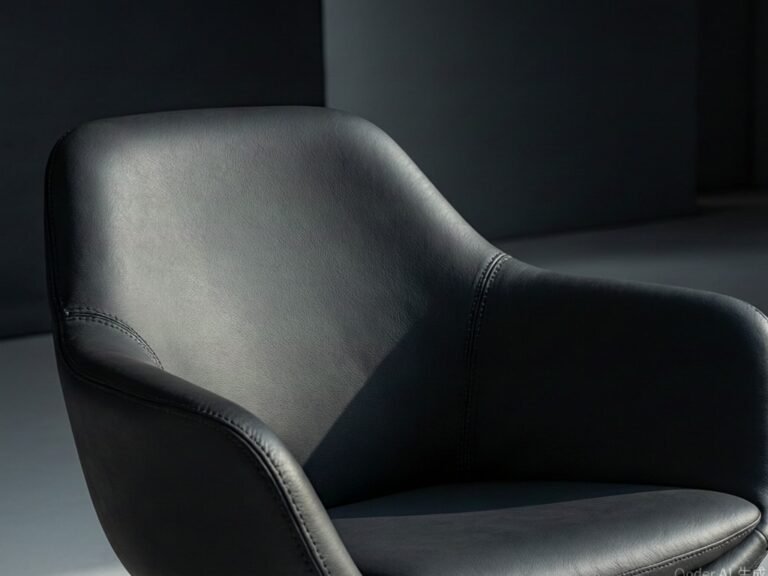
Black is the most specified color in B2B upholstery — and the most problematic. Leather black fabric absorbs more solar radiation than any other color, accelerating the exact failure modes that synthetic leather is prone to: UV-driven pigment degradation, plasticizer migration, and surface embrittlement. In our UV aging chamber, we’ve cycled leather black fabric samples through 1,000+ hours of accelerated weathering, and the results expose a gap that most procurement teams discover only after customer complaints arrive. PU-based leather black fabric loses measurable color depth within 500 UV hours. PVC versions crack at the flex points. The material that maintains Grade 4-5 color fastness after 1,000 hours isn’t a better coating — it’s a different chemistry entirely.
The Leather Black Fabric Problem: UV and Thermal Degradation
Black materials absorb across the full visible light spectrum — that’s why they’re black. In leather black fabric, this means surface temperatures reach 60-75°C under direct sunlight, compared to 35-45°C for lighter colors. That thermal load accelerates every degradation pathway simultaneously. Plasticizers in PVC volatilize faster. PU coatings undergo hydrolytic breakdown at accelerated rates. Pigment molecules gain enough energy to migrate toward the surface, causing the chalky residue that black leather develops after 12-18 months of sun exposure.
When we measured surface temperatures on leather black fabric samples under simulated sunlight at 760 W/m² irradiance, the readings told the story: PU black leather reached 68°C within 20 minutes, PVC reached 71°C, and silicone leather reached 59°C. That 9-12°C difference matters because chemical reaction rates double roughly every 10°C. A material running 10°C hotter degrades twice as fast — which is why PU black leather fabric that lasts 3 years in a showroom lasts 18 months in a south-facing window. For broader context on silicone vs PU material performance, the UV gap is widest in dark colors.

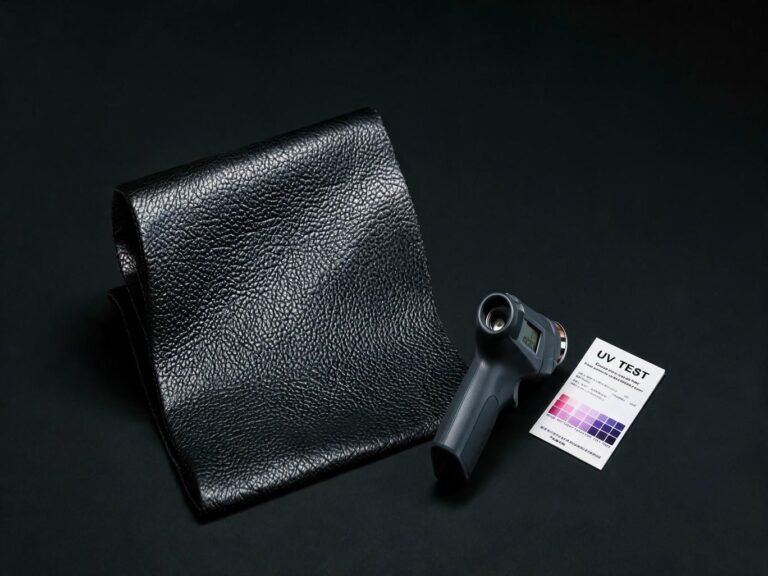
Thermal resistance testing — the same heat that causes fading in leather black fabric is what this test simulates under controlled conditions.
Why PU Fades First in Black Upholstery Applications
PU leather’s black pigment system typically uses carbon black dispersed in a polyurethane binder. The binder is the weak link. Polyurethane undergoes photo-oxidative degradation when exposed to UV radiation below 400 nm — the exact wavelengths that penetrate standard window glass. As the binder breaks down, pigment particles lose adhesion to the surface and migrate inward, leaving a gray, chalky appearance that buyers describe as “fading” but is technically binder degradation.
The test data makes this measurable. Under ASTM G154 accelerated UV testing (UVA-340 lamp, 340 nm, 0.89 W/m² at 60°C), standard PU leather black fabric drops from Grade 5 to Grade 3 color fastness within 400-500 hours. That translates to roughly 12-18 months of real-world exposure in a sunlit interior — or 3-6 months in outdoor applications. PVC performs similarly, with the added failure mode of plasticizer migration causing surface cracking alongside the color shift. For more on furniture and sofa applications, black is the default specification — which makes this the most common warranty claim in the industry.

Tensile strength testing — UV degradation weakens the material structure before visual fading becomes visible. This test catches what the eye can’t.
| Performance Metric | PU Black Fabric | PVC Black Fabric | Silicone Black Fabric |
|---|---|---|---|
| UV color fastness (1,000 hrs) | Grade 2-3 (significant fade) | Grade 2-3 (fade + cracking) | Grade 4-5 (negligible) |
| Surface temp at 760 W/m² | 68°C | 71°C | 59°C |
| Martindale abrasion | 50,000-80,000 cycles | 30,000-50,000 cycles | 200,000+ cycles |
| Thermal stability | -20°C to 80°C | -10°C to 60°C | -40°C to 250°C |
| Real-world fade onset | 12-18 months | 6-12 months | No visible fade at 5+ years |
Silicone Leather Black Fabric: UV-Stable by Chemistry
Silicone leather doesn’t resist UV degradation through additives — it’s immune to it by molecular structure. The Si-O (silicon-oxygen) backbone bond energy is 452 kJ/mol, compared to 346 kJ/mol for the C-C (carbon-carbon) bonds in polyurethane. UV radiation at 340 nm carries approximately 351 kJ/mol of energy — enough to break C-C bonds in PU, not enough to break Si-O bonds in silicone. This is physics, not formulation. No amount of UV stabilizer added to PU can match a bond that’s fundamentally stronger than the radiation attacking it.

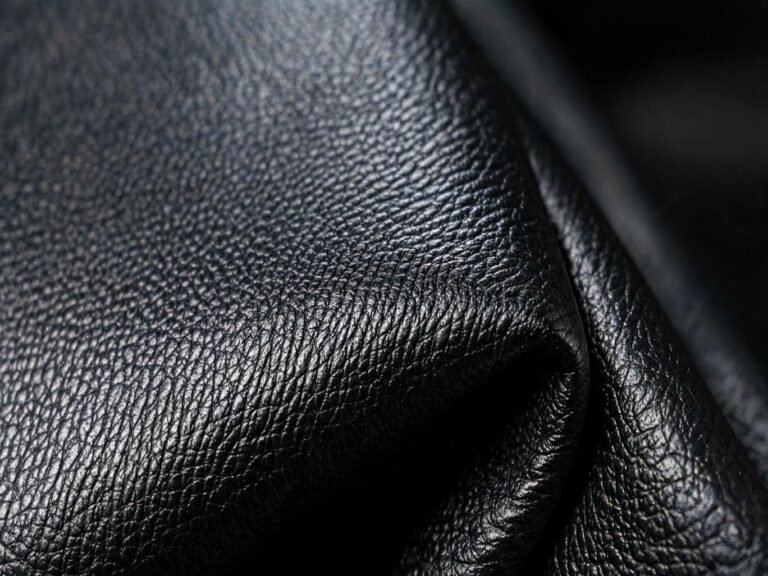
Dark leather texture closeup — the surface quality that must be maintained under UV exposure. Silicone leather retains this appearance after 1,000+ UV hours.
The practical result: silicone leather black fabric maintains ISO 105-B06 Grade 4-5 color fastness after 1,000+ hours of accelerated UV testing. In real-world terms, that’s 5+ years of direct sun exposure with no visible color shift. The surface temperature runs 9-12°C cooler than PU under identical irradiance, which means the underlying substrate and foam layers also experience less thermal stress. For brands concerned with eco-friendly material performance, the longevity benefit compounds: a material that lasts 10+ years doesn’t need replacement, reducing both cost and waste.

Material comparison — where black color performance diverges most sharply between PU, PVC, and silicone leather alternatives.
UV resistance overview — see how silicone leather’s molecular structure prevents the color degradation that affects PU and PVC black fabrics.
The UV energy that breaks PU bonds (351 kJ/mol) cannot break silicone bonds (452 kJ/mol). That 101 kJ/mol difference is why silicone leather black fabric doesn’t fade — and why no UV stabilizer added to PU can close the gap.
Specifying for 10-Year Color Performance
For procurement teams writing material specifications, the black leather fabric performance question comes down to two test data points: ISO 105-B06 color fastness grade and ASTM G154 UV exposure hours. A spec that says “UV resistant” without citing these numbers is a marketing claim, not a specification. A spec that says “ISO 105-B06 Grade 4-5 after 1,000 hours ASTM G154” is a testable, verifiable performance requirement.
For additional data on how black leather material specs compare across materials, the testing methodology is identical regardless of color. And for a deeper look at thermal fading in black leather fabric, the surface temperature data tells you more about real-world longevity than any accelerated test alone. The procurement decision is straightforward: if your product will see sunlight and the color is black, specify a material whose molecular bonds are stronger than the radiation it faces.
Frequently Asked Questions
Does black leather fabric fade faster than other colors?
Yes. Black materials absorb all visible light wavelengths, converting that energy to heat. This raises surface temperature 15-25°C above lighter colors under the same irradiance, accelerating chemical degradation of the coating binder. In PU leather, this means black fades 2-3x faster than white or beige under identical UV exposure. Silicone leather’s UV immunity is color-independent — black silicone leather fades at the same rate as white silicone leather (which is to say, it doesn’t fade measurably within 1,000+ UV hours).
What UV resistance rating should leather black fabric meet for outdoor use?
For outdoor applications, leather black fabric should meet ISO 105-B06 Grade 4-5 after 1,000+ hours of ASTM G154 accelerated UV testing. PU and PVC leather typically achieve Grade 3 at best after 500 hours — insufficient for outdoor use. Silicone leather achieves Grade 4-5 after 1,000+ hours, making it the only synthetic leather suitable for sustained outdoor black upholstery applications. For indoor applications near windows, Grade 4 after 500 hours is the minimum acceptable threshold.
Black Doesn’t Have to Be a Liability
Leather black fabric remains the most commercially important specification in B2B upholstery — and it doesn’t have to come with an 18-month expiration date. The fading, cracking, and thermal degradation that plague PU and PVC black fabrics aren’t inevitable properties of black materials. They’re consequences of molecular bonds that can’t withstand solar UV energy. Silicone leather black fabric solves the problem at the molecular level, not at the additive level. When the specification includes ISO 105-B06 Grade 4-5 after 1,000+ UV hours, you’ve written a testable standard that eliminates the most common warranty claim in black upholstery — before it happens.
About TOPSUN
TOPSUN manufactures UV-stable silicone leather black fabric for automotive interiors, furniture upholstery, and consumer electronics applications where color retention under prolonged light exposure is a specification requirement.
UV-stable 1,000+ hours · ISO 105-B06 Grade 4-5 · 200,000+ Martindale cycles · Zero-VOC · -40°C to 250°C thermal stability · Pantone black matching