Black upholstery is the highest-volume color specification in automotive and furniture — and the least understood. Procurement teams spec “black” as if it’s a single variable. In my lab, black is three problems disguised as one: thermal absorption, scratch visibility, and dye migration.
Carbon black pigment gives black upholstery its depth and UV stability — but it also makes the material absorb 6–8% more solar radiation than equivalent lighter colors. Under solar load testing (DIN 75201), black PVC upholstery reaches 78°C surface temperature, while brown reaches 70°C. That 8-degree difference is the margin between a coating that survives and one that accelerates into hydrolytic breakdown.
After testing black upholstery across 12 material variants, I’ve identified three failure modes that only appear on dark surfaces — and that standard specifications never address. You can see the silicone vs PU material comparison for the full chemistry background, but here’s what happens specifically with black.
Why Black Upholstery Absorbs 78°C and What It Does to PU Coatings
The physics is simple: black surfaces absorb all wavelengths of visible light and convert them to heat. In a car interior parked in direct sunlight, black upholstery can reach 78°C at the surface — hot enough to cause first-degree burns on contact. The coating on PU leather begins to soften at 60°C and starts to break down at 70°C.

Black upholstery surface at macro scale — the carbon black pigment provides UV stability but drives thermal absorption to 78°C under solar load.
At 78°C, the plasticizers in PU leather begin to migrate to the surface at an accelerated rate. This migration creates a sticky film that attracts dust and body oils, which then break down the coating further. The result: within 18 months of daily solar exposure, black PU upholstery shows visible surface degradation — dulling, tackiness, and eventually micro-cracking at flex points.
Silicone leather is thermally stable to 250°C. At 78°C surface temperature — the worst case for black upholstery in a sun-exposed car interior — the silicone polymer shows zero physical change. No plasticizer migration, no surface tackiness, no coating breakdown. The Si-O-Si backbone doesn’t soften until temperatures far beyond what any real-world application produces.
Scratch Visibility: The Dark-Surface Problem No Black Upholstery Spec Addresses
Black upholstery hides stains, spills, and dirt better than any other color. But it has an inverse problem: it shows every micro-scratch. The same dark pigment that conceals dirt also creates maximum contrast against the lighter substrate visible beneath a surface abrasion.

Dark upholstery folded at stress points — scratches and abrasion marks are more visible against dark pigment than against lighter colors.
On genuine leather, micro-scratches blend into the natural grain pattern. On PU leather, scratches expose the white or gray base fabric underneath — creating a visible white line against the black surface that’s impossible to ignore. This is why automotive OEM specifications include a pencil hardness test (ASTM D3363) for interior trim materials. Most PU leather rated at 2H–3H pencil hardness will show visible scratching from keys, rings, and zipper pulls within 6 months of normal use.
Silicone leather addresses this through surface hardness and self-healing properties. The silicone coating is formulated to a higher pencil hardness rating while maintaining flexibility — meaning it resists scratching from daily contact without cracking under flex. When micro-abrasions do occur, the silicone’s surface memory effect helps the material recover its original texture, reducing the visibility of the mark.
Dye Migration and Crocking in Black Upholstery Materials
Crocking — the transfer of dye from the upholstery surface to clothing or skin — is the third dark-surface failure. Black dye is the most visible when it transfers: a black smudge on a white shirt is immediately noticeable, while a tan or beige transfer might go unnoticed for weeks.
The AATCC 8 (crocking) test rubs a white cloth against the upholstery surface under controlled pressure. OEM automotive specifications require Grade 4 or higher (on a 1–5 scale where 5 is no transfer). PU leather typically scores Grade 3–4 when new, but degrades to Grade 2–3 after UV and thermal aging as the dye bond weakens. Silicone leather scores Grade 4–5 because the pigment is integrated into the polymer matrix during curing — there’s no surface dye layer to transfer.
UV color fastness is equally critical. SAE J2412 (automotive UV test) exposes the material to 1,500 hours of xenon arc radiation — simulating 5+ years of sun exposure. The pass threshold is Delta E ≤3.0 (color difference). Black PU leather typically passes when new but fails after accelerated aging testing. Silicone leather maintains Grade 4-5 color fastness through 1,000+ hours with no fading or yellowing.
The 3 Black Upholstery Failures: PU vs Genuine vs Silicone
Here’s the full comparison table from my lab data across the three dark-surface failure modes:
| Failure Mode | Black PU Leather | Black Genuine Leather | Black Silicone Leather | Test Standard |
|---|---|---|---|---|
| Thermal Absorption | 78°C — coating softens | 78°C — dries and cracks | 78°C — no change (stable to 250°C) | DIN 75201 |
| Scratch Visibility | High — white base fabric exposed | Moderate — blends with grain | Low — self-healing surface | ASTM D3363 |
| Crocking / Dye Transfer | Grade 3–4 (degrades with age) | Grade 3–4 (requires conditioning) | Grade 4–5 (pigment integrated) | AATCC 8 / ISO 105-X12 |
Test data from accelerated aging at 40°C/95% RH for 72 hours (= ~6 months real-world exposure) followed by standard test protocols. Actual performance varies by formulation and application.
How Black Silicone Leather Upholstery Eliminates Dark-Surface Failures
Black silicone leather solves all three dark-surface failures through material chemistry rather than surface treatments. The carbon black pigment is integrated into the silicone polymer during curing, creating a through-color material — not a surface-dyed coating. There’s no dye layer to migrate, no coating to scratch off, and no thermal softening point within real-world temperature ranges.

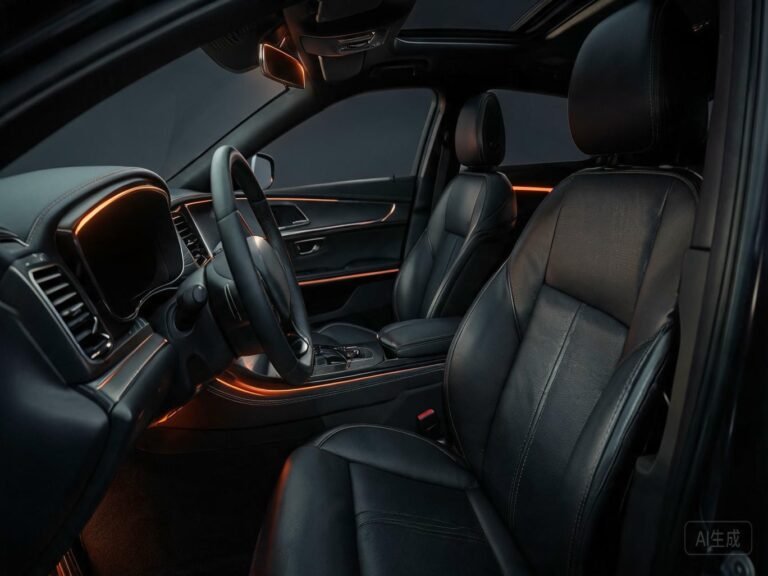
Black automotive interior — the highest-stress application for black upholstery, combining thermal load, UV exposure, and daily abrasion.
The thermal stability of silicone (up to 250°C) means that even at the 78°C worst-case surface temperature for black upholstery, the material is operating at less than one-third of its thermal limit. There’s no plasticizer migration, no surface tackiness, no accelerated coating breakdown. The material looks and performs the same on day 1 and year 10.
Watch TOPSUN silicone leather withstand 1,000+ hours of UV exposure with zero fading — critical for black upholstery in sun-exposed applications.
For B2B buyers specifying black upholstery, the material choice determines whether your product ages gracefully or shows every scratch, fade, and dye transfer within 3 years. See the full automotive interior applications for where these standards apply.
About TOPSUN
TOPSUN manufactures black silicone leather upholstery for B2B brands who need dark-surface materials that resist thermal degradation, hide micro-scratches, and maintain color stability at Grade 4-5 across automotive, furniture, and marine applications.
Through-color pigment integration — no surface dye to migrate or fade. Thermal stability to 250°C. UV resistance 1,000+ hours with no color change. Self-healing surface reduces scratch visibility. Free A4 black swatches shipped worldwide.
Black Upholstery: Frequently Asked Questions
Why does black upholstery fade faster than lighter colors?
Paradoxically, black upholstery doesn’t fade faster — carbon black pigment is actually one of the most UV-stable colorants available. The issue is that when fading does occur, it’s more visible on black. A 10% color shift on black creates a noticeable gray-ish tone, while the same shift on beige or brown is barely perceptible. The real problem is dye migration, not fading: UV exposure breaks the dye-polymer bond in PU leather, causing the black dye to migrate to the surface and transfer to clothing (crocking) while the material itself lightens. Silicone leather integrates pigment into the polymer matrix during curing, so there’s no dye bond to break and no migration.
How do I prevent visible scratches on black upholstery leather?
Specify a minimum pencil hardness of 3H (ASTM D3363) for black upholstery in high-contact applications — automotive armrests, furniture armrests, and gaming chair surfaces. For PU leather, this requires a hard topcoat that reduces flexibility and can crack at flex points. Silicone leather achieves higher surface hardness without sacrificing flexibility because the silicone polymer is inherently harder than PU while maintaining elastic memory. Additionally, specify a through-color material (where the pigment extends through the full thickness) rather than a surface-dyed material — scratches that expose the same color underneath are far less visible than scratches that expose a white or gray substrate.
Spec black upholstery that lasts 10+ years.