When the European Union’s Packaging and Packaging Waste Regulation (PPWR) entered force in August 2026, it joined REACH, EUDR, and CSRD as the fourth major compliance pillar reshaping how B2B buyers source flexible materials. For procurement teams evaluating a silicone leather supplier for Europe, the question is no longer just about price per meter — it is about whether the supplier can produce documentation that survives a third-party audit. This guide walks through the 2026 EU regulatory landscape, the compliance gaps in conventional PU and PVC leather, and how to build a supplier qualification checklist that protects your business.
Why the European Market Demands Silicone Leather in 2026
European B2B buyers across automotive, furniture, medical, and consumer goods sectors are shifting from polyurethane (PU) and polyvinyl chloride (PVC) leather to silicone-based alternatives. The drivers are regulatory, not aesthetic. Under REACH Regulation EC 1907/2006, the SVHC (Substances of Very High Concern) candidate list now includes 235+ entries as of June 2026, with plasticizers like DINP and DIDP facing increasing restriction. PVC leather relies on phthalate plasticizers that appear on this list; PU leather uses solvent-based DMF (dimethylformamide), which is classified as a Substance of Very High Concern under REACH Annex XV.
Silicone leather, by contrast, is fundamentally additive-free — its flexibility comes from the polymer chain structure itself (Si-O backbone), not from externally added plasticizers. This means a silicone leather supplier targeting Europe can produce REACH conformity declarations without exemption clauses or de minimis thresholds. For procurement teams, this translates to fewer compliance review cycles and faster time-to-market for finished goods sold into the EU.

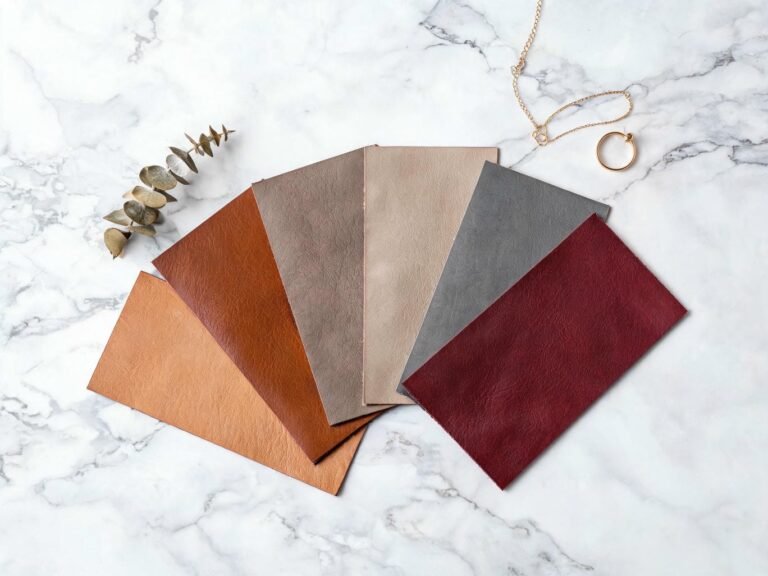
Silicone leather swatch rack with full color range available for European specification projects.
Four EU Regulations That Reshape Silicone Leather Supplier Europe Selection
If you are sourcing leather materials for products sold in the EU, your supplier must demonstrate compliance across four regulatory frameworks. Here is how each one impacts material choice:
| EU Regulation | Scope & Key Requirement | PU / PVC Risk | Silicone Leather |
|---|---|---|---|
| REACH (EC 1907/2006) | SVHC disclosure; restriction of phthalates, DMF | High — phthalate plasticizers and DMF solvents on SVHC list | Zero SVHC substances; no plasticizers needed |
| PPWR (2025/40) | Recyclability; minimum recycled content for packaging | Medium — multi-layer PVC/PU composites are non-recyclable | Thermoplastic; compatible with mechanical recycling streams |
| EUDR (2024/2483) | Deforestation-free supply chain; geolocation traceability | Medium — leather supply chain involves cattle farming land-use | No animal-derived inputs; zero deforestation risk |
| CSRD (2022/2464) | ESG reporting; Scope 3 emissions disclosure | High — solvent emissions and animal agriculture Scope 3 impact | Low Scope 3; water-based process; no animal inputs |
EU regulatory comparison — PU/PVC leather vs. silicone leather for B2B sourcing decisions.
The EUDR compliance advantage is particularly strategic. Since silicone leather contains zero animal-derived material, it bypasses the geolocation traceability and deforestation-free verification requirements entirely. For European furniture and automotive manufacturers who must map their entire supply chain under EUDR, sourcing from a silicone leather supplier eliminates an entire category of compliance documentation.
How to Evaluate a Silicone Leather Supplier for Europe: 7-Point Checklist
Not every manufacturer claiming to produce “silicone leather” can meet EU compliance standards. Some use silicone coatings over PU substrates — a hybrid that reintroduces SVHC risks. Use this checklist when auditing potential suppliers:
1. Full Silicone Formulation — Request the polymer composition report. The top layer must be 100% silicone elastomer, not a silicone-PU blend. Ask for FTIR spectroscopy data confirming the Si-O-Si backbone.
2. REACH Conformity Declaration — The supplier must provide a signed REACH declaration covering all 235+ SVHC substances, not just the historical “top 10.” Verify the declaration date is within 12 months.
3. PFAS-Free Certification — With the EU’s universal PFAS restriction proposal advancing through ECHA, demand a per- and polyfluoroalkyl substances (PFAS) test report from an accredited lab. Silicone leather should show zero detectable PFAS.
4. OEKO-TEX STANDARD 100 — Request the current OEKO-TEX certificate, Class I (baby-safe) if your end product touches skin. This is the baseline trust signal for European buyers.
5. DMF-Free Process Verification — PU leather manufacturing uses DMF as a solvent. Even if the final product is silicone-coated, if the base layer used DMF, residual SVHC may remain. Ask for a process flow diagram confirming water-based or solvent-free manufacturing.
6. ISO 14001 & LCA Data — Under CSRD, you will need supplier-level Life Cycle Assessment (LCA) data for Scope 3 reporting. A supplier with ISO 14001 environmental management certification and published LCA data saves your team months of data collection.
7. REACH Authorisation Readiness — Check whether the supplier proactively monitors REACH Annex XIV (Authorisation List) and can commit to reformulation timelines if new substances are restricted.

Physical testing laboratory verifying abrasion, tensile strength, and color fastness for EU market compliance.
Silicone Leather Supplier Europe: Certification and Testing Requirements
Beyond the regulatory frameworks above, European end-product standards create downstream requirements that your supplier must support. Automotive interiors need FMVSS 302 and UNECE R118 flammability certification. Furniture requires EN 1021-1/2 ignition resistance. Medical applications demand ISO 10993 biocompatibility testing. A qualified silicone leather supplier should have test reports ready for at least the first two categories.
TOPSUN maintains a full testing laboratory and provides third-party certified reports for all major EU-relevant standards. Watch the certification overview below to understand the scope of compliance documentation available with every order:
TOPSUN silicone leather certifications overview — automotive, baby-safe, and fire resistance testing.
For procurement teams sourcing silicone leather for the broader PU and faux leather market, the same compliance logic applies — but silicone’s inherent chemistry eliminates risk categories that PU and PVC cannot avoid. This is why European buyers increasingly use silicone leather supplier guides as a pre-qualification filter before requesting physical samples.
About TOPSUN: Your EU-Compliant Silicone Leather Supplier
TOPSUN is a specialized silicone leather manufacturer producing 100% silicone elastomer leather for B2B clients across Europe. Our silicone leather contains no plasticizers, no DMF solvents, no PFAS, and no animal-derived materials — making it inherently compliant with REACH, PPWR, EUDR, and CSRD requirements without exemption clauses. We serve European procurement teams in automotive interiors, contract furniture, medical devices, and consumer electronics with full compliance documentation, including REACH SVHC declarations, OEKO-TEX STANDARD 100 Class I certification, ISO 14001 environmental management, and third-party PFAS-free test reports. Every production batch ships with a Certificate of Analysis (CoA) traceable to raw material lot numbers.

Custom color matching service for European design specifications and RAL/Pantone references.
Silicone Leather Supplier Europe: Frequently Asked Questions
Q: Is silicone leather legally required to be REACH-compliant for products sold in the EU?
Yes. Any material placed on the EU market must comply with REACH, regardless of chemical composition. However, genuine silicone leather (100% silicone elastomer) inherently contains no SVHC-listed substances, so the compliance burden is minimal compared to PU or PVC leather, which require ongoing monitoring of plasticizer and solvent content.
Q: How does EUDR affect silicone leather sourcing compared to genuine leather?
EUDR requires geolocation traceability for products derived from cattle, soy, palm oil, rubber, and other deforestation-linked commodities. Genuine leather falls under cattle-derived material, requiring GPS-verified farm data. Silicone leather contains no animal inputs, so it is outside EUDR’s scope entirely — eliminating a significant documentation burden for EU importers.
Q: What is the minimum order quantity (MOQ) for European silicone leather sourcing?
TOPSUN’s MOQ for custom silicone leather ranges from 500 to 1,000 linear meters depending on color, texture, and backing specifications. Stock colors in standard textures are available in smaller trial quantities for prototyping and compliance testing. Contact our European sales team for project-specific MOQ and lead time estimates.
Q: Can silicone leather meet European fire safety standards for public transport and furniture?
Yes. TOPSUN silicone leather achieves FMVSS 302, UNECE R118, and EN 1021-1/2 fire safety ratings through inherent flame resistance — no chemical flame retardants are added. The Si-O backbone is naturally non-combustible, which also avoids the halogenated flame retardants that appear on the REACH SVHC list.
Request EU Compliance Documentation for Silicone Leather Supplier Europe
If your procurement team is evaluating silicone leather suppliers for the European market, request our EU Compliance Documentation Package before ordering samples. The package includes:
- REACH SVHC conformity declaration (all 235+ substances)
- PFAS-free third-party test report (ECHA-accredited lab)
- OEKO-TEX STANDARD 100 Class I certificate
- ISO 14001 environmental management certificate
- FMVSS 302, UNECE R118, EN 1021-1/2 fire test reports
- LCA summary data for CSRD Scope 3 reporting
Request the EU Compliance Documentation Package
Get REACH, PFAS, OEKO-TEX, and fire safety certifications in one package.
Related reading: Vegan Car Interior Leather Guide | Silicone Leather for Car Seats | Restaurant Booth Seating Material