The $7,500 Problem Hiding on Every Pool Deck
A 50-seat resort pool deck is not just a relaxation space — it is a materials endurance test running 365 days a year under the harshest conditions furniture can face: direct UV radiation, chlorinated water splash, salt air, body oils, sunscreen chemical transfer, and temperature swings from 15°C nights to 45°C surface temperatures. Standard sun lounger leather — the PVC and PU coatings used on most poolside cushions and upholstery — fails this test within 18 to 24 months.
For hospitality procurement teams, this failure is not a quality complaint to file with the supplier. It is a recurring capital expenditure line item. At $80–150 per cushion, replacing the upholstery on a 50-seat pool deck costs $4,000–7,500 every two years. Over a 10-year facility lifecycle, that is $20,000–37,500 in cushion replacement costs alone — before factoring in labor, disposal fees, and the guest experience damage of faded, cracking furniture visible to paying resort guests.
The industry has accepted this replacement cycle as “normal” because the dominant materials — PVC vinyl, PU leather, and solution-dyed acrylic fabrics — all share the same fundamental weakness: their polymer chemistry was never designed for sustained outdoor exposure. The question hospitality buyers should be asking is not “how often do we replace?” but “which material eliminates the replacement cycle entirely?”
Industry Data: Commercial furniture maintenance reports show that standard outdoor cushions lose compression and fabric integrity within 18–24 months in high-traffic pool areas. Premium solution-dyed acrylic covers extend this to 5–7 years — but only silicone leather combines that longevity with the luxury aesthetic, waterproof surface, and cleanability that hospitality standards require.
How Sun Lounger Leather Degrades: Four Attack Vectors
Poolside environments assault upholstery through four simultaneous degradation pathways. Understanding each is essential for procurement teams evaluating material specifications — because a material that resists UV but not chlorine will still fail, just through a different mechanism.
1. UV Radiation: The Color Killer
Pool decks receive direct UV exposure for 8–14 hours daily in resort climates, plus reflected UV off the water surface — effectively doubling the radiation load. UV breaks polymer chains through photo-oxidation: UV photons excite electrons in C-C and C-O bonds, generating free radicals that cleave the polymer backbone. The visible result is color fading (chromophore destruction), surface chalking (polymer powdering), and embrittlement.
PVC leather shows significant fading within 200 hours of UV exposure (per ASTM D4329). PU leather manages 500 hours before noticeable degradation. Silicone leather maintains color fastness at Grade 4.5 (ISO 105-B06) after 1,500 hours — the equivalent of 5+ years of tropical sun exposure. The Si-O bond energy (452 kJ/mol) exceeds the photon energy of UVA/UVB radiation, making the silicone backbone inherently UV-stable without relying on UV stabilizer additives that deplete over time.
2. Chlorinated Water: The Chemical Stripping Agent
Pool water contains 1–3 ppm free chlorine, which splashes onto lounger surfaces hundreds of times per day during guest use. Chlorine is a powerful oxidizer — the same mechanism that kills bacteria in the pool attacks the polymer chains in upholstery coatings. PVC’s chlorine content makes it doubly vulnerable: the chlorine already in the material acts as an internal degradation catalyst when exposed to external chlorine. PU’s ester bonds are susceptible to chlorine-induced hydrolysis.
The result is accelerated surface breakdown: coatings that might survive 2 years of UV alone fail in 12–18 months when combined with chlorine splash exposure. Silicone’s fully crosslinked structure and absence of hydrolyzable bonds makes it chemically inert to chlorine at pool-water concentrations — the surface can be splashed daily for years without molecular damage.
3. Salt Air: The Coastal Corrosion Factor
For beachfront resorts, salt spray is a third attack vector. Salt aerosol deposits on surfaces, creating a hygroscopic layer that pulls moisture from the air and maintains a corrosive brine on the upholstery surface. Salt also carries chloride ions that accelerate polymer breakdown through a mechanism similar to chlorine exposure but operating continuously, even when the pool is not in use.
| Salt Spray Resistance | PVC Vinyl | PU Leather | Silicone Leather |
|---|---|---|---|
| Time to surface degradation | 48–120 hours | 96–200 hours | 1,000+ hours (ASTM B117) |
| Mechanism of failure | Plasticizer extraction, embrittlement | Hydrolytic chain scission | No degradation observed |
| Real-world equivalent | 2–4 months coastal | 4–8 months coastal | 5+ years coastal |
4. Thermal Cycling: The Structural Stress
Poolside loungers experience daily temperature swings of 25–35°C — cool mornings, scorching midday surfaces (50–65°C in dark colors), and cool evenings. This thermal cycling causes differential expansion between the coating layer and substrate, creating internal stress that micro-cracks the surface and eventually delaminates the coating. PVC becomes brittle below 0°C and softens above 60°C. PU remains flexible through a moderate range but degrades at both extremes. Silicone leather maintains flexibility from -40°C to 250°C — the broadest operating range of any synthetic leather, eliminating thermal-cycling stress entirely.
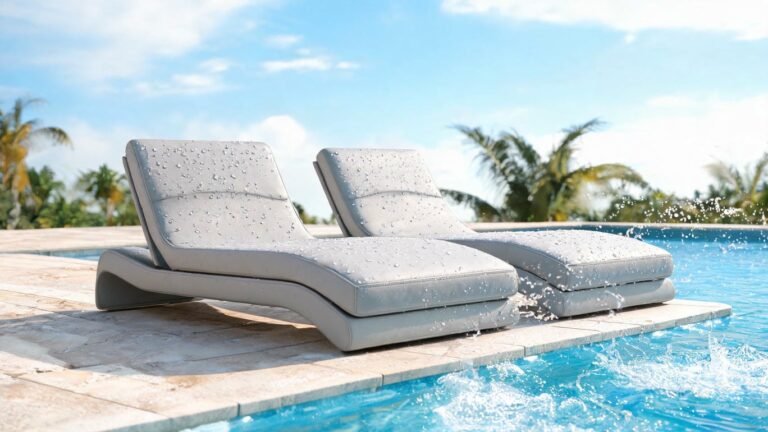
UV resistance demonstration — silicone leather surface maintains color, texture, and structural integrity after prolonged UV exposure that degrades conventional synthetic leathers.
Material Comparison for Sun Lounger Applications
The poolside furniture market currently uses five material families for lounger surfaces. Each was designed for a different primary application and brings different strengths — and different failure modes — to the outdoor hospitality environment.
| Parameter | PVC Vinyl | PU Leather | Acrylic Fabric | Textilene Mesh | Silicone Leather |
|---|---|---|---|---|---|
| UV resistance (hrs) | ~200 | ~500 | 1,500+ | 1,000+ | 1,500+ (Grade 4.5) |
| Salt spray (hrs) | 48–120 | 96–200 | N/A (fabric) | 500+ | 1,000+ (ASTM B117) |
| Waterproof | Yes (surface) | Partial | Water repellent | Permeable | 100% waterproof |
| Abrasion (Martindale) | ~2,000 | ~5,000 | N/A | ~15,000 | up to 150,000 |
| Aesthetic appeal | Plastic look | Leather-like | Fabric | Mesh/technical | Premium leather |
| Stain resistance | Moderate | Good | Poor (porous) | Fair | Class 5 (ISO 105-X12) |
| Temp range | -10 to 60°C | -15 to 80°C | -20 to 70°C | -30 to 80°C | -40 to 250°C |
| Expected poolside life | 6–12 months | 12–24 months | 5–7 years | 3–5 years | 5+ years |
| Sunscreen/oil resistance | Poor (stains) | Fair | Poor (absorbs) | Fair | Excellent |
The critical insight here is that acrylic fabrics and Textilene mesh achieve good UV longevity but sacrifice the premium aesthetic and cleanability that luxury resorts demand. PVC and PU offer the leather look but fail rapidly outdoors. Silicone leather is the only material that delivers both longevity and luxury — the leather aesthetic resorts want, with outdoor durability that matches or exceeds technical fabrics.

The Sunscreen Problem Nobody Talks About
There is a fifth degradation vector that material specifications rarely address but hospitality housekeeping teams battle daily: sunscreen and tanning oil transfer. Resort guests apply SPF 30–50 products that contain UV filters (avobenzone, oxybenzone), mineral blockers (zinc oxide, titanium dioxide), emollients (coconut oil, shea butter), and fragrance compounds. These substances transfer from skin to lounger upholstery every time a guest reclines.
For PVC and PU leather, sunscreen is a chemical nightmare. The oils penetrate the coating’s micro-pores, the UV filters stain permanently, and the emollients degrade the plasticizer system — accelerating the same embrittlement that UV causes, but from a chemical rather than photochemical pathway. Housekeeping teams spend significant labor scrubbing sunscreen residue from lounger surfaces, and the cleaning chemicals they use (solvents, surfactants) further degrade the coating.
Acrylic fabrics absorb sunscreen deeply into their fiber structure, where it cannot be removed by surface wiping — requiring machine washing or replacement. Textilene mesh is somewhat easier to clean but retains visible oily residues.
Silicone leather’s non-porous surface is chemically inert to sunscreen ingredients. UV filters, mineral blockers, and emollients sit on the surface and wipe off with a damp cloth — no solvents, no machine washing, no surface damage. For resorts where housekeeping turnover directly impacts operating costs, this cleanability advantage translates to measurable labor savings across hundreds of loungers cleaned daily.
Procurement Insight: Housekeeping labor for cleaning sunscreen residue from poolside furniture averages $15–25 per lounger per day in premium resort operations. A material that reduces cleaning time from 10 minutes to 2 minutes per lounger saves $8,000–13,000 annually on a 50-lounger pool deck — a cost reduction that pays for the material upgrade within the first year.
Total Cost of Ownership: 10-Year Pool Deck Analysis
The unit cost of sun lounger leather is the smallest number in the procurement equation. For hospitality buyers managing pool furniture budgets, the relevant metric is 10-year total cost of ownership (TCO) — encompassing material cost, replacement frequency, labor for replacement, disposal of old materials, and housekeeping maintenance.
| Cost Factor (50 loungers, 10 years) | PVC Vinyl | PU Leather | Acrylic Fabric | Silicone Leather |
|---|---|---|---|---|
| Unit cost per lounger | $45 | $75 | $110 | $150 |
| Replacement cycle | Every 1 year | Every 2 years | Every 6 years | Every 5+ years |
| Replacements in 10 yrs | 10 | 5 | 2 | 2 |
| Material cost (10 yr) | $22,500 | $18,750 | $16,500 | $15,000 |
| Replacement labor | $7,500 | $3,750 | $1,500 | $1,500 |
| Housekeeping premium | $45,000 | $35,000 | $25,000 | $12,000 |
| Disposal fees | $2,000 | $1,000 | $400 | $400 |
| Guest complaint impact* | High | Moderate | Low | Minimal |
| 10-Year TCO | $77,000 | $58,500 | $43,400 | $28,900 |
*Guest complaint impact refers to review scores, brand reputation, and potential room-rate discounting attributable to visible furniture degradation. Not quantified in dollar terms but represents the largest hidden cost for luxury properties.
The TCO analysis reveals a counterintuitive truth: the cheapest material per unit (PVC) is the most expensive material over time. Silicone leather, despite having the highest unit cost, delivers the lowest 10-year total cost — a 63% savings versus PVC and 34% savings versus acrylic fabric. For procurement teams defending material upgrade budgets to finance departments, this TCO model is the core argument.
B2B Sourcing Specifications for Sun Lounger Leather
For hospitality procurement teams and outdoor furniture manufacturers specifying sun lounger leather, the following technical specification parameters define outdoor-grade performance:
- UV stability: Minimum 1,000 hours per ASTM D329 (QUV) with color fastness Grade 4+ per ISO 105-B06 — ensures 5+ seasons of visible color integrity in tropical sun climates
- Salt spray resistance: Minimum 1,000 hours per ASTM B117 with zero surface degradation — critical for coastal and beachfront properties
- Hydrolysis resistance: 14 weeks per ASTM D3980 — validates performance in high-humidity tropical environments where moisture penetration accelerates coating breakdown
- Abrasion resistance: Minimum 50,000 Martindale cycles (1000g load) — accommodates the high-traffic nature of commercial pool deck environments with 8–12 hours of daily guest use
- Color fastness to rubbing: Class 5 per ISO 105-X12 — ensures that wet swimwear contact does not transfer color or degrade the surface
- Temperature range: -30°C to 120°C minimum — covers cold-storage winter conditions through peak summer surface temperatures
- Low-temperature flex resistance: 200,000 cycles at -30°C per ISO 1764 — validates that the surface does not crack during winter storage or cold-climate deployment
- Stain resistance: Class 5 against sunscreen, tanning oils, chlorinated water, food, and beverages — the specific stain vectors encountered poolside
- Flame retardancy: BS 5852 (Crib 5) for European hospitality markets, CA TB 117-2013 for North American markets, DIN EN 1021 for European contract furniture

About TOPSUN: Outdoor-Grade Silicone Leather Manufacturing
TOPSUN manufactures silicone leather specifically engineered for outdoor and semi-outdoor applications, with 8+ years of B2B production experience serving hospitality furniture manufacturers, resort suppliers, marine outfitters, and outdoor contract furniture brands across 30+ countries.
For sun lounger leather applications, TOPSUN offers:
- UV-stable silicone chemistry rated at 1,500+ hours per ASTM D329 — validated for 5+ years of tropical sun exposure without color degradation or surface embrittlement
- Salt spray resistance certified at 1,000+ hours per ASTM B117 — suitable for beachfront, island, and coastal resort deployments without surface failure
- Full waterproof surface — non-porous construction prevents water, chlorine, and sunscreen penetration, eliminating the absorption-related failure modes common in PU leather and acrylic fabrics
- Class 5 stain resistance (ISO 105-X12) against sunscreen, tanning oils, pool chemicals, food, and beverages — reducing housekeeping labor and extending the clean appearance cycle between professional deep cleans
- Custom color development with 1,500-hour UV color fastness — resort brand colors, chain standard palettes, and seasonal collections maintain visual consistency across multi-year deployment cycles
- Texture options optimized for outdoor comfort: lychee grain for slip-resistant poolside seating, satin finish for premium lounge areas, and custom-embossed patterns for branded resort properties
- Flame retardancy certifications: BS 5852 (Crib 5), CA TB 117-2013, DIN EN 1021 Parts I & II — meeting hospitality contract furniture requirements across all major regulatory markets
- Biocompatibility certified per ISO 10993 (cytotoxicity Level 1, skin sensitization Level 0) — relevant for resorts marketing hypoallergenic or skin-safe guest environments
Our production supports MOQs from 500 linear meters for pilot production through full container loads for resort chain deployments. Standard lead times: 15–25 days for first-article approval, 25–35 days for bulk production depending on color complexity and certification documentation requirements.

Frequently Asked Questions
What is the best leather material for outdoor sun loungers?
For outdoor poolside and beachfront applications, silicone leather is the optimal material. It combines 1,500+ hours of UV resistance (ASTM D329), 1,000+ hours of salt spray resistance (ASTM B117), 100% waterproof surface, and Class 5 stain resistance against sunscreen and pool chemicals — the four degradation vectors that destroy PVC (6–12 months), PU (12–24 months), and even acrylic fabrics (5–7 years) in poolside environments.
How long does sun lounger leather last outdoors?
PVC vinyl lasts 6–12 months in poolside conditions before UV and chlorine cause cracking and fading. PU leather lasts 12–24 months before hydrolytic breakdown and sunscreen staining. Solution-dyed acrylic fabrics last 5–7 years but lack the leather aesthetic and absorb sunscreen oils. Silicone leather lasts 5+ years with full color retention and surface integrity, requiring only simple wipe-down maintenance.
Can silicone leather withstand chlorine and salt water?
Yes. Silicone leather’s crosslinked Si-O polymer structure is chemically inert to chlorine at pool-water concentrations (1–3 ppm) and salt water at coastal concentrations. The non-porous surface prevents penetration — chlorine and salt sit on the surface and rinse off. This is fundamentally different from PU leather, whose ester bonds hydrolyze when exposed to chlorinated water, and PVC, whose own chlorine content acts as a degradation catalyst.
What is the MOQ for custom sun lounger leather?
TOPSUN supports MOQs from 500 linear meters for pilot production and resort sampling programs. Full-container production for chain-wide deployment typically requires 3,000–5,000 linear meters depending on width, thickness, and color specifications. Custom color development for resort brand palettes is available with dedicated color-matching services.
Does silicone leather meet hospitality fire safety standards?
Yes. TOPSUN silicone leather is certified to BS 5852 (Crib 5) for UK hospitality, CA TB 117-2013 for North American markets, and DIN EN 1021 Parts I & II for European contract furniture. Silicone is inherently flame-resistant — its polymer structure does not require fire-retardant additives, meaning the fire safety rating does not degrade over time or after cleaning, unlike additive-treated materials.
The Material Decision That Defines Pool Deck ROI
Every resort procurement director faces the same tension: deliver a premium poolside experience while controlling operational costs. The material specified for sun lounger leather sits at the intersection of these priorities — it is the surface guests touch, photograph, and review, and it is the surface that generates replacement invoices, housekeeping labor, and waste disposal costs.
The industry’s acceptance of 18–24 month replacement cycles for poolside upholstery is not a standard — it is a material chemistry limitation imposed by PVC and PU coatings that were never designed for sustained outdoor exposure. Silicone leather removes that limitation. Its polymer backbone does not photo-oxidize, does not hydrolyze, does not plasticize-migrate, and does not absorb sunscreen chemicals. The surface that guests sit on in year 5 is the same surface they sat on in year 1.
For B2B buyers evaluating the financial case, the TCO model speaks clearly: a 63% reduction in 10-year pool deck costs versus PVC, a 34% reduction versus acrylic fabric, and the elimination of guest-experience damage from visible furniture degradation. The unit cost premium of silicone leather is recovered within the first replacement cycle that does not happen — typically 18–24 months after deployment.
The question is no longer whether a material exists that can survive the poolside environment. It does. The question is whether your procurement specification reflects the material chemistry your operating environment demands.
Specifying sun lounger leather for your next resort project? TOPSUN provides material samples, UV/salt spray certification documentation, and custom color development for hospitality buyers and outdoor furniture manufacturers. Contact our B2B team to discuss your pool deck specifications, replacement cycle targets, and brand color requirements. Visit topsunsiliconeleather.com to start the conversation.
Related Reading: Marine Faux Leather Buying Guide | Why Leatherette Seats Fail | Silicone Leather & the Circular Economy | What is Silicone Leather?