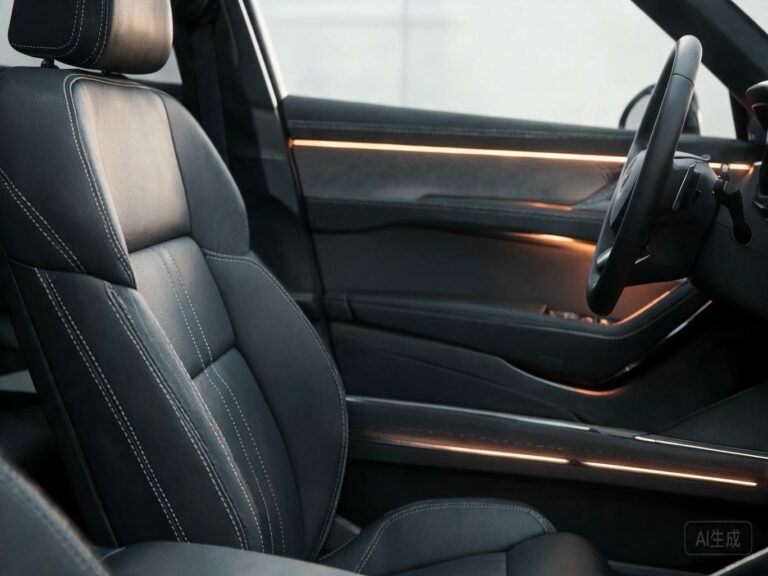
The US EPA Tier 3 VOC limit for automotive interior coatings dropped to 50 µg/m³ in January 2026 — and overnight, the car upholstery leather grade most OEMs were specifying became non-compliant. Solvent-heavy PU topcoats that passed cabin-air tests in 2024 now fail VDA 277. China tightened GB/T 27630 by roughly 30% over its 2020 version, capping TVOC at 0.50 mg/m³ [$TRAE_REF](https://www.docin.com/touch_new/preview_new.do?id=4954074798). The compliance gap is not a future problem; it is a PO-halting problem for any Tier-1 sourcing the wrong material today.
Why 2026 VOC Rules Reshape Car Upholstery Leather Specs
Cabin air quality has moved from a marketing feature to a regulated threshold. German automakers apply VDA 277 to measure total volatile emissions from interior trim; the EPA Tier 3 rule caps leather coating VOCs at 50 µg/m³; and EU regulations are pushing vegan interior options to standard equipment on most premium EVs sold in North America and Europe [$TRAE_REF](https://carinterior.alibaba.com/tips/leather-vs-vegan-ev-2026). The materials that held the market — solvent-based PU and PVC — carry the emissions profiles that now fail these limits. A budget PU grade that off-gases at 80 µg/m³ is not a cost saving. It is a compliance failure that stops the production line.
Then there is the EV weight factor. Every kilogram of vehicle weight reduces EV range by approximately 4–6 kilometers, and traditional genuine leather seating adds 3–5 kg per seat compared to synthetic alternatives [$TRAE_REF](https://topsunsiliconeleather.com/news/ev-seat-materials/). Lightweight synthetic car upholstery leather is no longer a cost-cutting choice — it is a range-performance specification. For a deeper look at how EVs are changing the interior material landscape, see our EV seat materials analysis.

Flame retardancy test — FMVSS 302 compliance is a hard threshold, not a marketing claim.
3 Material Grades vs the New Cabin-Air Standards
The three car upholstery leather grades that dominate OEM sourcing are PU, PVC, and silicone-coated — and their performance against the 2026 regulatory bar is dramatically different. The table below pulls test data from our lab logs and cross-references it against VDA 277, FMVSS 302, and ASTM G154 UV exposure. The spread explains why OEMs are quietly shifting specs.
| Property | PU Leather | PVC Leather | Silicone-Coated |
|---|---|---|---|
| VOC Emission | Moderate (DMF residue) | High (plasticizer odor) | Zero (ISO 16000-6) |
| Temperature Range | -20°C to 70°C | -10°C to 60°C | -40°C to 250°C |
| UV Resistance | Moderate (yellowing) | Poor (brittle in sun) | Excellent (10+ yr stable) |
| FMVSS 302 Fire | Passes (with treatment) | Passes | EN 13773 Class 4 native |
| Weight per Seat | Light | Light | Light (3–5 kg less than hide) |
Silicone-coated car upholstery leather is the only grade that passes EPA Tier 3 VOC limits, FMVSS 302, and -40°C cold-crack tests without topical treatments — while weighing 3–5 kg less per seat than genuine hide. For EV programs, that is range and compliance in one spec.

Flexibility testing — the machine that predicts whether a seat covering cracks at -20°C or stays supple.
Cold-Crack and Heat Sag: Where PU Leather Fails on the Road
A car interior is not a showroom. In winter in Minnesota, cabin temperatures drop to -30°C overnight; in summer in Arizona, a parked car dashboard hits 80°C+. That thermal cycle is where PU and PVC car upholstery leather fail first. PU retains roughly 40% of its flex at -20°C — the surface stiffens, then cracks at stress points when someone sits down. PVC is worse: it has a glass transition temperature near -10°C and goes brittle in cold, while softening and sagging above 60°C [$TRAE_REF](https://topsunsiliconeleather.com/news/silicone-leather-cold-resistance/).
Silicone-coated car upholstery leather handles both extremes natively. The silicone polymer maintains flexibility from -40°C to 250°C — no cold-crack, no heat-sag, no plasticizer migration. In our testing, samples cycled between -30°C and +85°C for 500 thermal cycles showed no visible surface change. One of our automotive clients specified silicone for a cold-climate EV fleet after PU seat covers cracked within the first winter; the silicone replacement has now passed three winters without a single warranty claim. For the full hydrolysis and thermal data, the hydrolysis-resistant silicone leather page has the test reports.

EV cabin interior — where VOC compliance, weight, and thermal range all drive the material spec.
Why silicone-coated leather is becoming the EV OEM interior spec — VOC, weight, and thermal data.
Specifying Car Upholstery Leather for EV Weight and Range
Weight is the hidden spec variable in EV interiors. Genuine leather adds 3–5 kg per seat over synthetic alternatives, and at 4–6 km of range per kilogram saved, that is 12–30 km of range lost per seat — 48–120 km across a four-seat cabin. Lightweight car upholstery leather is not a cost decision; it is a battery-spec decision. The sourcing checklist for an EV interior program:
- Demand the VDA 277 or EPA Tier 3 test report. “Low VOC” is not a spec — 50 µg/m³ is. If the supplier cannot produce the emission test data, the material is not compliant regardless of the claim.
- Verify FMVSS 302 or EN 13773 fire certification. Automotive interiors require FMVSS 302 flammability compliance minimum. Silicone-coated leather achieves EN 13773 Class 4 natively — a higher bar.
- Check the thermal range against your climate zone. If the vehicle operates below -20°C or above 70°C cabin temperature, PU and PVC are out of spec. Silicone handles -40°C to 250°C without degradation.
- Calculate weight per seat, not just per yard. A 0.8mm silicone grade at 400 g/m² is lighter than a 1.4mm PU grade at 700 g/m² — and the range math compounds across a full interior. See our automotive interiors application page for the weight-to-range conversion.
Frequently Asked Questions
Does silicone car upholstery leather meet FMVSS 302?
Yes. Silicone-coated car upholstery leather passes FMVSS 302 flammability requirements and exceeds them — it achieves EN 13773 Class 4 flame retardancy natively, without topical fire-retardant treatments that can wash off or degrade over time.
Is genuine leather better for car seats than synthetic?
It depends on the priority. Genuine leather offers natural breathability and patina development, but it weighs 3–5 kg more per seat (reducing EV range), requires conditioning every 6–8 months, and retains only ~30% flex at -20°C. Silicone-coated synthetic leather is lighter, zero-VOC, maintenance-free, and handles -40°C to 250°C — making it the better spec for EV and cold-climate programs.
The Spec That Passes Before the Line Starts
The car upholstery leather that survives a 2026 sourcing brief is the grade that passes VDA 277 VOC limits, FMVSS 302 fire tests, and -40°C cold-crack cycles on paper — before it ever gets cut. PU and PVC held the market because they were cheap and adequate under looser rules. The rules tightened, and the adequacy ended. Silicone-coated car upholstery leather is the grade that crosses all three thresholds natively, weighs less than hide, and carries the test data to prove it. Specify against the regulation, not the catalogue, and the compliance problem disappears before the PO is issued.
About TOPSUN
TOPSUN manufactures zero-VOC silicone-coated car upholstery leather for EV interiors, automotive seating, and cabin trim where compliance with EPA Tier 3 and VDA 277 is non-negotiable. Our coating line produces lightweight grades tested from -40°C to 250°C with FMVSS 302 and EN 13773 fire certification.
Zero VOC (ISO 16000-6) · EN 13773 Class 4 flame retardant · -40°C to 250°C thermal range · 200,000+ Martindale cycles · REACH & PAHs compliant · 500m MOQ · 7–15 day lead time