We’ve specified upholstery leather for projects across 40 countries, and nowhere is the compliance landscape more punishing than the UK. The Furniture and Furnishings (Fire) (Safety) Regulations have governed every commercial seating decision since 1988—and the 2026 amendment tightens the screws further. For B2B buyers sourcing upholstery leather UK-bound, understanding BS 5852 Crib 5 and BS 7176 hazard levels isn’t optional. It’s the difference between products that clear customs and products that get seized at the border.
Request UK Fire Safety Spec Sheet
Why Upholstery Leather UK Faces the World’s Strictest Fire Rules
The UK adopted furniture fire safety regulations after domestic fire deaths peaked in the 1980s. The result is a regulatory regime that makes upholstery leather UK specification fundamentally different from anywhere else in the world. The 2026 amendment, effective 1 April, eliminates a loophole that many suppliers relied on: visual flame-retardant labeling alone is no longer sufficient.
Under the new rules, every upholstered product must pass both smouldering ignition (cigarette test, BS EN 1021-1) and flaming ignition (match test, BS EN 1021-2) using laboratories accredited to UKAS ISO/IEC 17025 standards. Test reports must be retained for 5 years. Non-compliant products face recall, fines, and border seizure—a risk no B2B buyer can afford.

Direct flame ignition test: silicone leather self-extinguishes without chemical treatment
BS 5852 Crib 5: What the Test Actually Demands
BS 5852 Crib 5 is the most demanding ignition source test in the UK furniture standard. A wooden crib of defined dimensions and mass is placed at the junction between a test seat and back assembly, then ignited. To pass, three conditions must be met: all flames must self-extinguish within 10 minutes, all smoldering must cease within 60 minutes, and flames must not spread to the sample edges.
In our material lab, we’ve run BS 5852 Crib 5 tests on PU, PVC, and silicone leather samples. The results are stark. PU upholstery leather requires chemical flame retardant treatment to pass—and that treatment degrades over 2-3 years of cleaning, leaving the material non-compliant mid-lifecycle. PVC produces toxic smoke when ignited, failing the toxicity requirements even when it technically self-extinguishes. Silicone leather passes Crib 5 inherently, with no chemical treatment needed, because the silicone polymer chain is inherently flame-resistant.
From a 2025 project: One of our UK hospitality clients specified PU upholstery leather for 800 restaurant booths. The initial Crib 5 certificate was valid. After 18 months of commercial cleaning, retesting showed the flame-retardant treatment had leached out. Three booths failed re-test. The replacement cost for re-upholstering 800 booths with compliant material exceeded £180,000.
This is the hidden risk with treated PU upholstery leather: compliance at installation doesn’t guarantee compliance mid-lifecycle. For a deeper look at the chemistry behind this failure mode, see our silicone vs PU comparison.

Quality and safety compliance banner in the TOPSUN production facility
Upholstery Leather UK Compliance: BS 7176 Hazard Levels
While BS 5852 tests materials, BS 7176 classifies finished seating into four hazard levels based on end-use environment. Specifying upholstery leather UK without matching the correct hazard level is a compliance failure—even if the material passes BS 5852 in isolation.
| Hazard Level | Application | Ignition Source | Typical Material |
|---|---|---|---|
| Low | Domestic seating | Cigarette + match (Source 0/1) | Treated PU leather |
| Medium | Commercial offices, hotels | Crib 5 | FR-treated PU or PVC |
| High | Public buildings, transport | Crib 5 + smoke criteria | Silicone leather, wool |
| Very High | Prisons, healthcare | Crib 7 + toxicity | Silicone leather only |

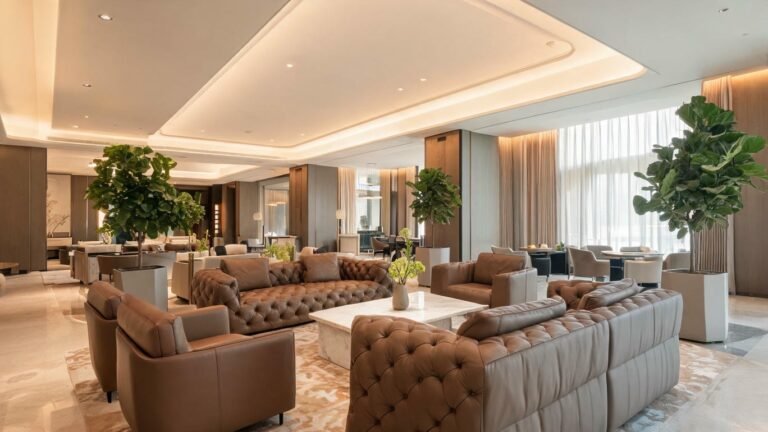
Commercial furniture upholstery must meet BS 7176 Medium or High hazard levels depending on venue type
The table reveals a critical gap in PU upholstery leather: it can achieve Medium hazard level with chemical treatment, but High and Very High applications demand materials with inherent flame resistance. Silicone leather is one of the few synthetic materials that passes Crib 5 without additives, making it suitable across all four hazard levels. For detailed performance data across furniture and sofa applications, our application specifications cover the full BS 7176 range.
Watch silicone leather pass flame retardant testing for sofa upholstery—no chemical treatment required
Frequently Asked Questions
Does all upholstery leather need to be flame retardant in the UK?
Yes. The Furniture and Furnishings (Fire) (Safety) Regulations require all upholstered furniture sold in the UK to meet minimum ignition resistance standards. Domestic furniture must pass Source 0 (cigarette) and Source 1 (match) tests. Commercial and public furniture must meet higher Crib 5 standards under BS 7176. There are no exemptions for leather—synthetic or genuine.
Can I use European EN 1021 test data instead of BS 5852?
Partially. The 2026 amendment accepts BS EN 1021-1:2014 and BS EN 1021-2:2014 as equivalent to BS 5852 Source 0 and Source 1 for domestic furniture. However, Crib 5 compliance for commercial applications still requires BS 5852 testing specifically. If you’re specifying for both UK and EU markets, request both test reports to avoid dual-testing costs. Our silicone leather fire safety resource covers cross-standard compliance in detail.
What Changes April 2026
Three changes define the 2026 amendment for upholstery leather UK specification:
- Mandatory UKAS ISO/IEC 17025 accredited lab testing—supplier self-declarations are no longer accepted
- 5-year test report retention with batch-level traceability linking material to finished product
- New labelling requirements including test standard reference, hazard level, and manufacturer declaration of conformity
For B2B buyers, this means three immediate actions: audit your current upholstery leather supplier’s test documentation, verify that lab reports are from UKAS-accredited facilities, and request leather furniture quality specifications that reference the 2026 amendment specifically. Materials specified before April 2026 under the old rules may need re-certification.
For hospitality and commercial furniture buyers managing large seating inventories, the hospitality sofa fabric TCO guide shows how fire safety compliance factors into 5-year total cost of ownership calculations.
The bottom line: upholstery leather UK specification was never simple, and the 2026 amendment raises the bar. Materials that rely on chemical treatment for flame retardancy will face mounting compliance risk as testing becomes more rigorous and documentation requirements more demanding. Silicone leather’s inherent flame resistance—self-extinguishing, low smoke, non-toxic—eliminates the treatment degradation risk that sinks PU leather compliance mid-lifecycle.
About TOPSUN
TOPSUN supplies BS 5852-compliant silicone leather for UK upholstery applications including commercial furniture, hospitality seating, and public transport interiors where fire safety certification is non-negotiable.
Inherent flame retardant (self-extinguishing), EN 13773 Class 4 certified (exceeds BS 5852 Crib 5), FMVSS 302 compliant, zero VOC emissions, 200,000+ Martindale abrasion cycles.