Walk through any international furniture fair in 2026 and you’ll notice something that wasn’t there five years ago: sustainability claims on couch fabric spec sheets. Not vague “eco-friendly” stickers — actual carbon footprint data, solvent emission metrics, and end-of-life recyclability ratings. The leather couch fabric market is undergoing a shift that B2B furniture manufacturers ignore at their peril. Consumers under 40 now research material composition before purchasing, retailers demand environmental documentation from suppliers, and regulations in the EU and California are phasing out the chemical shortcuts that made cheap leather couch fabric possible. This guide examines leather couch fabric through the lens of environmental impact, consumer behavior data, and the brand differentiation opportunity that sustainable material choices create.
Request Sustainable Leather Couch Samples
What Counts as Leather Couch Fabric in 2026?
The term “leather couch fabric” encompasses a broader material spectrum than most buyers realize. It includes traditional genuine leather (full-grain, top-grain, split, and bonded), synthetic alternatives (PU, PVC, microfiber), and emerging bio-based and silicone-coated options. Each material carries a completely different environmental footprint, and that footprint is increasingly visible to end consumers through certification labels, retailer disclosure requirements, and third-party rating systems.
For B2B furniture manufacturers, the question is no longer just “which leather couch fabric looks best and costs least?” — it’s “which material can I defend to a sustainability-conscious retailer, a regulating body, and a customer who reads ingredient labels?” The materials that performed acceptably in 2015 are facing existential pressure in 2026, and the replacement window is open for manufacturers who move first.

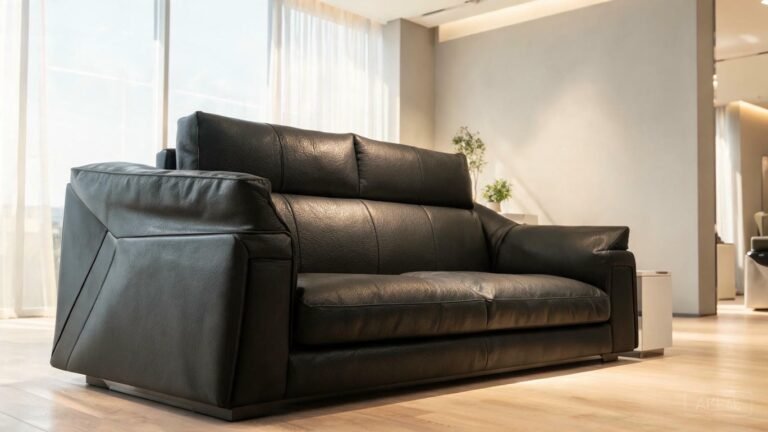
Modern leather fabric sofa — the surface consumers touch daily, and increasingly, the material they research before buying
The Environmental Footprint of Each Leather Couch Fabric Type
Let’s compare the five dominant leather couch fabric types across the environmental metrics that matter most: carbon footprint, water usage, chemical inputs, VOC emissions, and end-of-life recyclability. The data below is drawn from lifecycle assessment studies and our own manufacturing records:
| Environmental Metric | Genuine Leather | PU (Solvent) | PVC | Silicone Leather |
|---|---|---|---|---|
| CO₂ per sq. meter (kg) | 15-28 | 7-12 | 8-14 | 4-7 |
| Water usage (L/sq.m) | 17,000+ | 50-80 | 30-60 | 20-40 |
| Solvent inputs | Tanning chemicals (Cr³⁺) | DMF, MEK, toluene | Phthalates, stabilizers | None (solvent-free) |
| VOC off-gassing | Low (finished) | Moderate (3-6 mo peak) | High (continuous) | Zero |
| End-of-life recyclability | Biodegrades (slowly) | Landfill only | Landfill (leaches phthalates) | Mechanically recyclable |
| Animal-derived inputs | Yes (cattle hide) | No | No | No |
The hidden cost of genuine leather: Cattle leather’s 17,000+ liters of water per square meter includes irrigation for feed crops, processing water, and tanning effluent. That’s the equivalent of 114 bathtubs of water for a single couch cushion’s worth of leather — before accounting for the methane from the cattle themselves.
Consumer Behavior: How Leather Couch Fabric Choices Drive Purchase Decisions
The shift toward sustainability-conscious purchasing isn’t hypothetical — it’s showing up in furniture retail data. Consumers aged 25-44, who represent the largest demographic for new furniture purchases, increasingly research material composition before buying. A 2025 furniture industry survey found that 68% of respondents under 40 said they would pay a 10-15% premium for furniture made with environmentally certified materials, and 43% said they had avoided a purchase specifically because the material composition was unclear or concerning.
For B2B furniture manufacturers, this means leather couch fabric selection is no longer purely an engineering decision — it’s a marketing and brand positioning decision. A couch upholstered in solvent-free silicone leather can carry a sustainability story that resonates with target demographics. A couch upholstered in phthalate-laden PVC cannot, and increasingly, retailers are asking for documentation to verify claims before stocking products.

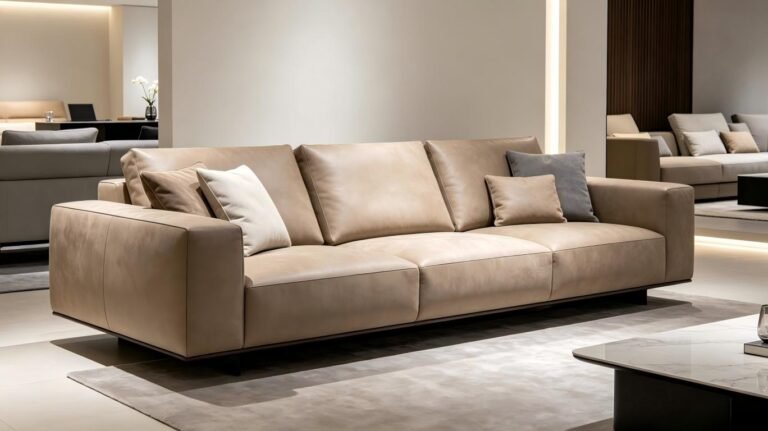
Vegan leather furniture interior — the sustainability narrative that increasingly drives consumer purchase decisions
Regulatory Pressure: The Timeline B2B Manufacturers Need to Watch
Three regulatory developments are converging to make traditional leather couch fabric choices harder to defend. First, the EU’s REACH regulation continues to add restricted substances — phthalates like DEHP, DBP, and BBP are already restricted, and DINCH alternatives face increasing scrutiny. Second, California’s Proposition 65 requires warning labels on products containing listed chemicals, and several phthalates and flame retardants used in PVC and PU couch fabric are on that list. Third, the EU’s Ecodesign for Sustainable Products Regulation (ESPR), which entered force in 2024, is phasing in digital product passport requirements that will eventually mandate material composition disclosure for furniture sold in the EU.
For furniture manufacturers exporting to both EU and US markets, managing compliance across different regulatory regimes adds hidden costs and supply chain complexity. Silicone leather simplifies this dramatically — its solvent-free formulation, zero phthalate content, and REACH, FDA, and PAHs certifications mean the same material passes compliance in every major market without reformulation or labeling workarounds. For more on how this applies specifically to vinyl-based materials, see our analysis of vinyl upholstery fabric regulatory pressure.
Zero-VOC silicone leather production — the solvent-free process that eliminates the environmental and regulatory burden of traditional leather couch fabric
The Solvent Problem: Why PU Leather Couch Fabric Faces a Reckoning
Solvent-based PU leather dominates the mid-range leather couch fabric market, and its environmental profile is under intensifying scrutiny. The production process uses dimethylformamide (DMF) as the primary solvent — a reproductive toxicant restricted under REACH Annex XVII. While most DMF is recovered during production, residual solvent continues to off-gas from finished couch fabric for months after manufacturing. Worker exposure in PU coating facilities remains a occupational health concern in regions with weaker enforcement.
Water-based PU was developed as a cleaner alternative, and it does eliminate the DMF problem. But water-based PU leather sacrifices abrasion resistance and hydrolysis stability compared to solvent-based PU — which means couch fabric that fails sooner and generates more waste. The trade-off between environmental impact and durability has been the fundamental tension in PU leather for two decades. Silicone leather resolves this tension by offering both: zero solvents during production and superior durability in the field. For a deeper comparison, our silicone vs PU analysis covers the technical details.

Silicone leather lifecycle display — from raw silica to finished couch fabric, the entire supply chain is solvent-free
How Sustainable Leather Couch Fabric Creates Brand Differentiation
For furniture manufacturers competing in crowded retail channels, leather couch fabric is one of the few components where a sustainability upgrade creates a visible, marketable difference at the point of sale. Unlike frame engineering or foam density — which consumers can’t see or feel — the couch surface is the part they touch, smell, and photograph for social media. A couch that looks identical to a competitor’s but carries a “solvent-free, zero-VOC, recyclable silicone leather” label commands a price premium and earns shelf placement in sustainability-focused retail channels.
The brand differentiation strategy works because it’s verifiable. Unlike vague “eco-friendly” claims, silicone leather’s sustainability attributes are backed by third-party certifications: REACH compliance, ISO 10993 biocompatibility, FDA food-contact safety, and PAHs testing. These certifications give furniture brands defensible marketing claims that survive retailer scrutiny and consumer fact-checking. For manufacturers ready to make the shift, our sofa material leather guide covers the practical transition steps.
Brand differentiation opportunity: In a market where most couch fabric looks identical to consumers, sustainability certification is the one differentiator that can’t be visually copied. A competitor can match your color and texture in weeks — they can’t match your REACH, FDA, and ISO 10993 certifications without fundamentally changing their material chemistry.

Solvent-free silicone leather production process — the manufacturing flow chart furniture brands can reference in sustainability documentation
Frequently Asked Questions
Is genuine leather couch fabric environmentally sustainable?
Genuine leather has a complex environmental profile. On one hand, it’s a byproduct of the meat industry and biodegrades at end of life. On the other hand, cattle farming generates significant methane emissions, tanning uses chromium salts and large volumes of water (17,000+ liters per square meter), and the chemical inputs in tanning create toxic wastewater. For B2B furniture manufacturers, genuine leather’s environmental footprint is increasingly difficult to defend in sustainability-focused retail channels, especially when silicone leather offers comparable durability without the animal-derived inputs or tanning chemicals.
Can leather couch fabric be recycled?
Recyclability depends entirely on the material type. PVC and solvent-based PU leather couch fabric cannot be economically recycled — they end up in landfill, where PVC leaches phthalates for decades. Genuine leather biodegrades slowly but cannot be mechanically reprocessed into new material. Silicone leather is the only faux leather type that can be mechanically recycled: the silicone coating can be separated from the fabric substrate and reprocessed, making it compatible with circular economy models that furniture brands are increasingly adopting.
What certifications should B2B buyers look for in sustainable leather couch fabric?
At minimum, look for REACH compliance (EU chemical safety), ISO 10993 biocompatibility (skin-contact safety), and PAHs testing (polycyclic aromatic hydrocarbons). For food-contact applications (e.g., furniture in food service settings), FDA certification is essential. For VOC-conscious markets, request VDA 278 or similar chamber emission test results. The key is to verify that certifications come from accredited third-party laboratories — not in-house testing. Our certification documentation demonstrates the standard B2B buyers should expect from a compliant supplier.
The Material Choice That Defines Your Brand’s Next Decade
Leather couch fabric selection has evolved from a cost-and-color decision into a strategic choice that affects regulatory compliance, brand positioning, and market access. The materials that dominated the last two decades — solvent-based PU and phthalate-plasticized PVC — are facing regulatory phase-outs, consumer skepticism, and retailer disclosure requirements that will only intensify. Genuine leather retains prestige but carries environmental baggage that younger demographics increasingly reject.
Silicone leather represents the convergence point where sustainability, performance, and compliance meet. Its solvent-free production process, zero-VOC formulation, mechanical recyclability, and full certification stack (REACH, FDA, ISO 10993, PAHs) make it the leather couch fabric that furniture manufacturers can specify with confidence in 2026 and beyond. The per-meter cost is higher than PU or PVC — but the brand value, regulatory future-proofing, and consumer appeal it delivers are assets that compound over a product line’s lifecycle. For manufacturers ready to make the transition, the first step is simple: request samples and test them against your current material.
Start Your Sustainability Transition
About TOPSUN
TOPSUN manufactures solvent-free silicone leather for couch and furniture applications, serving B2B manufacturers in 30+ countries who need leather couch fabric that meets the sustainability, compliance, and performance standards of 2026 and beyond. Our production process uses zero solvents, zero plasticizers, and zero animal-derived inputs — delivering a material with 4-7 kg CO₂ per square meter, 20-40 liters of water usage, and full mechanical recyclability at end of life.
Certified to REACH, FDA, ISO 10993, and PAHs standards by SGS and Intertek. Custom color matching, embossing, and substrate engineering available for OEM/ODM furniture production lines. Sustainability documentation and lifecycle assessment data provided for qualified B2B inquiries.