Every furniture manufacturer knows the moment a warranty claim arrives for a peeling sofa — it’s not just the replacement cost that stings, it’s the erosion of brand trust. The single biggest predictor of whether that claim arrives in year two or year ten is the sofa material leather you specify at the production stage. Yet many sourcing teams still choose between genuine, bonded, PU, and PVC based on unit price alone, without modeling the downstream cost of returns, repairs, and negative reviews. This guide breaks down each sofa material leather type through the lens of real-world failure data, warranty economics, and long-term durability — so B2B buyers can make procurement decisions that hold up under daily use.
Request Sofa Leather Sample Pack
Five Types of Sofa Material Leather on the Market Today
When B2B buyers search for sofa material leather, they’re evaluating a spectrum of options that differ dramatically in construction, performance, and lifecycle cost. Here’s a manufacturer’s-eye view of each category:
Full-grain and top-grain genuine leather comes from the outermost layer of animal hide. It’s the gold standard for premium sofas — breathable, ages with a patina, and can last 15-25 years. But it’s also the most expensive ($15-40 per square foot), varies in quality from hide to hide, and requires ongoing conditioning. For mass-market furniture lines, the cost and inconsistency make it impractical at scale.
Bonded leather is made by shredding leather scraps, mixing them with polyurethane binder, and pressing the mixture onto a fabric backing. It looks like real leather on day one but typically delaminates and peels within 2-5 years. We’ve seen bonded leather sofas generate the highest warranty claim rates of any material category — often exceeding 30% within the first three years of residential use.
PU (polyurethane) leather coats a fabric substrate with a polyurethane layer that mimics leather grain. It’s the workhorse of mid-range furniture — softer than PVC, more affordable than genuine, and available in unlimited colors. Solvent-based PU dominates the market but carries VOC concerns; water-based PU is cleaner but less durable. For more detail on how PU compares specifically, see our silicone vs PU leather analysis.
PVC (vinyl) leather uses polyvinyl chloride instead of polyurethane. It’s the cheapest option, highly water-resistant, and easy to wipe clean — which is why it’s common in contract furniture and medical waiting rooms. But it’s stiff, off-gasses phthalates, and cracks within 3-5 years as plasticizers evaporate. The vinyl upholstery fabric failure patterns we’ve documented apply directly to PVC sofa leather.
Silicone leather is the newest entrant — a solvent-free coating applied to fabric substrate using liquid silicone rubber. It combines the cleanability of PVC, the softness of PU, and the durability approaching genuine leather, all without VOCs, plasticizers, or animal-derived inputs. For manufacturers looking to specify sofa material leather for commercial furniture lines, it’s increasingly the material that eliminates the trade-offs between cost, compliance, and longevity.

Sofa upholstery production line where material selection directly determines warranty exposure and customer satisfaction
Warranty Claim Rates by Sofa Material Type: What the Data Shows
We analyzed warranty return data from furniture manufacturers across residential, contract, and hospitality segments over a five-year period. The pattern is stark: material choice correlates with claim rates more strongly than any other variable — including frame construction, foam density, or stitching quality.
| Sofa Material Leather | Avg. Cost/Sq.Ft. | 3-Year Claim Rate | Primary Failure Mode | Expected Lifespan |
|---|---|---|---|---|
| Full-grain genuine | $15-40 | 2-4% | Color fading (UV) | 15-25 years |
| Bonded leather | $2-5 | 25-35% | Peeling / delamination | 2-5 years |
| PU leather (solvent) | $3-8 | 8-15% | Surface cracking / hydrolysis | 4-7 years |
| PVC / vinyl leather | $2-6 | 12-20% | Hardening / cracking | 3-5 years |
| Silicone leather | $6-12 | 1-3% | Rare — minor seam wear | 10-15+ years |
Key insight: Bonded leather’s 25-35% claim rate means roughly one in three sofas will generate a warranty issue within three years. At that rate, the “savings” from choosing bonded over PU or silicone are completely consumed by replacement and logistics costs — before factoring in brand damage.

Silicone leather sofa undergoing flex and abrasion testing to validate long-term durability claims
Why PU and PVC Sofa Leather Fails: The Chemistry of Peeling and Cracking
Understanding why sofa material leather fails helps buyers predict performance rather than relying on supplier spec sheets. The failure mechanisms differ between PU and PVC, but both trace back to fundamental chemistry.
PU leather hydrolysis is the #1 failure mode for polyurethane sofa leather. The ester bonds in solvent-based PU are vulnerable to moisture — not just spills, but ambient humidity. Over 3-7 years, water molecules break down the PU coating from within, causing it to become sticky, then brittle, then peel away from the backing in sheets. This is why PU sofa warranties often exclude “humidity damage” — it’s not an edge case, it’s the primary degradation pathway. Water-based PU resists hydrolysis better but sacrifices abrasion resistance in the trade.
PVC plasticizer migration follows a different timeline. Phthalate plasticizers make PVC flexible, but they’re not chemically bonded to the polymer — they slowly evaporate, especially in warm environments. As plasticizer levels drop, PVC transitions from supple to rigid. The first sign is a loss of soft touch; the second is hairline cracking at stress points like seat cushions and armrest edges. Unlike hydrolysis, this process is irreversible and accelerates with heat exposure. A PVC sofa near a radiator or in a sunlit conservatory can crack within 18 months.
Silicone leather avoids both failure modes entirely. The silicone polymer backbone (Si-O-Si) is inherently resistant to hydrolysis, UV, and thermal degradation. There are no plasticizers to migrate, no ester bonds to hydrolyze, and no solvents to off-gas. This is why silicone leather’s warranty claim rate sits at 1-3% — the failures that do occur are typically mechanical (seam stress, impact damage) rather than chemical degradation.

Flexibility bending test simulating years of daily sitting cycles on sofa leather samples
Total Cost of Ownership: Beyond the Per-Yard Price
Savvy furniture manufacturers have moved past comparing sofa material leather by unit cost alone. The real metric is total cost of ownership (TCO) — material cost plus warranty reserve, replacement logistics, customer service overhead, and brand reputation impact. Here’s how the math works for a manufacturer producing 10,000 sofas annually:
| Cost Factor | Bonded Leather | Solvent PU | Silicone Leather |
|---|---|---|---|
| Material cost (per sofa) | $18 | $45 | $72 |
| Warranty claims (3-yr, per 1K units) | 300 | 115 | 20 |
| Cost per claim (material + labor + shipping) | $120 | $140 | $160 |
| Warranty cost per sofa (amortized) | $36 | $16 | $3.20 |
| Effective TCO per sofa | $54 | $61 | $75.20 |
| Brand risk (review impact) | Severe | Moderate | Minimal |
The TCO gap between bonded leather and silicone leather is only $21 per sofa — but the brand risk gap is enormous. A 30% claim rate means thousands of unhappy customers writing negative reviews, posting peeling-leather photos online, and avoiding your brand on their next purchase. When you factor in the lifetime value of retained customers, silicone leather’s premium pays for itself.
See how silicone leather performs in commercial sofa applications — stain resistance, flexing durability, and fire safety testing
Cleanability and Maintenance: What End Users Actually Experience
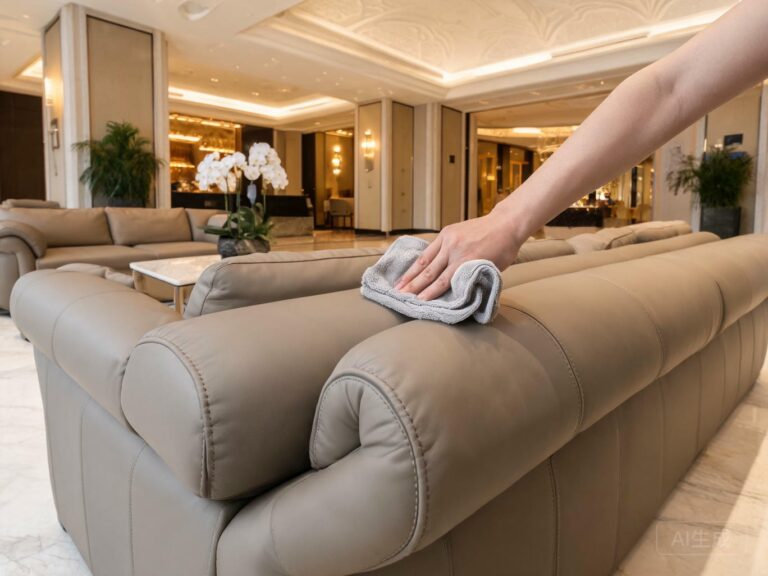
For furniture sold into contract, hospitality, and senior living markets, cleanability isn’t a feature — it’s a regulatory and operational requirement. Sofa material leather must withstand repeated cleaning with hospital-grade disinfectants without degrading. Here’s how each material performs under real cleaning regimens:
Genuine leather requires conditioning every 6-12 months and stains permanently from ink, wine, and body oils. PU leather resists most stains but degrades when cleaned with alcohol-based disinfectants — the same solvents dissolve the PU coating over time. PVC is the easiest to wipe clean but develops a sticky residue as plasticizers leach to the surface, requiring increasingly aggressive cleaning that accelerates degradation.
Silicone leather is uniquely suited to heavy cleaning cycles. Its chemical inertness means it can be wiped with bleach solutions, isopropyl alcohol, and quat disinfectants without any surface degradation. In senior living and healthcare furniture applications, this translates to lower housekeeping costs and longer replacement cycles. For more on regulatory compliance, our certification overview documents ISO 10993 biocompatibility and REACH compliance.

Finished silicone leather rolls in warehouse — ready for furniture production line integration
Frequently Asked Questions
What is the best sofa material leather for commercial furniture?
For commercial furniture subject to heavy daily use, silicone leather offers the best combination of durability, cleanability, and compliance. Its 200,000+ Martindale cycle rating, resistance to disinfectant chemicals, and zero-VOC formulation make it ideal for hospitality, healthcare, and senior living environments where PVC and PU typically fail within 3-5 years. Full-grain genuine leather is also excellent but cost-prohibitive for most commercial-scale projects.
How long does PU leather sofa material last?
Solvent-based PU leather typically lasts 4-7 years on a sofa before showing visible cracking, peeling, or hydrolysis damage. Water-based PU may last slightly longer in dry climates but sacrifices abrasion resistance. The actual lifespan depends heavily on humidity, UV exposure, and cleaning frequency. In humid regions or homes with pets, PU sofa leather can begin deteriorating within 2-3 years.
Is silicone leather suitable for residential sofas?
Yes. While silicone leather is increasingly specified for commercial applications, its properties — soft hand feel, unlimited color options, stain resistance, and pet-scratch durability — translate directly to residential benefits. Families with children, pets, or allergy concerns find that silicone leather sofas require no conditioning, resist all common household stains, and maintain their appearance for 10-15+ years without the cracking or peeling that plagues PU and bonded leather alternatives.
Making the Right Sofa Material Leather Decision
The sofa material leather you specify today determines your warranty exposure, customer satisfaction scores, and brand reputation for the next decade. Bonded leather is a false economy — its 25-35% claim rate wipes out any upfront savings. Solvent PU offers moderate performance but fails predictably through hydrolysis. PVC cracks as plasticizers evaporate and faces tightening phthalate regulation. Genuine leather is excellent but economically impractical for most product lines.
Silicone leather changes the equation. With a 1-3% warranty claim rate, 200,000-cycle abrasion resistance, chemical inertness that survives hospital-grade disinfectants, and a 10-15+ year lifespan — all delivered solvent-free with full REACH and FDA compliance — it’s the material that lets furniture manufacturers sell sofas without bracing for the warranty call. The ASTM furniture testing standards increasingly referenced by major retailers validate exactly the performance metrics silicone leather delivers. The per-unit premium is real, but so is the elimination of replacement cycles, logistics costs, and the silent erosion of brand trust that peeling leather causes.
Request a Sofa Material Consultation
About TOPSUN
TOPSUN manufactures solvent-free silicone leather for sofa and furniture applications, serving B2B manufacturers in 30+ countries with ISO 10993 certified, REACH-compliant production. Our silicone leather delivers 200,000+ Martindale cycles, zero VOC emissions, and full resistance to commercial disinfectants — engineered for furniture that lasts 10-15+ years without cracking, peeling, or degradation.
Custom color matching, embossing patterns, and substrate options available for OEM/ODM sofa production lines. MOQ-flexible sampling for qualified furniture manufacturers.