The question “vegan leather — how is it made?” isn’t academic. The manufacturing method directly determines whether your finished product emits 400+ grams per liter of volatile organic compounds or zero. It determines whether the coating adhesion passes ISO 2411 at 30 N/3cm or fails at 15 N/3cm. It determines whether the material survives five weeks of hydrolysis testing or disintegrates in one. Most B2B buyers specify vegan leather by thickness, color, and texture — but the production process behind those specs is what actually governs field performance. Here’s a technical breakdown of four vegan leather manufacturing methods, ranked by hard test data.
Request Manufacturing Spec Sheet
| Method | VOC (g/L) | Hydrolysis (wks) | Peel Adhesion | DMF-Free |
|---|---|---|---|---|
| Solvent PU (Dry) | 400+ | 1–2 | 15 N/3cm | No |
| Waterborne PU (Wet) | <50 | 3–5 | 20 N/3cm | Yes |
| Silicone (Solvent-free) | 0 | 7+ | 30+ N/3cm | Yes |
| Plant-Based Composite | Varies (50–200) | 2–4 | 15–20 N/3cm | Partial |
Method 1: Solvent-Based Dry Process PU
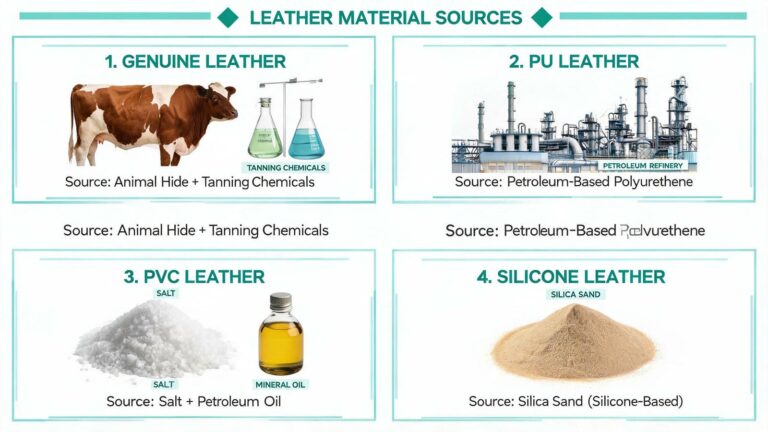
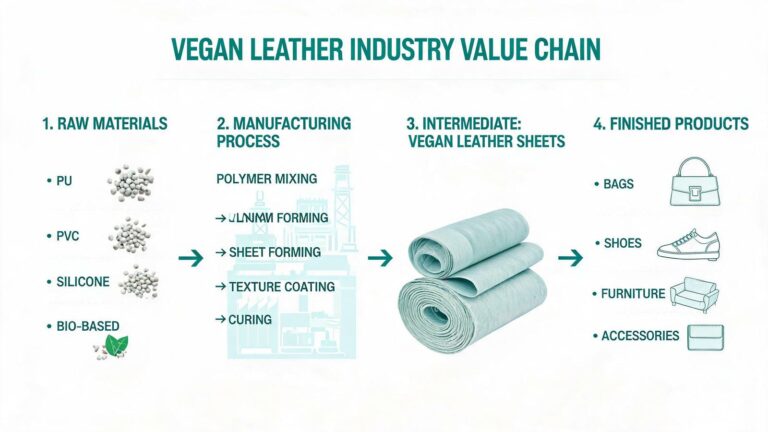
The most common vegan leather manufacturing method — and the most chemically intensive. Solvent-based PU dissolved in DMF (dimethylformamide) is coated onto release paper embossed with a grain texture. The coated paper passes through drying ovens at 100–130°C, where solvent evaporates and the PU crosslinks into an elastic film. A fabric backing — typically polyester or cotton — is laminated onto the semi-cured PU layer, and once fully cured, the release paper is peeled away.
The problem is in the solvent. DMF is classified as a Substance of Very High Concern under EU REACH regulation, known for hepatotoxic properties. Solvent-based PU VOC content commonly exceeds 400 g/L. Major European automotive OEMs now have binding timelines requiring supply chains to eliminate DMF-containing materials entirely. Even after manufacturing, finished PU leather can continue releasing residual DMF, formaldehyde, and other solvents for weeks — a particular concern for indoor applications like furniture and automotive interiors.
In our production experience, solvent-based PU leather manufactured without proper ventilation controls leaves measurable solvent residue that fails VDA 278 testing for organic emissions. The TOPSUN factory production process eliminated solvent-based methods entirely in favor of solvent-free silicone coating — a decision driven by both regulatory compliance and worker safety.

Drying ovens cure the polymer coating — solvent-based PU releases 400+ g/L VOCs during this step; silicone releases zero.
Method 2: Waterborne PU Wet Process
Waterborne PU replaces organic solvents with water as the carrier medium. The PU dispersion is applied through a wet process where the base fabric is immersed directly into a PU solution bath, then passes through a water coagulation bath. The result is a sponge-like porous internal structure that improves breathability — the closest synthetic approximation to genuine leather’s microstructure.
VOC emissions drop from 400+ g/L to under 50 g/L, with certain zero-VOC formulations now commercially available. Waterborne PU systems comply with China’s GB/T 27630 standard for passenger vehicle interior air quality and Germany’s VDA 278 test method. However, the lower solids content of waterborne dispersions means more coating passes are needed to achieve the same film thickness, and when total cost of ownership is modeled — including solvent procurement avoidance, waste gas treatment elimination, and fire suppression savings — the effective cost differential narrows considerably.
For artificial PU leather applications where budget constraints prevent silicone specification, waterborne PU is the responsible fallback — but it still hydrolyzes. High-performance polycarbonate waterborne PU retains over 85% elongation at break after accelerated hydrolysis testing (70°C, 95% RH, 7 weeks), which is better than standard PU but still below silicone’s indefinite hydrolysis resistance.
Method 3: Solvent-Free Silicone Coating
Silicone leather manufacturing follows a fundamentally different pathway. Liquid Silicone Rubber (LSR) is compounded with an organohydrogen polysiloxane crosslinking agent and a platinum catalyst. The silicone mixture is knife-coated onto a fabric substrate — woven polyester, microfiber, or nylon — in controlled layers. The coated material passes through heating zones where the platinum catalyst initiates crosslinking at specific temperatures, bonding the silicone to the fabric at the molecular level.
The entire process uses zero solvents and produces zero VOC emissions. No DMF, no formaldehyde, no plasticizers. The crosslinked silicone matrix is chemically stable from -40°C to 250°C, does not hydrolyze, and does not embrittle under UV exposure. Silicone leather’s coating adhesion exceeds 30 N/3cm in ISO 2411 testing — double the standard commercial synthetic leather benchmark of 15 N/3cm.

Release film roller on the silicone coating line — no solvent evaporation, no DMF recovery system needed.
In our facility, the full silicone versus semi-silicone distinction matters here. Full silicone leather uses 100% food-contact-grade silicone for both the coating and adhesive layers. Semi-silicone variants may combine a silicone topcoat with a PU adhesive layer — which reintroduces some of the solvent and hydrolysis concerns. For medical, food-contact, or infant applications, only full silicone construction is acceptable.

Complete silicone leather production flow: compounding → coating → curing → embossing → inspection → rewinding.
Walk through the TOPSUN silicone leather production line — from raw silicone compounding to finished roll inspection.
Method 4: Plant-Based Composite Manufacturing
Plant-based vegan leather — Piñatex (pineapple leaves), Desserto (cactus), mycelium — follows a hybrid process. Raw plant material is harvested, dried, and mechanically processed to extract cellulose fibers. These fibers are then mixed with a polymer binder — most commonly PU — at roughly a 50/50 ratio, and the mixture is coated onto a fabric backing using the same dry or wet process as conventional PU.
The agricultural inputs reduce fossil fuel dependency, but the PU binder means most plant-based leathers are not fully biodegradable. VOC emissions fall between solvent-based and waterborne PU, depending on the binder chemistry. A 2021 FILK Freiberg Institute study found measurable levels of pesticides in Desserto and plasticizers in Piñatex when materials were exposed to heat — raising questions about chemical safety that plant-based marketing rarely addresses.
Quality Control: What to Test and Why
Regardless of manufacturing method, four test standards separate specification-grade vegan leather from commodity material:
- ISO 2411:2024 — Coating adhesion. A 30mm specimen is partially separated at the substrate-coating interface, clamped in a dynamometer, and pulled at 100 mm/min. Standard commercial synthetic leather fails below 15 N/3cm; engineering-grade microfiber and silicone exceed 30 N/3cm.
- SATRA TM344 — Hydrolysis resistance. Tested at 70°C, 95% RH. Standard PU fails within 1–2 weeks; premium microfiber survives 5+ weeks; silicone leather shows no measurable degradation at 7+ weeks.
- EN ISO 12947-2 — Martindale abrasion. Standard PU: 30,000 rubs. Premium microfiber: 100,000+ rubs. Silicone leather: 200,000+ rubs in our testing.
- VDA 278 / GB/T 27630 — VOC emissions. Solvent-based PU fails both standards. Waterborne PU passes. Silicone leather emits zero measurable VOCs.
When comparing vegan leather alternatives, request all four test reports before signing a spec sheet. Any supplier who cannot produce ISO 2411 adhesion data and SATRA TM344 hydrolysis results is selling untested material.

The manufacturing method determines whether this sofa upholstery lasts 3 years or 10+.
Get Manufacturing Test Reports
The Manufacturing Method Is the Product
Vegan leather how it’s made isn’t a background detail — it’s the single largest determinant of product performance. A PU sofa manufactured via solvent-based dry process and a silicone sofa manufactured via solvent-free coating may look identical on day one. Three years later, the PU sofa’s topcoat is delaminating while the silicone sofa looks new. The difference wasn’t the color, the texture, or the thickness. It was the manufacturing method — and the chemistry behind it.
For B2B sourcing teams, the actionable takeaway is simple: specify the manufacturing method in your purchase order, not just the finished material properties. Require ISO 2411 adhesion data, SATRA TM344 hydrolysis results, and VDA 278 VOC reports as mandatory line items. The suppliers who can produce these documents are the ones whose manufacturing process is worth specifying.
About TOPSUN
TOPSUN operates a 60,000+ m² silicone leather manufacturing facility using solvent-free dry coating technology, with 10+ automated production lines and 500,000+ m monthly capacity across three bases in Dongguan, Yichang, and Xiangyang.
Every batch ships with ISO 2411 adhesion, SATRA TM344 hydrolysis, and VDA 278 VOC test reports. Platinum-catalyzed curing, zero-solvent process, REACH and OEKO-TEX Standard 100 certified.