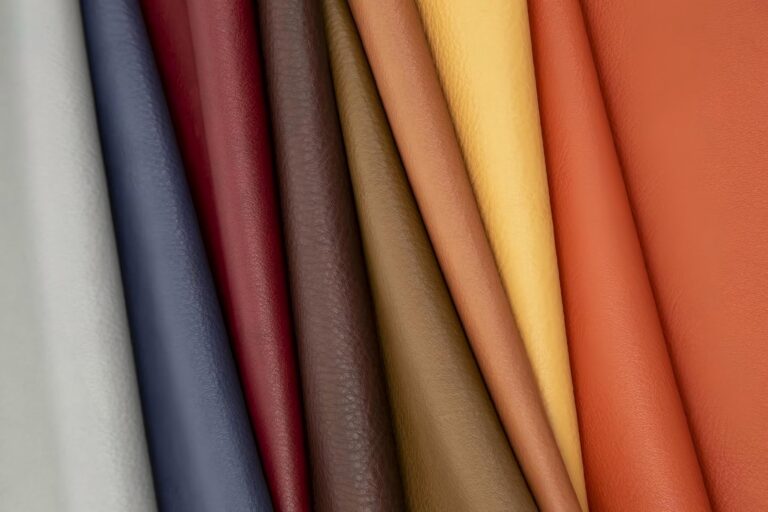
Imagine your compliance team opening a shipment of “eco-friendly vegan leather” from a new supplier. The spec sheet lists thickness, color, and texture — but no polymer chemistry, no VOC data, no PFAS test results. France just banned PFAS in textile-based imitation leather products effective January 2026. California’s AB 1817 PFAS threshold drops to 50 ppm in 2027. EU REACH restricts phthalates in synthetic leather. If you can’t prove what’s in your material, you can’t prove it’s compliant — and “eco-friendly” becomes a liability, not a selling point.
What “Eco-Friendly” Actually Requires in 2026
The FTC Green Guides prohibit unqualified claims like “eco-friendly” without specific, substantiated evidence. European Commission data shows 53% of green claims are vague, misleading, or unfounded. For vegan leather, genuine eco-friendly status requires proof across four dimensions: material origin (what’s it made of?), manufacturing emissions (VOCs, solvents, DMF), durability (how long before it ends up in a landfill), and end-of-life (recyclable or biodegradable?).

Water resistance testing — eco-friendly claims require performance data, not just marketing labels.
Which Vegan Leather Materials Pass Compliance?
Silicone leather currently holds the strongest compliance profile. It contains no PVC, PU, phthalates, PFAS, or plasticizers. Manufacturing uses zero solvents and emits zero VOCs. It carries OEKO-TEX Standard 100 Product Class I certification (the strictest tier, tested to baby-textile limits), REACH compliance with no SVHC substances above threshold, and non-detect PFAS results from independent Hohenstein laboratory testing. At end-of-life, the silicone coating can be separated from the backing fabric and recycled independently.
Waterborne PU is the responsible fallback — VOC emissions drop from 400+ g/L to under 50 g/L, and it’s DMF-free. But it still hydrolyzes, still sheds microplastics, and still requires replacement within 3–5 years. Biodegradable vegan leather reached $1.52 billion in 2025 with 7.8% CAGR — but most plant-based options still use PU binders, limiting true biodegradability.

Controlled manufacturing environment — zero-VOC production eliminates the need for solvent recovery systems.
See the full certification stack — OEKO-TEX, REACH, RoHS, PFAS-free — verified in TOPSUN’s eco-certification overview.
Decision Tree: Which Material Should You Specify?
- If your target market includes the EU or California → eliminate PVC and solvent-based PU immediately (PFAS/phthalate non-compliance risk)
- If your product contacts food, skin, or infants → specify full silicone leather with FDA 21 CFR 177.2600 and OEKO-TEX Class I
- If budget constrains silicone pricing → use waterborne PU (DMF-free, <50 g/L VOC) with documented hydrolysis test data
- If marketing claims “biodegradable” → verify the binder chemistry; if it contains PU, the claim is partial at best
- If the supplier cannot produce PFAS test results → walk away, regardless of the “eco-friendly” label

Biodegradable vegan leather in furniture — but check the binder before trusting the label.
The future of bio-based silicone leather combines the best of both worlds: silicone’s zero-VOC chemistry with renewable input sourcing. But until that technology scales, full silicone leather remains the only vegan leather category that passes every current and pending regulation without compromise.
Get Compliance-Verified Samples
About TOPSUN
TOPSUN manufactures environmentally friendly vegan leather using 100% solvent-free silicone coating technology, serving brands that require full regulatory compliance across EU, US, and Asian markets.
OEKO-TEX Standard 100 Class I certified, REACH compliant (zero SVHC), PFAS non-detect (Hohenstein tested), RoHS compliant, zero-VOC manufacturing, FDA 21 CFR 177.2600 food-contact rated, 500,000+ m monthly capacity.