A standard sofa gets sat on a few times a day. A sofa bed gets folded, unfolded, stretched, compressed, and sat on — every single day. The sofa bed upholstery fabric you choose is not just about looks. It is about whether the material can survive thousands of flex cycles without cracking at the crease lines, delaminating at stress points, or losing its surface finish where the human body makes repeated contact.
We have supplied materials to sofa bed manufacturers across Europe and North America. The most common failure pattern we hear about is not abrasion. It is cracking at the fold lines. After 6–12 months of daily use, the upholstery along the hinge area starts to split. The customer calls it a warranty issue. The manufacturer calls it a material selection problem. Here is how to avoid it.
Why Sofa Beds Destroy Most Upholstery Fabrics
The mechanics of a sofa bed create stress patterns that static sofas never encounter. When the bed mechanism folds, the upholstery is compressed at the hinge point and stretched across the sleeping surface. When it unfolds back to sofa position, the tension reverses. Over 365 days of daily use, that is 730 full stress cycles — plus the incidental sitting, lying, and shifting that happens in between.
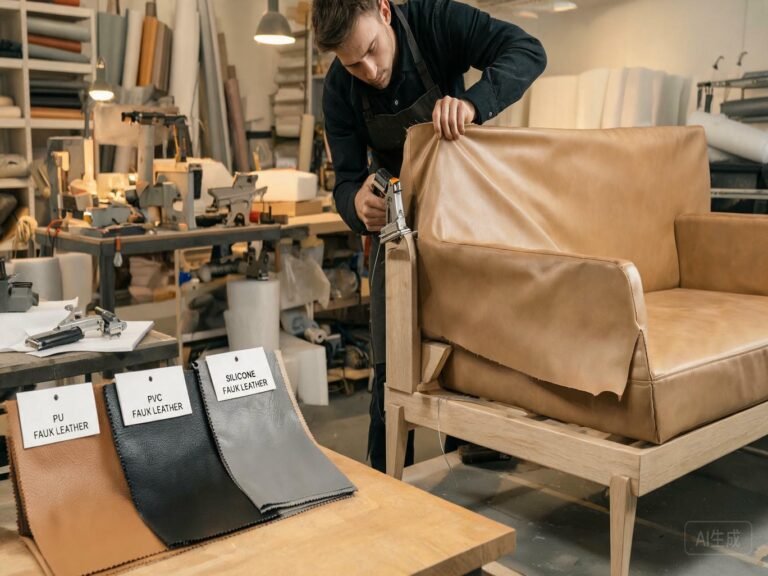
Standard woven fabric handles folding reasonably well but pills and frays at high-friction points. PU leather is the worst performer in this application. Its surface coating is rigid relative to the fabric substrate. Repeated folding creates micro-cracks in the PU layer, which propagate into visible splits. Within a year, the fold lines look like weathered asphalt.

PVC vinyl cracks even faster than PU because the plasticizers that keep it flexible migrate over time, leaving the material brittle. We have seen PVC-upholstered sofa beds develop visible crease cracks within 3–4 months in warm climates where plasticizer migration accelerates.
The hidden cost: A sofa bed that needs reupholstering after one year creates negative reviews, warranty claims, and brand damage that far exceeds the cost difference between a budget fabric and a higher-performance material.
Sofa Bed Upholstery Fabric Flex Testing: What the Data Shows
Flex resistance is measured using a Ross flexing test (ASTM D1052) or similar methodology, which repeatedly bends material samples through a defined angle under controlled tension [1]. The test simulates the stress a sofa bed upholstery fabric experiences at the fold line.
In our internal testing, we run a modified flex test that combines bending with surface abrasion — closer to real-world sofa bed conditions than a pure flex test alone. Here is what we found after 50,000 combined flex-and-abrasion cycles:

- Polyester fabric — Survived 50K cycles with moderate pilling but no structural failure. The downside is staining and odor absorption from the mattress surface.
- PU leather — Visible surface cracking at 8,000–12,000 cycles. Complete delamination along the fold line by 20,000 cycles.
- PVC vinyl — Surface crazing at 5,000–8,000 cycles. Full-thickness cracks by 15,000 cycles.
- Silicone leather — No visible surface change after 50,000 cycles. The silicone polymer’s inherent flexibility and bond strength to the substrate fabric allow it to absorb repeated bending stress without cracking or delamination.
Watch silicone leather endure repeated flexing without surface cracking or delamination
Beyond Flexing: Sleep Surface Comfort and Hygiene
The sleeping surface of a sofa bed has its own requirements. When the bed is unfolded, the upholstery becomes the mattress cover. It needs to feel comfortable against skin, resist moisture absorption, and be easy to clean between uses.
Fabric absorbs sweat, body oils, and spills directly into the fibers. Even with a mattress protector, the upholstery itself becomes a hygiene concern over time. PU and PVC create a barrier, but PU’s porous structure can trap odors. PVC is fully impermeable but traps heat and moisture against the sleeper’s body.

Silicone leather offers the best of both worlds. The non-porous surface prevents liquid absorption and odor retention. It wipes clean with mild soap. For hospitality applications — serviced apartments, Airbnb properties, guest houses — this translates to faster turnover cleaning and fewer complaints about mattress hygiene.
Material Selection Guide by Sofa Bed Application
| Application | Recommended Material | Why |
|---|---|---|
| Budget residential (occasional use) | Standard fabric | Lowest cost; acceptable for infrequent folding |
| Mid-market residential (daily use) | Silicone leather | Withstands daily folding; easy to clean; premium feel |
| Hospitality / short-term rental | Silicone leather | Bleach-safe cleaning; odor-resistant; long lifespan |
| Student housing / institutional | PVC vinyl or silicone leather | Vinyl for lowest cost; silicone for durability upgrade |
Request Sofa Bed Fabric Swatches
Frequently Asked Questions
How thick should sofa bed upholstery fabric be?
Thickness depends on the mechanism design. Thinner materials (0.6–0.8mm) work better for tight-folding mechanisms because they create less bulk at the hinge point. Thicker materials (1.0–1.2mm) offer more cushion feel on the sleeping surface but require more clearance in the folding mechanism. We typically recommend 0.8–1.0mm for sofa bed applications — a balance between durability and foldability. For custom thickness requirements, we can adjust the coating weight to match your mechanism specifications.
Does silicone leather make noise when folding?
No more than PU leather or vinyl. The surface friction of silicone leather is comparable to other synthetic leathers. If noise is a concern for your design, the mechanism hardware and frame tolerances are typically the bigger factors than the upholstery material itself. We have supplied silicone leather for sofa and sleeper sofa lines without noise complaints.
Can I use silicone leather on both the seating and sleeping surfaces?
Yes. In fact, that is the ideal configuration. Using the same material on both surfaces ensures consistent appearance, eliminates color-matching issues between different fabrics, and simplifies your supply chain. The material’s comfort properties work equally well for sitting and sleeping contact.
Choosing the Right Sofa Bed Upholstery Fabric
Sofa beds are among the most demanding applications for upholstery fabric. The combination of daily folding, direct body contact during sleep, and the need for easy cleaning creates a set of requirements that most standard materials simply cannot meet long-term.
If your sofa bed line is experiencing warranty claims related to fold-line cracking, surface delamination, or hygiene complaints, the material is likely the root cause. Switching to a silicone leather upholstery fabric eliminates these failure modes while adding a premium feel that commands a higher retail price.
We would be happy to send flex-tested samples and mechanism-specific thickness recommendations for your next sofa bed project.
About TOPSUN
TOPSUN manufactures silicone leather for furniture, sofa bed, and hospitality applications. Our factory produces custom thickness, color, and texture options with solvent-free coating technology and full OEM/ODM support.
Relevant standards: REACH compliant, RoHS compliant, OEKO-TEX Standard 100, FDA 21 CFR 177.2600.