When a European rail operator tendered 12,000 seat covers in 2025, three suppliers submitted samples claiming EN 45545 compliance. Only one passed HL2 fire testing on the first attempt. Railway seat leather faces the harshest upholstery environment in public transit — daily passenger traffic, deliberate vandalism, industrial cleaning chemicals, and mandatory fire safety standards that reject materials failing by a single percentage point. Here are the seven specifications every railway seat leather must verify before it touches a passenger train.
Request Rail Transit Leather Samples
What Makes Railway Seat Leather Different?
Railway seat leather isn’t just upholstery — it’s a safety-critical component regulated under EN 45545-2, the mandatory European standard for fire protection on rail vehicles since 2016. The standard classifies railway vehicles into three hazard levels: HL1 (lowest risk, regional above-ground trains), HL2 (medium risk, standard passenger trains), and HL3 (highest risk, underground metros and sleeper cars). Each level demands progressively stricter fire performance across heat release, smoke density, and toxic gas emission.
Beyond EN 45545, additional national standards apply: UIC 564-2 for seat fire resistance, BS 6853 for UK rail, and TB/T 3237 for China’s railway system. The European Union Agency for Railways enforces these requirements across all member states. For manufacturers new to rail specification, understanding how TOPSUN approaches rail compliance provides context for the testing process.

Factory quality and safety standards: rail-grade leather undergoes multi-stage inspection before shipment
7 Specs Every Railway Seat Leather Must Pass
In our testing facility, we’ve validated railway seat leather against every standard below. Most suppliers test for fire and abrasion — but skip the remaining five specs that determine real-world service life:
- 1. Fire resistance (EN 45545-2): Materials must pass heat release rate, smoke density (EN ISO 5659-2), and toxic gas analysis. HL2 and HL3 require lower smoke opacity and reduced CO/HCN emissions. Silicone leather passes inherently — no flame retardant additives needed.
- 2. Abrasion resistance: EN 16139 mandates 40,000–60,000+ Martindale cycles for high-traffic transit seating. Standard PU leather achieves 10,000–30,000; silicone leather exceeds 100,000.
- 3. Cleanability with industrial disinfectants: Transit seats are cleaned daily with quaternary ammonium, bleach-based, or alcohol solutions. Material must not discolor, crack, or lose surface integrity after 500+ cleaning cycles.
- 4. Vandalism resistance: Ballpoint ink, permanent marker, and blade cuts are daily realities. Material must resist puncture, resist ink absorption, and allow marker removal with standard cleaning agents.
- 5. UV stability: Above-ground routes expose seats to direct sunlight through windows. Materials must pass 1,500+ hours ASTM D4329 without color shift or surface degradation.
- 6. Cold flexibility: Rolling stock operates in temperatures from -25°C to +70°C. Seat covers must not crack at low temperatures during winter service.
- 7. Smoke toxicity (EN ISO 5659-2 FTIR): When combusted, material must emit limited quantities of CO, HCN, HCl, and other toxic gases. This spec alone eliminates many conventional vinyl formulations.

Fire retardant testing: direct flame application to verify EN 45545-2 compliance for railway seat leather
For applications requiring similar extreme durability standards, our marine and outdoor applications demonstrate how silicone leather performs under UV, salt spray, and thermal cycling.
Traditional vs Silicone Transit Materials: Where They Diverge
The comparison between conventional railway upholstery materials and silicone leather reveals where each chemistry succeeds — and where it falls short:
| Test Category | Standard | PU / Vinyl | Silicone Leather |
|---|---|---|---|
| Fire (HL2) | EN 45545-2 | Passes with FR additives | Passes inherently |
| Abrasion | Martindale | 10,000–30,000 cycles | 100,000+ cycles |
| Smoke Toxicity | EN ISO 5659-2 | Moderate (additive-dependent) | Low (water vapor + silica) |
| Ink/Vandalism | Field test | Absorbs, difficult removal | Wipes clean, no absorption |
| Cold Flexibility | -20°C bend | Cracks (PU) / Brittle (vinyl) | No cracking at -40°C |
Silicone leather for rail transit: see how the material performs under fire, abrasion, and vandalism testing
The inherent flame resistance of silicone — no additives, no coatings — is what makes it particularly suited for eco-friendly transit applications where smoke toxicity limits are tightening.
When Transit Seating Fails in Real Service
The most common failure we see in the field isn’t catastrophic fire — it’s gradual degradation. PU leather on metro seats begins showing visible wear paths at high-contact zones (armrests, seat edges) within 18–24 months. Vinyl develops hairline cracks at seam stitch points after repeated cleaning with alcohol-based disinfectants. Ink from vandalism penetrates the PU coating’s micro-pores and becomes permanent within hours.
One transit authority we supplied reported a 60% reduction in seat cover replacement frequency after switching from PU to silicone leather on their busiest metro line. The mass transit seating materials guide covers the full durability comparison across bus, train, and metro applications.
For aviation-grade seating requirements — which share many fire safety standards with rail — our aviation seating leather analysis provides additional context.

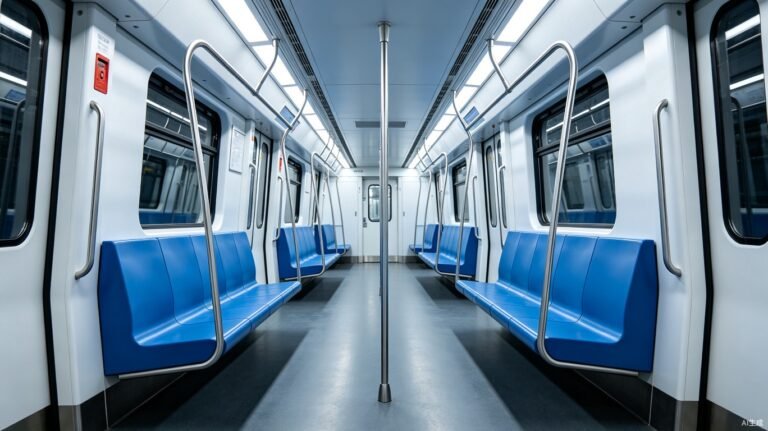
Public transit seating: materials must withstand daily passenger traffic, cleaning chemicals, and occasional vandalism
Frequently Asked Questions
Does silicone leather meet EN 45545 HL3 for underground rail?
Yes. Silicone leather’s inherent flame resistance — derived from the polymer structure, not chemical additives — allows it to pass HL3 requirements for smoke density and toxic gas emission. This is the highest hazard level, applicable to underground metros and sleeper cars where evacuation time is longest.
How often should railway seat leather be replaced?
PU and vinyl railway seat covers typically need replacement every 3–5 years depending on traffic volume and cleaning frequency. Silicone leather extends this to 7–10+ years under identical service conditions — a 2–3x improvement that significantly reduces lifecycle cost for fleet operators.
Specifying Railway Seat Leather That Lasts
Railway seat leather is one of the few upholstery applications where a specification failure can become a safety incident. The seven specs above — fire, abrasion, cleanability, vandalism, UV, cold flexibility, and smoke toxicity — form a complete evaluation framework that most supplier datasheets don’t fully address. Request test reports for all seven before approving any material for passenger rail service. The cost of a failed seat cover tender isn’t just replacement material — it’s delivery delays, compliance re-testing, and passenger safety exposure during the gap.
Get a Custom Quote for Rail Transit Leather
About TOPSUN
TOPSUN supplies silicone leather for railway seat applications across high-speed rail, metro, and tram networks where EN 45545 fire compliance and 100,000+ cycle abrasion resistance are mandatory.
Our materials are certified to EN 45545-2, FAR 25.853, and ISO 10993, with zero flame retardant additives and inherent smoke toxicity compliance for all hazard levels.