When a supplier emails you a PVC PU leather quote at $3.20 per square meter, the number looks like a win. It rarely is. Procurement teams evaluating synthetic leather for automotive interiors, contract furniture, or consumer electronics routinely compare PVC and PU on unit price alone, then absorb the real cost in warranty claims, re-upholstery cycles, and compliance documentation years later. This guide breaks down the pvc pu decision the way a sourcing manager actually lives it: raw material price, hidden performance gaps, compliance burden, and total cost of ownership. We also map where silicone leather fits as a premium alternative that lowers lifetime cost.
Request a Lifecycle Cost Breakdown
Why PVC PU Price Quotes Hide the Real Cost
The unit price on a PVC PU leather quote is the tip of the iceberg. It covers resin, coating, lamination, and a thin margin for the converter. What it never itemizes is the cost you carry downstream: warranty reserves, replacement labor, third-party compliance testing, label revisions when a regulation tightens, and end-of-life disposal fees. A quote that wins on cost per square meter can lose badly on cost per year of service life.
In our experience reviewing B2B specs, the buyers who get burned are the ones who normalize quotes to a single line item. The procurement teams that hold margin do the opposite. They model pvc pu leather cost per square meter against expected service life, replacement frequency, and the compliance documentation each material demands. That reframing is the difference between a spec that looks cheap at the PO stage and one that stays cheap through the program.
One furniture program we reviewed replaced a $3.50/m2 PVC spec after three years of cracking and plasticizer bloom. A $9/m2 silicone spec in the same line is now in year seven with zero field failures. The per-year cost flipped in silicone’s favor by year four.

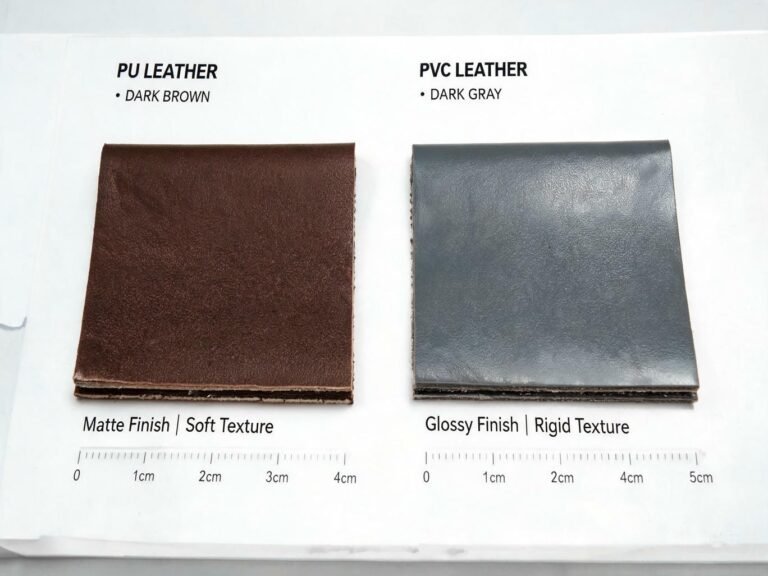
Color and texture consistency directly affect rejection rates and rework cost in volume production.
Performance Gaps That Drive Replacement Cycles
The reason PVC PU specs fail early is not mystery, it is chemistry. PVC relies on phthalate plasticizers to stay flexible. Over time those plasticizers migrate to the surface, volatilize, and leave the film brittle. The result is cracking, sticky bloom, and embrittlement, often within two to four years in warm or sun-exposed environments. PU leather is softer and more breathable, but its polyester or polyether backbone is vulnerable to hydrolysis resistance failure: humidity and heat break the urethane bonds, causing peeling, delamination, and tackiness.
Here’s why this matters for sourcing. A material that fails in year three is not three times cheaper than one that lasts nine years, it is three times more expensive on a per-year basis, before you count the labor and downtime of the swap. If you want a deeper read on the difference between faux leather and PU failure modes, the pattern is consistent: the cheaper the upfront chemistry, the shorter the replacement cycle.

Premium swatches hold their hand and color far longer than budget PVC PU grades.
The Compliance Burden Hidden in the Unit Price
Compliance is where PVC PU quotes quietly grow a tail. PVC needs phthalate plasticizers like DEHP and DINP, substances restricted under EU REACH and flagged on California Proposition 65. PU is often solvent-processed with DMF (dimethylformamide), a reproductive toxicant on the REACH SVHC candidate list. None of that shows up on a price-per-meter line, yet all of it shows up on your documentation load.
Every shipment can trigger requests for SVHC statements, phthalate panels, DMF residue tests, VOC emission data, and end-market certifications. If you ship to the EU, the compliance cost per program easily runs into five figures once you factor in re-testing when a regulation tightens. Suppliers that cannot supply this paperwork simply pass the liability to you. For a wider view of where PVC leather alternatives are heading under tightening chemical rules, the direction is unmistakably away from plasticizer-dependent chemistries.
See how silicone leather removes the compliance overhead that PVC PU specs carry into production.
Get Supplier Evaluation Checklist
A PVC PU Sourcing Checklist for Procurement Teams
Before you sign off on any PVC PU leather spec, run it through this checklist. Each item maps to a cost that the quote will not surface on its own:
- Request full SVHC and phthalate test reports, not just a generic certificate of conformance.
- Demand hydrolysis aging data, for example 28-day humid-heat exposure, not a one-line “weather resistant” claim.
- Confirm plasticizer type and ask for plasticizer migration test results; migration is what turns a flexible film into a cracking one.
- Verify the end-of-life pathway and recyclability claim, since mixed PVC and plasticizer waste is costly to dispose of.
- Lock multi-year raw-material price-stability clauses so resin volatility does not reopen your cost model mid-program.
The table below compresses the same logic into a side-by-side you can drop into a sourcing review. It is built around the factors that actually move total cost, not the ones that look good in a brochure.
| Factor | PVC Leather | PU Leather | Silicone Leather |
|---|---|---|---|
| Raw Material Cost/m2 | Lowest ($2-5) | Mid ($4-8) | Higher ($8-15) |
| Service Life (years) | 2-4 | 3-6 | 8-12+ |
| Plasticizer Migration | High (phthalates leach) | Low to moderate | None |
| Hydrolysis Resistance | Poor | Moderate (fails humid) | Excellent |
| End-of-Life Recyclability | Difficult | Limited | Recyclable, non-toxic |
| Compliance Cost | High (REACH, phthalate, VOC) | Moderate (DMF, VOC) | Low (inherently compliant) |

Application fit decides which material is cheapest across a real usage cycle.
Why Silicone Leather Lowers Total Cost of Ownership
Silicone leather is not the cheapest material on the quote sheet, and it is not trying to be. It is the material that wins on total cost of ownership once you stop measuring at the factory gate and start measuring across the program. Because the silicone polymer contains no plasticizers and no DMF, there is nothing to migrate, volatilize, or leach out. The film stays flexible and stable for eight to twelve years or more, even under UV, heat, and humidity that would age PVC PU grades into failure.
That longevity is what flips the math. A higher unit price amortized over a service life two to four times longer produces a lower cost per year, before you count the compliance savings. Silicone’s inherent chemistry means the documentation load shrinks: no phthalate panels, no DMF residue tests, far fewer re-tests when a rule changes. If you are weighing silicone vs PU or looking at the full silicone leather vs PU vs PVC picture, the total cost of ownership crossover typically lands around year four or five of a program.
Frequently Asked Questions
Is PVC or PU leather cheaper over a 5-year lifecycle?
Neither wins on total cost. PVC cracks as plasticizers migrate, and PU hydrolyzes in humid conditions. Both typically need replacement within three to six years, so the lower unit price is offset by re-purchase and re-labor. Silicone leather often beats both on cost-per-year by year four or five.
What compliance documents should I demand from a PVC PU supplier?
Ask for a REACH SVHC statement, phthalate (for PVC) and DMF (for PU) test reports, VOC emission data for your end market, and a hydrolysis aging test report. If a supplier cannot supply these, the real compliance cost falls on you. Reference the latest REACH candidate list at the European Chemicals Agency.
Does silicone leather really cost less than PVC PU long-term?
On unit price, no. On total cost of ownership, frequently yes. Factor in a service life of eight to twelve-plus years, zero plasticizer-migration liability, and minimal compliance documentation, and the crossover usually lands around year four or five of a program.
The Bottom Line for Sourcing Teams
The PVC PU comparison only tells the truth when you run it on total cost of ownership, not unit price. PVC wins on the quote line and loses on replacement cycles and phthalate compliance. PU is softer but hydrolyzes, and its DMF burden adds documentation cost every shipment. Silicone leather costs more upfront yet pays back in service life, compliance simplicity, and predictable multi-year costing. Run your next spec on cost per year of service life, and the right material becomes obvious.
Request Silicone vs PVC PU Samples
About TOPSUN
TOPSUN manufactures silicone leather for B2B buyers who need defensible total cost of ownership across automotive interiors, contract furniture, medical devices, and marine applications.
Plasticizer-free, DMF-free formulations with REACH, RoHS, and OEKO-TEX documentation; hydrolysis resistance validated beyond 10 years in accelerated aging; in-house silicone compounding that buffers raw-material price swings; PPAP- and IMDS-ready documentation for regulated sourcing pipelines.