As a compliance officer, I review material safety documentation for furniture and automotive supply chains. When procurement teams hand me a spec sheet listing polyvinyl chloride leather, I don’t look at the price per meter first. I look at the phthalate content, the VOC emission data, and the regulatory timeline. Because the invoice price is the cheapest part of PVC leather — the compliance costs come later, and they’re escalating fast.
REACH has restricted 12+ phthalates commonly used in PVC leather production. Phase-out deadlines are hitting in 2026-2027. If your supply chain still specifies polyvinyl chloride leather, here’s what the next 24 months look like — and what compliance will actually cost you.
Request Compliance Documentation
What’s Actually in Polyvinyl Chloride Leather?
Polyvinyl chloride leather is made by polymerizing vinyl chloride monomer — a known human carcinogen per IARC Group 1 — and then adding plasticizers to make it flexible. Those plasticizers are typically phthalates: DEHP, DBP, BBP, DINP, DIDP, and others. The EU has restricted most of these under REACH Annex XVII. The US has restricted them in children’s products under CPSIA. And the list keeps growing.
When I review polyvinyl chloride leather phthalate declarations, I see three patterns. Cheapest PVC contains restricted phthalates at concentrations above REACH limits — illegal in the EU. Mid-range PVC uses replacement plasticizers like DINCH, which are currently allowed but face scrutiny. Premium PVC claims “phthalate-free” but still uses chlorine chemistry and solvent-based production. None of these options eliminates the fundamental problem: PVC’s chlorine backbone creates dioxins when burned, and its plasticizer additives migrate out over time.

Environmental controls in the production workshop — PVC leather manufacturing requires strict VOC management that adds cost.
The Compliance Cost Hidden in Polyvinyl Chloride Leather Pricing
Here’s what procurement teams miss: the per-meter price of PVC leather doesn’t include compliance costs. Those hit later — when third-party testing is required, when reformulation is needed to meet new REACH restrictions, when products are rejected at customs, or when a customer demands a material change mid-contract.
| Cost Factor | PVC Leather | Silicone Leather | Annual Impact |
|---|---|---|---|
| Third-party phthalate testing | Required per batch | Not applicable | $0.15–0.30/m |
| REACH SVHC screening | Required annually | Pass — no SVHC | $2,000–5,000/year |
| Reformulation cost | Likely 2026-2027 | Not applicable | $15K–40K per change |
| Customs rejection risk | Moderate–High | Very low | Shipment delays |
| VOC emission testing | Required (high VOC) | Near-zero — exempt | $1,500–3,000/batch |
Add these costs to the PVC leather unit price and the picture changes. A PVC leather quoted at $3.50/meter can effectively cost $4.20–$4.80/meter once compliance overhead is factored in. Silicone leather starts higher on the invoice but carries near-zero compliance overhead — no phthalates to test for, no SVHC to screen, no reformulation risk.
Compliance reality: One automotive client spent $28,000 reformulating their PVC interior leather after DINP was added to the REACH Candidate List in 2023. The reformulation took 14 weeks. During that time, production was halted. The total cost — reformulation + downtime + lost revenue — exceeded $200,000. That’s not on the PVC price quote.
REACH Phase-Out Timeline: What Changes in 2026-2027
The PVC leather VOC emissions profile and phthalate content are why the regulatory net is tightening. Here’s the timeline I track for clients:
- 2026 Q1: REACH Annex XVII updates restrict additional orthophthalates in articles
- 2026 Q3: EU PVC restriction proposal under REACH Annex XV — scope includes plasticized PVC in furniture and automotive
- 2027: Expected restriction on PVC in articles above certain concentration thresholds
- 2027-2028: US EPA TSCA evaluations on remaining phthalates used in PVC
For silicone leather, none of these deadlines apply. Silicone chemistry doesn’t use phthalates, plasticizers, or chlorine. It passes REACH SVHC screening by default. It’s FDA food-contact certified. When I compare compliance trajectories, PVC is moving toward restriction while silicone is moving toward acceptance. That’s a fundamental supply chain risk difference.
See the eco-certifications that make silicone leather REACH-compliant by design — no phthalates, no chlorine, no compliance overhead.

Release film roller on the silicone leather coating line — solvent-free production eliminates VOC compliance burden.
Why Procurement Teams Are Moving to PVC-Free Materials
The shift away from polyvinyl chloride leather isn’t just about regulation — it’s about risk management. When I audit supply chains for polyvinyl chloride leather safety concerns, I look at three risk categories: regulatory risk (will this material be restricted?), reputational risk (will customers accept PVC in the product?), and operational risk (will reformulation disrupt production?).
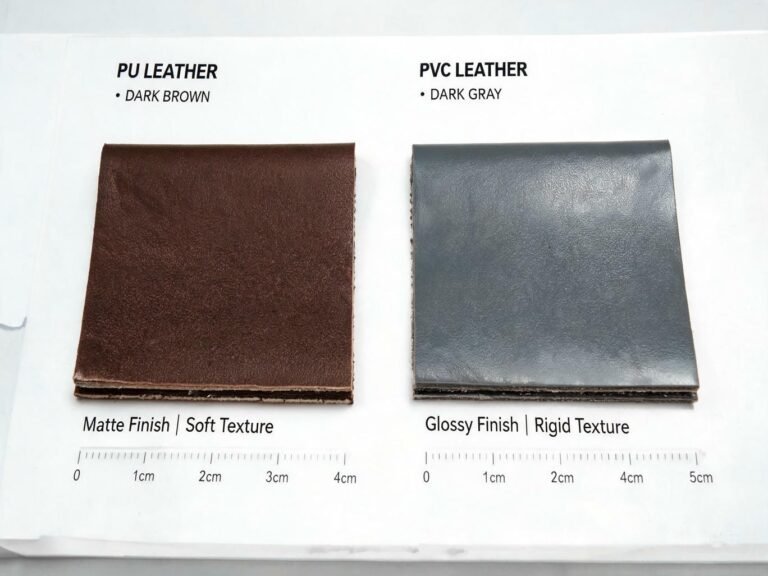
The shift to PVC-free materials is accelerating because all three risks are increasing simultaneously. EU restrictions tighten every year. Consumer awareness of PVC’s health and environmental impact is growing. And every reformulation cycle costs more than the last. Forward-looking procurement teams are making the switch now — before compliance deadlines force a rushed, expensive transition. The comparison between PU and PVC leather also shows that neither synthetic option eliminates the underlying chemical risk the way silicone does.

Release film rolls ready for the coating line — part of the solvent-free silicone leather production process.

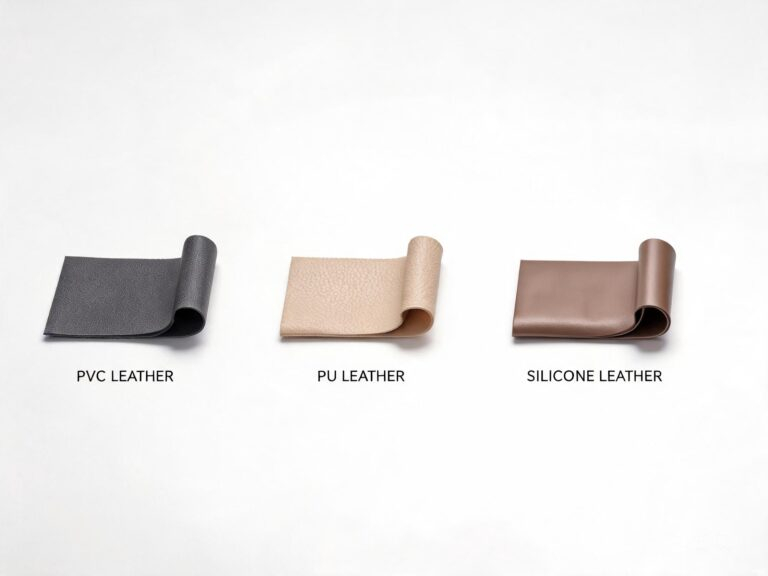
PVC leather texture closeup — visually similar to silicone, but chemically worlds apart.
Frequently Asked Questions
Is polyvinyl chloride leather toxic?
PVC leather itself is a finished product, but its chemical composition raises concerns. Vinyl chloride monomer — the building block of PVC — is a IARC Group 1 carcinogen. Phthalate plasticizers used to make PVC flexible can migrate out of the material over time and are linked to endocrine disruption. When burned, PVC releases dioxins. REACH restricts multiple phthalates used in PVC. While finished PVC products aren’t acutely toxic in normal use, the cumulative health and environmental concerns are driving regulatory phase-outs across the EU and US.
Is PVC leather being banned?
PVC leather isn’t banned outright, but it’s being restricted incrementally. The EU REACH regulation restricts specific phthalates used in PVC, and a broader restriction on PVC in articles is under proposal. The US CPSIA restricts phthalates in children’s products. Several major brands have voluntarily phased out PVC. The trajectory is clear: the regulatory window for PVC leather is closing. B2B buyers specifying PVC today should have a transition plan.
The Compliance Equation
Polyvinyl chloride leather looked cheap because the costs were deferred. Testing, reformulation, customs delays, regulatory compliance — those weren’t on the price quote. But they’re on the invoice now, and they’re growing. When you add compliance overhead to the base price, PVC leather’s cost advantage shrinks dramatically. When you add regulatory risk, it disappears entirely.
The procurement teams I work with are redefining “cost” — not as price per meter, but as total compliance burden plus replacement risk. By that measure, polyvinyl chloride leather is the most expensive material in the spec sheet. The question isn’t whether to transition away from PVC. It’s whether you transition on your schedule or on the regulator’s.
Download REACH Compliance Checklist
About TOPSUN
TOPSUN manufactures PVC-free silicone leather for B2B buyers across automotive, furniture, and healthcare industries who need materials that pass REACH, RoHS, and FDA compliance without the phthalate liability and reformulation risk associated with chlorine-based chemistry.
Zero VOC emissions verified · No plasticizers or phthalates · FDA food-contact certified · ISO 10993 biocompatible · REACH SVHC-free by chemistry