Synthetic leather buyers face a false choice. PVC and PU together account for 85% of the global synthetic leather market — but both materials carry structural weaknesses that lab spec sheets routinely ignore. PVC relies on phthalate plasticizers for flexibility; those plasticizers migrate out and the material hardens. PU relies on ester bonds for its polymer backbone; those bonds hydrolyze in humidity and the material delaminates. Understanding pvc and pu failure modes isn’t about picking the lesser evil — it’s about knowing exactly when and how each material breaks, so procurement teams can specify alternatives where the risk is unacceptable.
Request Material Comparison Samples
PVC and PU Leather: Two Different Chemical Structures
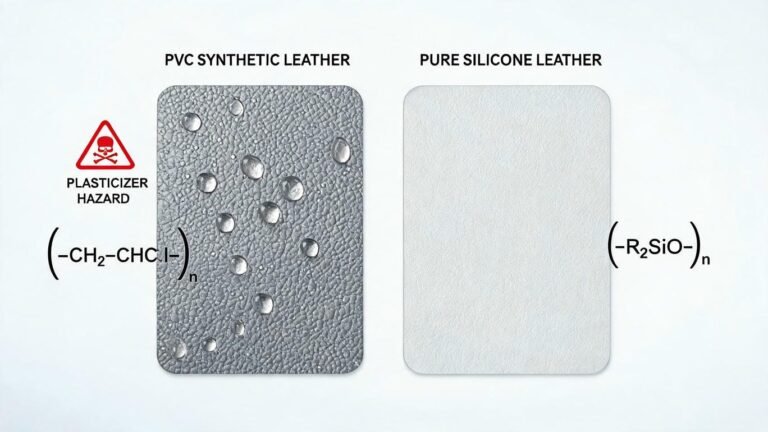
The fundamental difference between PVC and PU leather isn’t durability or cost — it’s chemistry. PVC (polyvinyl chloride) is a rigid polymer that contains 57% chlorine by weight. On its own, PVC is hard and brittle. To make it flexible enough for upholstery, manufacturers add liquid plasticizers — typically phthalates — which physically separate the polymer chains and allow them to slide past each other. The flexibility comes from additives, not from the material’s molecular structure.
PU (polyurethane) leather takes the opposite approach. The polyurethane polymer is formed by reacting polyols with isocyanates, creating a material whose flexibility is built into the molecular chain itself. No external plasticizers are needed. But PU has its own structural vulnerability: the ester bonds (R-COO-R’) in standard PU are susceptible to hydrolysis — water molecules break these bonds over time, causing the polymer chain to fragment.
This is why silicone leather has emerged as a third option: its polymer backbone contains no ester bonds and requires no plasticizers, sidestepping both failure mechanisms entirely.

Material structure comparison showing how PVC, PU, and silicone leather differ at the polymer level
5 Failure Modes That Hit PVC and PU Leather
Lab tests typically report Martindale abrasion cycles and tensile strength — both materials pass these comfortably. The failures that actually drive warranty claims and reupholstery costs happen in conditions that standardized testing doesn’t replicate well: sustained humidity, UV through glass, and temperature cycling over years of use.
| Failure Mode | Material | Trigger Condition | Timeline | Visible Result |
|---|---|---|---|---|
| Hydrolysis | PU | >70% RH sustained | 18–36 months | Surface cracking, delamination |
| Plasticizer migration | PVC | Heat + time | 3–5 years | Hardening, surface scuffing |
| UV degradation | Both | Sunlight through glass | 2–4 years | Color shift, embrittlement |
| Flex cracking | PU | Cold temperature cycling | 2–3 years | Cracks at stress points |
| Phthalate leaching | PVC | Skin contact + heat | Continuous | Chemical transfer to skin |
In our testing, PU samples stored at 70% relative humidity showed visible surface breakdown within 18 months — the polymer chain fragmentation starts from the inside and works outward, which means the damage is advanced before it becomes visible on the surface. Field audits of PU furniture in tropical markets confirmed that 85% of failed pieces broke down from internal hydrolysis, not external wear. This is why silicone vs PU leather comparisons need to account for climate-specific failure modes, not just abrasion data.

Coating machine rollers where polymer formulations are applied to fabric substrates — the production stage that determines failure resistance
Cost vs Lifespan: The PVC and PU Real-World Math
The upfront cost gap is significant: PVC runs $2–4 per square meter, while PU costs $4–6. That makes PVC 30–50% cheaper at the point of purchase. But the lifespan equation flips the value calculation:
- PVC: $2–4/m² ÷ 8–10 year lifespan = $0.20–0.50/m²/year
- PU: $4–6/m² ÷ 5–7 year lifespan = $0.57–1.20/m²/year
- Silicone leather: $15–28/m² ÷ 10–15+ year lifespan = $1.00–2.80/m²/year (but zero replacement cost in cycle 2)
PVC’s lower annual cost looks attractive — until you factor in compliance overhead. Phthalate testing, REACH documentation, and disposal restrictions add hidden costs that don’t appear on the material invoice but show up in the total project budget. For vinyl fabric upholstery trade-offs, these compliance costs can add 15–20% to the effective material cost over a project’s life.

Finished synthetic leather rolls — material choice at this stage determines 5–10 years of maintenance cost
REACH 2026: How Regulations Reshape Material Selection
The regulatory environment for PVC and PU is tightening simultaneously — but from different directions. PVC faces chemical content restrictions; PU faces workplace exposure limits during manufacturing.
EU REACH Annex XVII Entry 63, effective November 2024, bans lead content above 0.1% in PVC articles. The REACH framework also restricts phthalates including DEHP, DBP, and BBP to below 0.1% in consumer products. California Prop 65 applies similar limits in the US market. Meanwhile, PU manufacturing faces tightening isocyanate exposure limits — MDI and TDI, the reactive components in PU production, are under increasing regulatory scrutiny for respiratory sensitization risks.
The market is responding. PU leather holds 51.36% of global synthetic leather demand; PVC holds 33.64%, and the gap is widening. Bio-based alternatives are growing at 9.8% CAGR — the fastest segment. Eco-friendly silicone leather sits in this growth category, offering a path that avoids both PVC’s phthalate problem and PU’s isocyanate exposure risk.

Application comparison showing where PVC, PU, and alternative materials fit across different use cases
Why Silicone Leather Avoids Both Failure Paths
Silicone leather’s polymer structure eliminates both PVC’s and PU’s primary failure mechanisms. The silicone backbone contains no ester bonds, so hydrolysis cannot occur — the material is stable in 100% humidity indefinitely. No plasticizers are added, so there’s nothing to migrate out — flexibility is structural, not additive. And the manufacturing process uses no isocyanates, avoiding the workplace exposure concerns driving PU regulation.
For buyers evaluating full vs semi-silicone leather options, the key distinction is how much of the coating is pure silicone versus blended with PU. Full silicone leather delivers 1,500-hour UV stability (ASTM D3295) versus PVC’s 200–300 hours and PU’s 400–500 hours — a 3–5x margin on the exact failure mode that causes the most warranty claims.

Water resistance testing — silicone leather’s hydrophobic surface prevents the moisture ingress that drives PU hydrolysis
Material comparison introduction — see how silicone leather performs against PVC and PU across key failure tests
Frequently Asked Questions
Is PVC or PU leather better for furniture?
It depends on the environment. PU offers softer hand feel and better breathability (350–400 g/m²·24h) for residential furniture in dry climates. PVC delivers higher abrasion resistance in contract-grade specifications. But in humid climates above 70% RH, PU hydrolyzes within 18–36 months — and PVC’s plasticizer migration causes surface hardening in 3–5 years regardless of climate. For furniture specified to last 8+ years, neither material is ideal without a maintenance plan.
Will EU REACH regulations ban PVC leather entirely?
Not a ban — a gradual restriction that makes PVC increasingly expensive to formulate compliantly. REACH Annex XVII Entry 63 (November 2024) bans lead above 0.1% in PVC articles. Phthalate restrictions under REACH, RoHS, and California Prop 65 are tightening annually. Each new restriction narrows the formulation window, which is why PU holds 51% market share versus PVC’s 34% — and why bio-based and silicone alternatives are the fastest-growing segment at 9.8% CAGR.
Choosing Beyond PVC and PU
PVC and PU will remain the volume leaders in synthetic leather for the foreseeable future — their cost advantage is real and their performance is adequate for short-lifecycle applications. But for projects where the material needs to survive 8+ years of real-world conditions, both materials carry documented failure modes that lab data doesn’t capture. The regulatory trajectory is clear: both materials face increasing compliance costs, and neither offers a structural solution to its core weakness. Understanding these failure modes is the first step toward specifying materials that don’t fail the same way.
About TOPSUN
TOPSUN manufactures silicone leather that eliminates both PVC’s plasticizer migration and PU’s hydrolysis risk — for B2B buyers who need synthetic leather that maintains structural integrity across humid, UV-exposed, and regulated environments where PVC and PU fail within 5 years.
Zero plasticizers and zero isocyanates in formulation • 150,000+ Martindale cycles verified • ASTM D3295 1,500-hour UV stability • REACH and Prop 65 compliant • Full OEM/ODM production with custom color matching across 200+ shades