The PVC and leather sourcing landscape has shifted beneath buyers’ feet. In November 2024, EU REACH Annex XVII Entry 63 banned lead content above 0.1% in PVC articles — effective immediately for new production. Phthalate restrictions under Entries 51 and 52 continue tightening, with enforcement expanding beyond toys into furniture, automotive, and consumer goods. For B2B buyers specifying PVC and leather materials, the question is no longer “is PVC cheaper?” but “will this material pass compliance audit in 18 months?” In our regulatory tracking, three specific regulations are making conventional PVC leather non-compliant in markets that matter — and most buyers don’t realize they’re exposed until a shipment is held at customs.
Request PVC-Free Compliance Kit
PVC and Leather: The Regulatory Gap Widening in 2026
PVC leather has dominated budget upholstery for decades — marine seating, commercial furniture, automotive door panels, and fashion accessories all relied on its low cost, waterproof surface, and adequate abrasion resistance. But the chemistry that made PVC cheap is what makes it non-compliant. PVC requires up to 40% plasticizers by weight to achieve flexibility, and those plasticizers — primarily ortho-phthalates like DEHP, DBP, and BBP — are exactly what regulators are restricting.
The gap between PVC and leather alternatives isn’t just about performance anymore. It’s about legal exposure. A furniture brand that specifies PVC leather for a product line sold in the EU now carries compliance risk that didn’t exist two years ago. The European Chemicals Agency’s REACH restrictions are expanding, not contracting. In our compliance audits, we’ve found that buyers often confuse “PVC-free” marketing claims with actual third-party verified compliance — a gap that becomes expensive when a product liability claim emerges. For a broader material overview, see our silicone leather introduction.

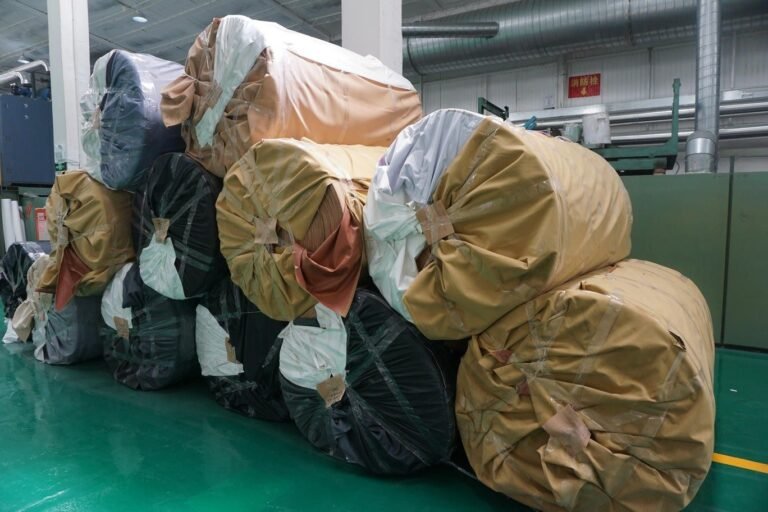
Calendering equipment — the production stage where PVC plasticizer content is determined and documented.
3 Regulations That Make PVC Leather Non-Compliant
Our compliance team monitors regulatory changes across 40+ markets. These three regulations are the most impactful for B2B buyers specifying PVC and leather materials:
| Regulation | Scope | PVC Impact | Silicone Status |
|---|---|---|---|
| REACH Entry 51 & 52 | Phthalates (DEHP, DBP, BBP, DIBP, DINP, DIDP, DNOP) ≤ 0.1% | PVC leather typically exceeds limits | Phthalate-free — inherently compliant |
| REACH Entry 63 (Nov 2024) | Lead content ≤ 0.1% in PVC articles | Lead stabilizers common in PVC | No lead — no stabilizers needed |
| CA Prop 65 + RoHS | Heavy metals, phthalates in consumer products | Requires reformulation or exemption | Compliant without modification |
The REACH Entry 63 lead ban deserves specific attention. PVC leather manufacturers traditionally used lead-based heat stabilizers during processing. The November 2024 amendment eliminated the transition period for new production — meaning any PVC leather manufactured after that date must use alternative stabilizers (calcium-zinc or organic-based), which typically cost more and may affect material performance. For furniture sofa applications and marine outdoor applications where PVC has been the default, this regulatory shift creates an opening for alternative materials.
PVC leather requires up to 40% plasticizers for flexibility — every gram of phthalate additive is a gram of compliance liability. Silicone leather needs zero plasticizers; its flexibility is intrinsic to the polymer.

Chemical mixing equipment — where PVC plasticizers and stabilizers are added. Silicone leather skips this stage entirely.
Why PVC Leather Fails Where Genuine Leather Ages
The comparison between PVC and leather often frames them as two synthetic options on a spectrum. But they fail in fundamentally different ways. Genuine leather ages — it develops patina, may show wear patterns, and eventually dries out. PVC leather doesn’t age; it degrades. Plasticizer migration causes the surface to harden and crack. The material doesn’t develop character; it loses structural integrity. In our testing, PVC leather samples exposed to 60°C surface temperature for 6 months showed measurable plasticizer loss and surface embrittlement.
The failure timeline for PVC leather in real-world applications: 6-18 months for UV-triggered cracking in outdoor settings, 2-4 years for plasticizer migration in indoor furniture, and 3-5 years for overall embrittlement in automotive interiors. Compare this to genuine leather’s 10-20+ year lifespan (with maintenance) or silicone leather’s 10+ year lifespan (maintenance-free). For a deeper comparison, see our silicone vs PU analysis — PVC shares PU’s organic coating vulnerability but adds the plasticizer problem on top.

PVC leather surface closeup — the material that’s losing regulatory approval across global markets.
The PVC-Free Path: Silicone Leather Compliance Profile
For B2B buyers moving away from PVC, silicone leather offers a compliance profile that requires no reformulation, no additive substitution, and no ongoing regulatory monitoring. The material is inherently PVC-free, phthalate-free, lead-free, and produces zero VOC emissions. It meets REACH, RoHS, CA Prop 65, and EN 71 toy safety requirements without modification. Its fire safety performance — EN 13773 Class 4, FMVSS 302 — is intrinsic to the silicone polymer, not achieved through chemical flame retardant additives that themselves face regulatory scrutiny.
In our export records, silicone leather shipments to EU markets clear customs with a documentation package that includes SGS third-party test reports for REACH SVHC compliance, RoHS heavy metal screening, and ISO 16000-6 VOC emission testing. PVC leather shipments to the same markets increasingly require additional compliance documentation — and still face border inspection risk. For more on our compliance certifications, see the certificates page and the PVC-free faux leather guide we’ve published.
Flame retardant certifications overview — see why silicone leather’s inherent fire safety eliminates the chemical additive compliance cycle that traps PVC.
Frequently Asked Questions
Is PVC leather still legal for furniture upholstery?
PVC leather is not banned outright for furniture upholstery, but it faces increasing regulatory restrictions that make compliance difficult and expensive. EU REACH Entry 51/52 limits phthalates to 0.1% — many conventional PVC leathers exceed this. REACH Entry 63 (November 2024) banned lead above 0.1% in PVC articles, eliminating traditional lead-based stabilizers. CA Prop 65 requires warning labels for products containing listed chemicals. While PVC leather can theoretically be reformulated with alternative plasticizers and stabilizers, the cost increases and performance trade-offs make it increasingly uncompetitive against materials like silicone leather that are inherently compliant. For eco-friendly alternatives, see our eco-friendly silicone leather page.
What makes silicone leather a better alternative to PVC?
Silicone leather outperforms PVC in three critical areas: compliance, durability, and safety. Compliance-wise, silicone contains no phthalates, no lead, no plasticizers, and produces zero VOC — meeting REACH, RoHS, and Prop 65 without reformulation. Durability-wise, silicone leather achieves 200,000+ Martindale cycles vs PVC’s typical 50,000-100,000, and its Si-O backbone resists hydrolysis and UV degradation that cause PVC to crack. Safety-wise, silicone is inherently flame retardant (self-extinguishing, non-toxic smoke) while PVC releases hydrogen chloride when burned. The trade-off is unit cost — silicone costs more per meter — but the total cost of ownership favors silicone when compliance, replacement frequency, and liability risk are factored in.
Compliance Is the New Price War
The B2B leather market used to compete on price per meter. In 2026, it competes on compliance per shipment. PVC leather’s low unit cost evaporates when you add the cost of phthalate testing, lead content certification, reformulation engineering, and border delay risk. The material that ships with a complete compliance package — REACH, RoHS, Prop 65, zero-VOC, EN 13773 Class 4 — without a single chemical additive is silicone leather. When your next PVC and leather sourcing decision comes across your desk, ask not what the material costs per meter. Ask what it costs per compliance audit. The answer will send you to silicone.
Download Regulatory Spec Sheet
About TOPSUN
TOPSUN manufactures PVC-free silicone leather for furniture, automotive, marine, medical, and consumer goods brands transitioning away from PVC and leather materials that face tightening phthalate, lead, and VOC regulations across global markets.
REACH compliant, RoHS compliant, CA Prop 65 compliant, phthalate-free, lead-free, zero-VOC, EN 13773 Class 4 — all certifications backed by SGS and Intertek third-party test reports.