A European furniture importer learned the hard way in Q1 2026: their entire 12-container shipment of PU fabric leather was held at Rotterdam customs for 23 days. The reason? DMF residue tested at 14ppm — 4ppm above the EU REACH threshold that took full effect in December 2025. The supplier had promised “REACH compliant” material, but the solvent-based PU production line they used couldn’t consistently stay under 10ppm. The importer absorbed €47,000 in demurrage, reformulation, and expedited air freight for replacement material. This isn’t an isolated incident. It’s the new reality of sourcing PU fabric leather in 2026 — where regulatory compliance is no longer a checkbox but a supply chain survival question.
Request Compliant PU Leather Samples
What PU Fabric Leather Actually Is in 2026
PU fabric leather is a composite material: a woven or knitted fabric base (typically polyester or cotton) coated with a polyurethane layer that mimics the texture, grain, and hand-feel of genuine animal leather. It’s the workhorse of the synthetic leather industry — used in furniture upholstery, automotive interiors, footwear, bags, and fashion accessories. The global PU synthetic leather market is projected to grow steadily through 2034, driven by its balance of aesthetics, flexibility, and cost advantage over both genuine leather and PVC.
But “PU fabric leather” in 2026 is not one material — it’s a spectrum. At the bottom end, solvent-based PU uses dimethylformamide (DMF) to dissolve polyurethane resins for coating. At the top end, water-based PU replaces DMF entirely with water dispersions. In between, solvent-free PU and bio-based PU variations are emerging. These aren’t marketing distinctions — they determine whether your product clears customs, meets indoor air quality standards, and survives in the field. For a deeper comparison of polyurethane fake leather types and their trade-offs, the chemistry behind each grade directly determines its compliance profile.

PU coating line — where polyurethane resin is applied to fabric backing, determining material grade and compliance
The DMF Problem: Why Solvent-Based PU Faces Phase-Out
Dimethylformamide (DMF) is the chemical that made solvent-based PU fabric leather cheap and scalable. It dissolves polyurethane resin into a coatable solution that penetrates fabric backing, creating the porous, leather-like structure that gives PU its hand-feel. But DMF is classified as a substance of very high concern (SVHC) under EU REACH, with documented reproductive toxicity. As of December 2025, the transition period ended, and finished goods containing DMF residues above 10ppm are now non-compliant for import into the EU market. China’s synthetic leather industry green factory standard (T/CNIA 0134-2025) has also tightened VOC emission limits to ≤50g/m², forcing production lines to either upgrade or shut down.

Chemical mixing station — where PU resin solvents are prepared; DMF-free lines require different equipment
The practical impact for B2B buyers is this: solvent-based PU fabric leather from non-upgraded production lines carries real customs risk. The DMF residue level depends on the drying process efficiency, and older lines — particularly in lower-tier factories — cannot consistently achieve sub-10ppm results. A supplier may test clean on one batch and fail on the next, because DMF residue fluctuates with humidity, drying temperature, and fabric thickness. For buyers sourcing PU cloth material for EU-bound products, requesting per-batch DMF test reports is now baseline due diligence, not premium service.
Water-Based PU Fabric Leather: The Industry’s Pivot
Water-based PU fabric leather eliminates DMF by replacing organic solvents with water as the dispersing medium for polyurethane resin. The result is a material with zero hazardous solvent residues, zero VOC emissions during production, and full compliance with REACH SVHC restrictions. Leading brands in automotive, fashion, and furniture are shifting to water-based PU to meet ESG targets and secure EU market access.

Water-based PU production — eliminating DMF from the coating process for compliant material
But water-based PU is not a drop-in replacement. It has trade-offs that B2B specifiers need to understand. First, hydrolysis resistance: water-based PU retains ester linkages in its polymer structure, which means it still degrades in humid environments — the fundamental weakness of all PU leather. Water-based processing improves the safety profile, not the field durability. Premium grades can pass the Jungle Test (70°C, 95% RH) for 10+ weeks, but standard grades still begin surface breakdown within 18-36 months in tropical or high-humidity applications.
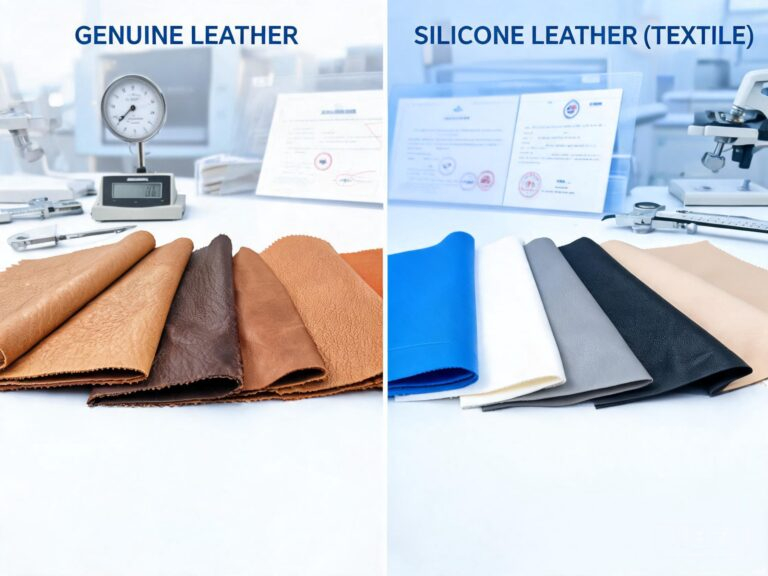
Second, cost. Water-based PU production requires different equipment — coagulation baths, drying tunnels calibrated for water evaporation rather than solvent recovery — and the capital investment translates to a 20-35% price premium over solvent-based PU. For buyers comparing synthetic leather vs PU leather options, the compliance premium of water-based PU narrows the cost gap with higher-grade alternatives like silicone leather — which is inherently DMF-free and solvent-free by chemistry, not by process.
PU Fabric Leather vs Silicone: The Compliance Gap
When B2B buyers evaluate PU fabric leather against silicone leather in 2026, the comparison is no longer just about durability or feel — it’s about regulatory trajectory. PU leather, even water-based, is fighting a defensive battle against tightening chemical regulations. Silicone leather is ahead of every current and proposed regulation because its chemistry (silicon-oxygen backbone) contains no DMF, no phthalates, no plasticizers, and no VOC-emitting solvents — by molecular nature, not by manufacturing workaround.

Scratch resistance testing — where silicone leather’s harder surface outperforms PU by 3-5x in cycle counts
| Compliance Factor | Solvent-Based PU | Water-Based PU | Silicone Leather |
|---|---|---|---|
| DMF residue | 10-30ppm (risky) | 0ppm (DMF-free) | 0ppm (inherent) |
| REACH SVHC | Non-compliant risk | Compliant | Compliant (exceeds) |
| VOC emissions (ISO 16000-6) | 40-80 g/m² | ≤50 g/m² (borderline) | Zero |
| Hydrolysis resistance | 2-3 years | 3-5 years | Immune (Si-O bond) |
| UV resistance | 500-800 hrs | 600-1,000 hrs | 2,000+ hrs |
| Cost per m² (bulk) | $3-$6 | $5-$9 | $12-$18 |
| Service life | 2-3 years | 3-5 years | 10+ years |
The cost gap between water-based PU ($5-$9/m²) and silicone ($12-$18/m²) is real. But when you factor in the total cost of ownership — replacement cycles, warranty claims, customs risk, and the regulatory trajectory that may further restrict PU chemistry in coming years — the calculus shifts. For applications where the material must last 7+ years in the field, understanding the PU vs PVC vs silicone hierarchy prevents the most expensive sourcing mistake: buying cheap material that becomes a liability.
What B2B Buyers Must Specify in 2026 PU Fabric Leather Orders
The 2026 procurement spec for PU fabric leather should include five non-negotiable items that most purchase orders still omit. First, DMF residue testing: demand per-batch test reports showing <10ppm for EU-bound goods, and specify the test method (typically GC-MS). Second, VOC emission data: require ISO 16000-6 results showing total VOC emissions below the applicable threshold (50g/m² for China, lower for specific EU markets). Third, hydrolysis resistance: request Jungle Test data (70°C, 95% RH, minimum 7-day exposure without visible cracking) and specify the minimum acceptable duration in weeks.
Fourth, thickness consistency: specify tolerance bands (e.g., 0.8mm ±0.05mm across full roll width) and require in-line quality data. Inconsistent thickness causes stitching failures, pattern mismatch, and surface irregularities that escalate in production. Fifth, certification chain: verify REACH compliance, OEKO-TEX Standard 100, and where applicable, GRS certification for recycled content claims. For guidance on PU and PVC material testing protocols, the testing methodology matters as much as the results — a self-declared “compliant” without third-party lab data is worth nothing at customs.

PU fabric leather in furniture upholstery — where compliance and durability determine warranty exposure
About TOPSUN: Silicone Leather Built Beyond Compliance
TOPSUN manufactures silicone-coated leather that exceeds every 2026 regulatory standard by chemistry, not by process. Our silicone leather contains zero DMF, zero phthalates, zero plasticizers, and emits zero VOCs — verified under ISO 16000-6. For B2B clients evaluating the transition from PU fabric leather to a material that won’t face future regulatory restrictions, we provide full lab documentation including REACH SVHC compliance, OEKO-TEX Standard 100 certification, and FMVSS 302 fire safety data. Our production facility runs solvent-free coating lines, and every batch ships with third-party verified test reports. We supply furniture manufacturers, automotive OEMs, and fashion brands across Europe, North America, and Asia with custom colors, textures, and specifications tailored to their compliance requirements.
Frequently Asked Questions
Is PU fabric leather still legal in the EU in 2026?
Yes, but with strict conditions. PU fabric leather is legal in the EU as long as DMF residues remain below 10ppm in finished goods. Solvent-based PU from non-upgraded production lines may fail this threshold. Water-based PU, which eliminates DMF from production, fully complies. B2B buyers should demand per-batch DMF test reports from their suppliers and specify the REACH SVHC compliance requirement explicitly in purchase orders.
How long does water-based PU fabric leather last compared to solvent-based?
Water-based PU typically lasts 3-5 years in normal indoor applications, compared to 2-3 years for solvent-based PU. The improvement comes from better polymer structure integrity in water-based processing, but the fundamental hydrolysis vulnerability of PU chemistry remains. Silicone leather, by contrast, lasts 10+ years because its silicon-oxygen backbone is immune to moisture-driven degradation.
What’s the price difference between PU fabric leather and silicone leather?
Solvent-based PU costs $3-$6/m², water-based PU costs $5-$9/m², and silicone leather costs $12-$18/m² in bulk. While silicone is 2-4x more expensive upfront, its 10+ year service life versus PU’s 2-5 years means total cost of ownership favors silicone by 30-50% over a decade — before factoring in warranty claims, replacement labor, and regulatory risk.
Can I request DMF test reports from my PU leather supplier?
Yes — and in 2026, you should. Reputable PU fabric leather suppliers provide per-batch GC-MS test reports showing DMF residue levels. If a supplier cannot or will not provide these reports, treat it as a red flag. The cost of third-party DMF testing (€150-300 per batch) is negligible compared to the cost of a customs hold or product recall. For high-volume orders, specify DMF testing as a contract requirement with batch-level traceability.
The PU fabric leather market in 2026 is at a regulatory crossroads. Solvent-based PU carries customs risk, water-based PU offers compliance at a premium but doesn’t solve the durability problem, and silicone leather represents the only material that is compliant, durable, and future-proof by chemistry. For B2B buyers, the question isn’t whether to continue sourcing PU fabric leather — it’s whether the material you specify today will still be importable, warrantable, and competitive in three years. Request lab reports, test for DMF, calculate total cost of ownership, and make the specification that protects your supply chain, not just your unit cost.