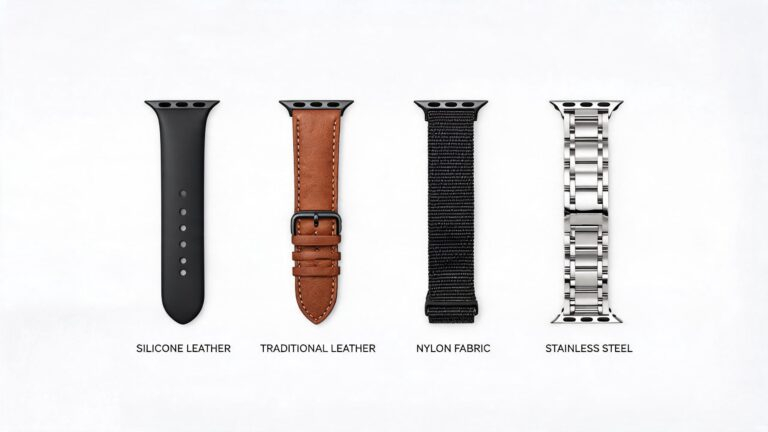
As a wearable product designer, I’ve tested every strap material on the market. The results are clear: genuine leather watch straps fail from sweat within 6–12 months. Fluoroelastomer (FKM) straps work — but they contain PFAS “forever chemicals” that major brands are now under pressure to eliminate. PU leather causes skin irritation in eczema-prone users. The material that solves all three problems — sweat resistance, skin safety, and PFAS-free chemistry — is silicone leather.
The smartwatch strap market is a microcosm of B2B material selection: a small surface area where every material property is amplified by 16+ hours of daily skin contact, continuous moisture exposure, and constant flex stress. What works for furniture upholstery fails on a wrist. What works for automotive trim fails against sweat. The material requirements for wearable straps are uniquely demanding — and uniquely suited to silicone leather’s property profile.
The wearable material problem: Skin contact + sweat + flex + UV = the harshest material environment in consumer electronics. Genuine leather degrades from sweat oils. PU leather causes phthalate-related dermatitis. Fluoroelastomers contain PFAS. Silicone leather is ISO 10993-5 biocompatibility certified, phthalate-free, PFAS-free, and sweat-resistant — by material design, not by coating.
The 4 Strap Materials Compared for Wearables
| Property | Genuine Leather | PU Faux Leather | Fluoroelastomer (FKM) | Silicone Leather (TOPSUN) |
|---|---|---|---|---|
| Sweat resistance | Poor — salt & oils degrade in 6–12 months | Poor — hydrolysis from moisture | Excellent | Excellent — non-porous, hydrolysis-proof |
| Skin safety / hypoallergenic | Moderate — chrome tanning residue risk | Poor — phthalate migration causes dermatitis | Moderate — PFAS content under scrutiny | Excellent — ISO 10993-5 biocompatibility certified |
| Flex resistance (daily wear) | 10,000–30,000 cycles | 10,000–30,000 cycles | 50,000+ cycles | 50,000–100,000+ cycles |
| UV resistance (outdoor wear) | Poor — fades & cracks in sun | Poor — 200–400 hours | Good | Excellent — 1,000+ hours no fading |
| Temperature comfort | Breathable but absorbs sweat | Non-breathable, traps heat | Non-breathable | Breathable, non-porous surface |
| Pfas / forever chemicals | No | No (but phthalate risk) | Yes — PFAS content | No — PFAS-free, phthalate-free |
| Minimum thickness | 1.0mm+ (hide limitation) | 0.6mm+ | 1.5mm+ (molding limitation) | 0.23mm (ultra-thin collection) |
| Expected strap life | 6–12 months (sweat degradation) | 4–8 months (hydrolysis) | 2–3 years | 3–5+ years |

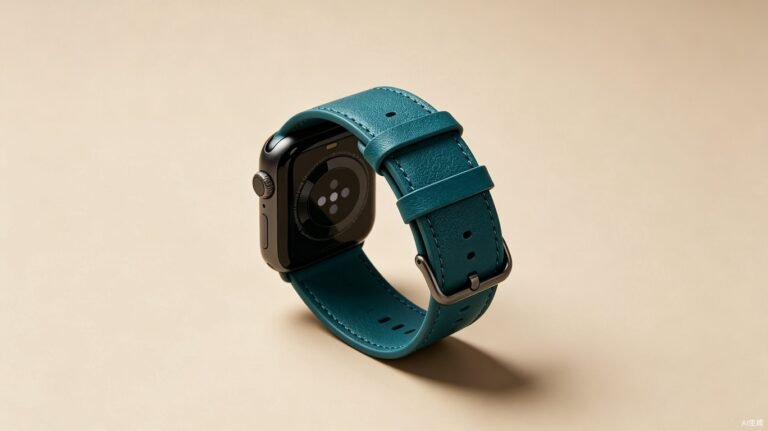
Ultra-soft silicone leather — foldable, skin-friendly, and sweat-resistant for wearable strap applications.
Why Genuine Leather Watch Straps Fail
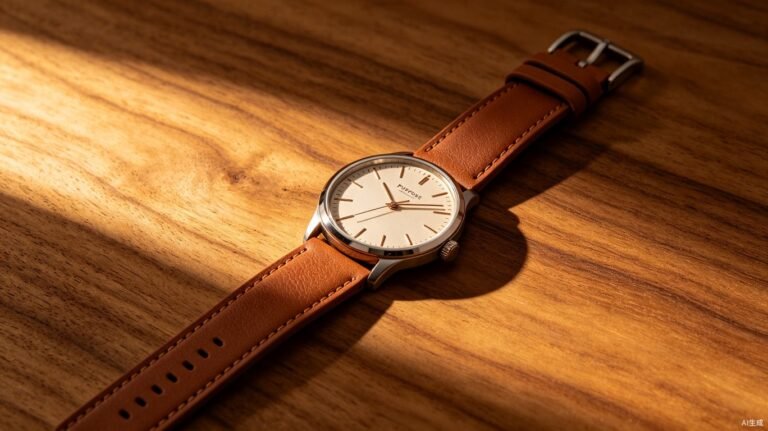
Genuine leather watch straps — typically calfskin or vegetable-tanned cowhide — fail for three predictable reasons:
1. Sweat Oil Degradation
Human sweat contains sebum (skin oils), salt, and urea. These compounds penetrate genuine leather’s porous surface and break down the tanning agents over 6–12 months. The leather first becomes discoloured at contact points (wrist-side), then flexible but weak (tanning agents degraded), then brittle and cracking. No amount of conditioning fully reverses this — it’s chemical degradation, not drying.
2. Chrome Tanning Residue
Chrome-tanned leather (80%+ of watch straps) can leach chromium III, which oxidizes to chromium VI on skin contact — a known sensitiser that causes allergic contact dermatitis. For users with sensitive skin or existing metal allergies, this manifests as wrist rash within weeks of daily wear. ISO 10993-5 biocompatibility testing isn’t standard for genuine leather straps — it’s assumed safe because it’s “natural.”
3. Dimensional Instability
Leather absorbs moisture, expanding and contracting with humidity changes. On a watch strap, this means the strap loosens in humid conditions and tightens in dry conditions — inconsistent fit that degrades the user experience. The strap hole elongates over time, eventually causing the buckle to slip.

Silicone leather texture closeup — fine grain detail that mimics premium leather while remaining non-porous and sweat-resistant.
The PFAS Problem: Why Fluoroelastomer Isn’t the Answer
Fluoroelastomer (FKM) straps — used by Apple, Google, and Samsung for their sport bands — solve the sweat and durability problems but introduce a new one: PFAS (per- and polyfluoroalkyl substances). A 2024 investigation found that major smartwatch bands contain fluoroelastomers classified as “forever chemicals” — persistent in the environment and under increasing regulatory scrutiny globally.
For B2B product teams, this creates a material selection dilemma: genuine leather fails from sweat, PU causes skin irritation, and fluoroelastomer raises PFAS compliance risk. Silicone leather is the only material that passes all three tests — sweat-resistant, skin-safe (ISO 10993-5), and PFAS-free.
Regulatory horizon: EU REACH is expanding PFAS restrictions. California’s AB 1200 restricts PFAS in consumer products. Major brands are actively seeking PFAS-free alternatives for wearable materials. Silicone leather — with its inherent chemical stability, no PFAS content, and ISO 10993-5 biocompatibility — is positioned as the compliance-ready alternative.
Silicone Leather for Smartwatch Straps: Technical Advantages
- Ultra-thin capability: TOPSUN’s Ultra Thin Collection offers 0.23mm thickness — thin enough for single-layer straps with quick-release pin mechanisms. Genuine leather can’t reliably go below 1.0mm without structural failure.
- ISO 10993-5 biocompatibility: Certified for direct, prolonged skin contact. No cytotoxicity, no irritation, no sensitisation. This is the medical-grade standard — not a consumer-grade assumption.
- Non-porous surface: Sweat, oils, and moisture sit on the surface and wipe clean. No absorption means no degradation, no odour retention, and no bacterial growth within the material.
- FLEX resistance: 50,000–100,000+ flex cycles (ISO 5402) — surviving 3–5 years of daily wrist bending without cracking. Genuine leather typically fails at 10,000–30,000 cycles.
- Breathable texture options: Embossed patterns (lychee, pebbled, smooth) create micro-channels for air circulation, reducing heat buildup without sacrificing the non-porous barrier.
- Antimicrobial: Intrinsic antimicrobial properties — inhibits bacteria, mold, and mildew without chemical additives. No antimicrobial coating to wear off.
- Quick-release compatible: 0.23–0.8mm thickness works with standard 18mm, 20mm, 22mm, and 24mm quick-release pin mechanisms. Easy die-cutting without edge fraying.

Silicone precision manufacturing — the same material science enables both molded components and coated leather for wearables.
Silicone leather for 3C electronics — ultra-thin, skin-safe, sweat-resistant for wearable applications.
About TOPSUN
TOPSUN manufactures silicone leather at a 60,000+ m² facility in Dongguan, Yichang, and Xiangyang, China. Our Ultra Thin Collection (0.23–0.8mm) is specifically engineered for 3C electronics and wearable applications — including smartwatch straps, phone cases, tablet covers, and wearable device surfaces. We produce 500,000+ meters monthly for 100+ brands worldwide.
For wearable applications, the critical specifications: ISO 10993-5 biocompatibility certified (SGS-verified), 0.23mm minimum thickness for ultra-thin straps, 50,000–100,000+ flex cycles, non-porous sweat-resistant surface, intrinsic antimicrobial properties (no chemical additives), PFAS-free and phthalate-free chemistry, 100+ embossed textures, unlimited Pantone-matched colours (Delta E ≤1.0). Available in 18mm, 20mm, 22mm, 24mm strap widths with quick-release compatibility. 500m MOQ, 7–15 day lead time, free A4 swatch samples worldwide.
Ultra Thin Collection | 3C applications | Request strap samples
Frequently Asked Questions
Can silicone leather be die-cut into smartwatch strap shapes?
Yes. Silicone leather at 0.23–0.8mm thickness die-cuts cleanly with standard steel rule dies — no edge fraying, no delamination, no post-cut conditioning required. The non-porous surface means cut edges don’t absorb moisture or degrade. We provide die-cutting parameter recommendations and can supply pre-cut strap blanks if your production team doesn’t handle cutting in-house. For custom strap shapes, we produce custom embossing rollers in 7–10 days and can match any Pantone colour with Delta E ≤1.0.
Is silicone leather truly hypoallergenic for prolonged skin contact?
Yes — and it’s certified, not assumed. Our silicone leather passes ISO 10993-5:2009 biocompatibility testing (in vitro cytotoxicity / MTT assay), conducted by SGS-CSTC Guangzhou. This is the same standard used for medical device materials that contact human tissue. The material contains no phthalates, no chromium, no DMF, no formaldehyde, and no PFAS. Unlike genuine leather (which may leach chromium III) or PU (which may migrate phthalates), silicone leather’s chemical inertness means nothing transfers to the skin — even after years of daily contact.
How thin can you make silicone leather for wearable straps?
Our Ultra Thin Collection starts at 0.23mm — thin enough for single-layer straps, bonded constructions, or laminated to a flexible substrate for multi-layer designs. At 0.23mm, the material maintains 200,000+ Martindale abrasion cycles (verified by SGS), which is extraordinary for this gauge. For comparison, genuine leather can’t reliably go below 1.0mm without structural integrity issues, and PU leather typically bottoms out at 0.6mm before coating defects appear. Custom thicknesses between 0.23mm and 0.8mm are available with ±0.05mm tolerance.
Get Ultra-Thin Silicone Leather Samples for Wearables
Request free A4 samples in 0.23–0.8mm thickness, in your brand’s Pantone colour, with ISO 10993-5 certification documentation.
Explore our Ultra Thin Collection or see 3C electronics applications.