Two swatches went into the aging oven on a Monday morning. Both black, both 0.9 mm, both sold under the same label: plastic leather material. A thousand hours of elevated temperature later, one still folded to a crease without whitening; the other had lost a third of its elongation and cracked at the fold like old tar paper. Nothing on either one-page spec sheet predicted the split. The difference was chemistry — invisible in the showroom, inevitable in the field. Every plastic leather material ships with one or more slow chemical clocks already running: plasticizer migration inside PVC, hydrolysis inside PU, oxidation under heat and UV. Here is each clock, the standardized tests that read them, and where each material family still earns its place on a spec sheet.
Request Free Aging-Tested Swatches
What “Plastic” Actually Means in Plastic Leather Material
The word plastic is not a style description — it is a chemistry commitment. Polyvinyl chloride, the resin behind most economy roll goods, is 57% chlorine by mass, a polymer rigid enough for drain pipes in its natural state. The suppleness buyers associate with plastic leather material comes from plasticizer — typically 25 to 60 parts per hundred of resin worked into the formulation. Phthalate esters still hold roughly 70% of the plasticizer market, and the defining fact of their chemistry is that they are never covalently bonded to the polymer chain: they sit between the chains by design, which is exactly why they can walk out of the material over time as the literature on plasticizers documents.
Polyurethane takes the opposite route to softness: no borrowed additive, but a polymer whose flexibility is built into its own backbone. The trade is that common ester-based PU chains carry bonds that react with the humidity in ordinary room air. Silicone leather — the family we coat at TOPSUN — is not a plastic in the strict sense at all: a silicon–oxygen backbone closer to quartz chemistry than to oil-derived resin, with nothing added that needs to stay behind. If you are weighing families for a specific program, our PVC and PU breakdown covers the production side of the same divide.

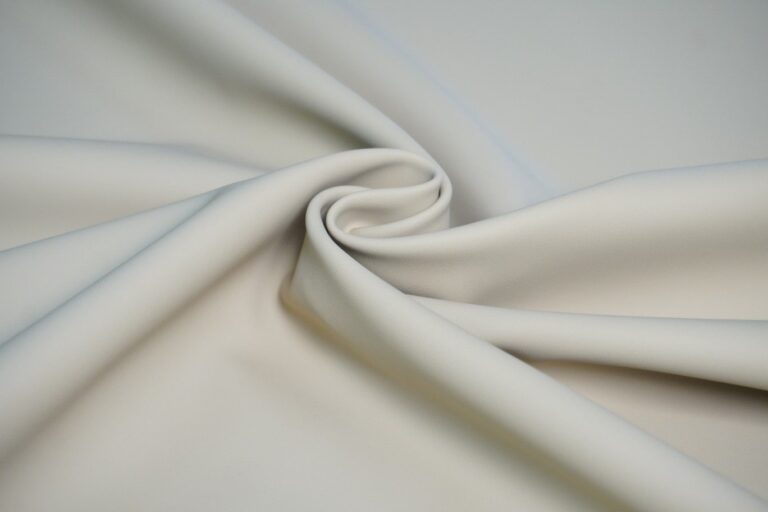
The formulation stage — where plasticizer content and chain chemistry decide every later aging behavior before the first meter is coated.
The Three Clocks Inside Plastic Leather Material
Read enough aging-oven logs and the failures sort into three repeating mechanisms. None of them show up on delivery day; all of them are running on delivery day. What each clock does to a surface, and the lab test that catches it early, fits in one table:
| Aging clock | Where it strikes | What the surface shows | The test that catches it |
|---|---|---|---|
| Plasticizer migration | PVC and vinyl-PU blends | Surface hardens and glazes, sheen turns greasy then matte, corners craze; a cold snap finishes the cracks | Air-oven aging with elongation re-tested at intervals — the retained percentage is the verdict |
| Hydrolysis | Ester-based PU coatings | White bloom along seams, loss of body, top skin lifts and peels in sheets | Humid-heat aging with coating-adhesion re-testing on the aged specimen |
| UV and heat oxidation | Every organic polymer family | Chalky bloom, color drifts, ΔE climbs past the visible threshold | ASTM G154 lamp exposure with periodic ΔE measurement |
How 1,000 Hours in an Oven Predicts Year Five
Accelerated aging is the industry’s answer to a simple problem: buyers cannot wait five years to learn whether a roll survives five years. The method is unglamorous. Die-cut dumbbell specimens hang in a calibrated air oven — ASTM D573 governs the rubber-and-thermoplastic version, with ISO 188 as its international twin — then come out at set intervals for tensile and elongation re-testing. A material that keeps 90% of its elongation after a full cycle is a different product from one holding 55%, whatever their brochures claimed in common. The same logic extends to humidity cabinets for the PU clock and UV cabinets for the oxidation clock.
Two habits separate a useful aging file from a decorative one. First, aged numbers only mean something against unaged baselines from the same lot — demand both columns. Second, the test must match the threat: an oven cycle proves nothing about a coastal hotel’s humidity, and a UV cabinet proves nothing about a heated seat’s 80°C surface. We run construction-specific aging on our own lab equipment before any silicone construction reaches the sample stage, and the reason PU failures look so predictable to us is documented in our PU failure-mode library.

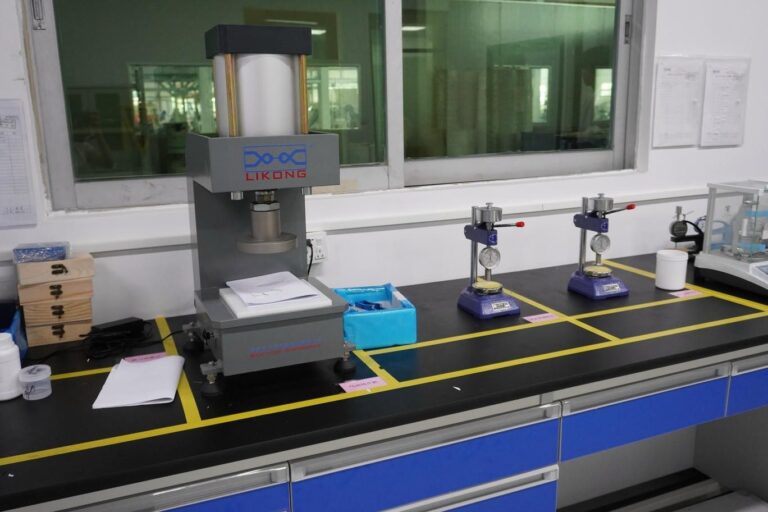
Oven equipment of the kind that turns five years of field chemistry into a four-week bench verdict.
Where Plastic Leather Material Still Wins
Honesty cuts both ways: the clocks do not make these materials bad, they make them scoped. PVC’s chlorine-heavy backbone brings inherent flame resistance and chemical stability at a price point nothing else touches — the right answer for trade-show builds, rental staging, seasonal retail refresh, and any program whose realistic service life is under three years. PU delivers a calfskin-like hand that structured silicone takes deliberate effort to match, which is why fashion-adjacent goods keep using it. The engineering failure is not choosing plastic leather material; it is paying ten-year program prices for three-year chemistry. Match the material’s clock to the program’s lifespan and the economics resolve themselves — a family-by-family orientation starts with the main types of fake leather.

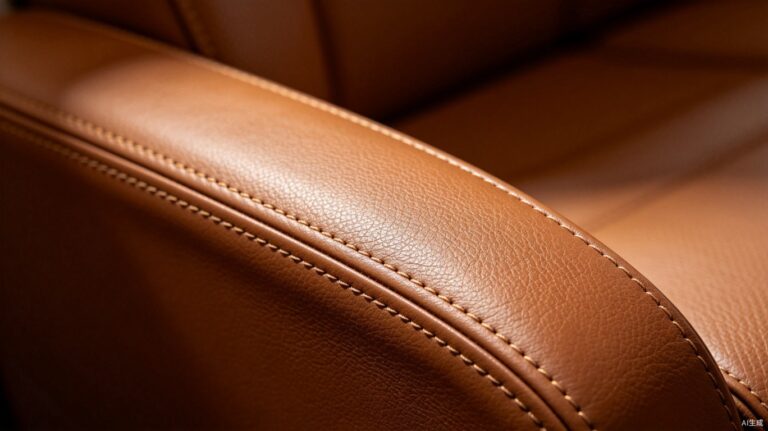
Application reality: PU and PVC earn their keep in short-lifecycle and budget programs — when the program’s lifespan matches the material’s clock.
The PVC-Free Exit: What Changes Chemically
Silicone leather removes the clocks rather than slowing them. The Si–O backbone carries no plasticizer — flexibility is the polymer itself, so there is nothing to migrate out and no glassy endpoint waiting decades down the line. There are no ester bonds for humidity to cleave, which is why the construction is rated hydrolysis-proof rather than hydrolysis-resistant. The payoff shows in the numbers our constructions test to: 1,000+ hours of UV exposure without fading or yellowing, flexibility held from −40°C to 250°C, 200,000+ Martindale cycles, and a service life rated past ten years — roughly five times the working span of PU and PVC in comparable duty. For the full three-family picture, the silicone-vs-PU-vs-PVC comparison puts the test columns side by side.
Material family comparison — the same aged-versus-unaged logic, shown on the bench instead of the page.
Frequently Asked Questions
Is plastic leather material the same as PVC?
No — PVC is one family under the umbrella. Polyurethane, TPO, and silicone-coated constructions are all sold as plastic leather material, and each runs on a different clock. Identify the family first, then read the spec sheet.
Why does plastic leather material crack and harden as it ages?
In PVC, the plasticizer that made it supple was never chemically bonded — it migrates to the surface and evaporates, so the material slowly reverts toward rigid resin. In PU, humidity cleaves the ester bonds in the chain itself. Both look like the material “drying out”; neither has anything to do with dryness.
Can I test plastic leather material before committing to a volume order?
Yes, and cheaply. Request aged and unaged swatches of the plastic leather material from the same lot, fold both to a crease, and compare. Any coating mill with its own lab can also share oven-aging retained-elongation data per construction — that single number predicts year five better than any brochure.
About TOPSUN
TOPSUN coats silicone leather at three Chinese plants — Dongguan, Yichang, Xiangyang — whose combined floorspace exceeds 60,000+ m² across 10+ automated lines, shipping 500,000+ meters monthly into furniture, healthcare, automotive, and consumer programs.
Every construction ships with construction-specific test data — UV, hydrolysis, abrasion, and flex — backed by ISO 10993-5, EN 13773 Class 4, and FDA 21 CFR 177.2600 certifications issued in our own name.