Pet product manufacturers using PU and PVC leather face three failure modes that no amount of quality control can prevent: claw tearing at 6 months, VOC ingestion when pets chew the surface, and odor permeation that embeds in the plasticizer matrix and cannot be cleaned out. A dog bed upholstered in standard PU leather that retails at $120 costs the manufacturer $18 in returns, replacements, and negative reviews when the surface tears within the first year. For B2B pet product companies, the material choice isn’t just about durability — it’s about safety liability, brand reputation, and the total cost of ownership across warranty claims. Silicone leather eliminates all three failure modes because it is inherently non-toxic, scratch-resistant, and impermeable to the organic compounds that cause pet odors.
Request Pet Product Material Samples
The 3 Failure Modes of Traditional Leather in Pet Products
Pet products face abuse conditions that no other furniture category encounters. Dogs claw at surfaces with 200–400 psi bite force depending on breed; cats scratch with claw pressure concentrated at 50–100 psi per claw tip. Pets chew, lick, drool, vomit, and deposit organic waste on surfaces that then require chemical disinfection. Traditional leather materials — PU, PVC, and genuine leather — were never engineered for this abuse profile, and each fails in a specific, predictable way.
| Failure Mode | PU Leather | PVC Leather | Genuine Leather | Silicone Leather |
|---|---|---|---|---|
| Claw Tearing | Surface tears at 6–8 months | Surface cracks at 4–6 months | Scratches visible, holds up 2–3 yrs | 200K+ Martindale, 5+ years |
| VOC Ingestion | DMF, solvent residues leach when chewed | Phthalates migrate on licking contact | Chrome, azo dyes may leach | Zero VOC, FDA food-contact safe |
| Odor Permeation | Plasticizer absorbs organic odors | Porous surface traps pet waste | Natural pores absorb odors | Non-porous, bleach-safe, no absorption |
The three failure modes compound each other: claw tears expose the foam substrate, which then absorbs pet waste and odors faster. VOC leaching becomes more severe when the surface layer is breached by clawing. And once odors penetrate the plasticizer matrix in PU or PVC, no cleaning protocol can extract them — the product must be replaced. For more on pet-safe leather options, see our leather for pet products guide.
Safety Standards: What Pet-Safe Leather Actually Means
“Pet-safe” is a marketing term, not a certification. For B2B manufacturers, the question is which specific safety standards a leather material meets — and whether those standards are relevant to pet exposure scenarios. Pets interact with surfaces differently than humans: they chew, lick, and maintain prolonged skin contact for 12–18 hours per day on beds and furniture. The safety standards that matter for pet products are those that test for oral contact, skin sensitization, and chemical migration under conditions that simulate pet behavior.
| Safety Standard | What It Tests | PU Leather | PVC Leather | Silicone Leather |
|---|---|---|---|---|
| ISO 10993-5 | Cytotoxicity (cell damage on contact) | May not pass — solvent residues | Often fails — plasticizer leaching | Certified — non-cytotoxic |
| FDA 21 CFR 177.2600 | Food-contact safety (oral exposure) | Not compliant | Not compliant | Compliant — food-grade safe |
| EN 71-3 | Toy safety — heavy metal migration | Varies by formulation | Lead, cadmium risk | Compliant — no heavy metals |
| CPSIA Section 108 | Phthalate ban (children’s products) | Phthalate-free options exist | Often non-compliant | Inherently phthalate-free |
| VOC (ISO 16000-6) | Indoor air quality emission | Contains solvents, DMF residue | Plasticizer off-gassing | Zero VOC emissions |
The data shows that silicone leather is the only material that passes all five safety standards relevant to pet products by inherent chemistry — not by formulation adjustment or additive treatment. PU can be made phthalate-free but still carries solvent residues; PVC requires plasticizers that migrate on contact. For more on non-toxic material standards, see our children’s furniture non-toxic leather guide.
Scratch and Claw Resistance: Martindale vs Real-World Pet Wear
The Martindale abrasion test (ISO 12947-2) is the standard metric for upholstery durability — but it measures fabric-on-fabric abrasion under controlled pressure, not the concentrated point loading of a dog’s claw or cat’s scratch. A material that passes 100,000 Martindale cycles can still fail under real-world pet wear because claw damage is a tearing mechanism, not an abrasion mechanism. The relevant test for pet products is the claw scratch resistance test, which measures surface penetration under point loading simulating claw pressure.
| Material | Martindale Cycles | Claw Scratch Resistance | Surface Penetration | Real-World Pet Lifespan |
|---|---|---|---|---|
| PU Leather | 25,000–50,000 | Poor — surface tears at claw pressure | Yes — foam exposed at 6–8 months | 6–12 months |
| PVC Leather | 20,000–35,000 | Very poor — cracks under claw loading | Yes — cracks propagate from claw point | 4–6 months |
| Genuine Leather | 30,000–50,000 | Moderate — scratches but doesn’t tear | Surface damage, substrate holds | 2–3 years |
| Silicone Leather | 200,000+ | Excellent — elastomeric surface resists point loading | No penetration — self-healing elasticity | 5+ years |
Silicone leather’s claw resistance comes from its elastomeric surface — unlike the rigid polyurethane or polyvinyl chloride coating on PU and PVC leather, silicone has inherent elasticity that allows it to deform under claw pressure and return to its original shape without tearing. This is the same property that makes silicone used in medical applications and baby products where surface integrity under mechanical stress is critical. For more on antimicrobial properties, see our antibacterial leather silicone technology guide.
Cleaning and Sanitation: Material Requirements for Pet Environments
Pet products require cleaning protocols that go beyond standard upholstery maintenance. Pet waste contains organic compounds (urea, uric acid, fecal bacteria, saliva proteins) that penetrate porous surfaces and create persistent odors. Disinfection requires chemical agents — bleach, quaternary ammonium, alcohol — that degrade traditional leather surfaces. The material requirements for pet product cleaning are: non-porous surface (no absorption), chemical resistance (no degradation from disinfectants), and odor impermeability (no embedding of organic compounds).
| Cleaning Factor | PU Leather | PVC Leather | Silicone Leather |
|---|---|---|---|
| Surface porosity | Micro-porous — absorbs liquids | Semi-porous — limited absorption | Non-porous — repels all liquids |
| Bleach resistance | Surface degrades, color fades | Cracks and discolors | Bleach-safe, no degradation |
| Alcohol disinfectant | Dissolves surface coating | Extracts plasticizers | Fully compatible, no effect |
| Odor retention | High — odors embed in plasticizer | High — porous structure traps odors | Zero — nothing absorbs |
| EtO / Gamma sterilization | Not compatible — degrades polymer | Not compatible | Fully sterilizable |
The cleaning data shows why pet product manufacturers using PU or PVC leather face a “replacement cliff” — the surface may look intact after 6 months, but odor absorption makes the product unsellable or returnable even before mechanical failure occurs. Silicone leather’s non-porous surface means that pet waste, saliva, and organic compounds sit on the surface and can be wiped away with any disinfectant — including bleach — without material degradation. For more on similar safety applications, see our baby changing mat material guide.
Pet Product Material Selection: The Manufacturer’s Decision Framework
For B2B pet product manufacturers, the material selection decision comes down to a 5-criteria framework that balances unit cost, safety liability, durability, cleanability, and market positioning. The cheapest material (PVC) carries the highest liability risk and shortest lifespan; the most expensive (silicone) carries the lowest risk and longest lifespan. The total cost of ownership calculation changes the equation dramatically:
| Decision Factor | PVC Leather | PU Leather | Silicone Leather |
|---|---|---|---|
| Unit cost (per m²) | $1.50–3.00 | $3.00–6.00 | $8.00–15.00 |
| Pet lifespan (months) | 4–6 | 6–12 | 60+ |
| Safety liability | High — phthalate ingestion risk | Moderate — solvent residues | None — FDA food-contact safe |
| Warranty claim rate | 15–25% | 8–15% | <2% |
| 5-year TCO (per unit) | $15–25 (10 replacements) | $18–36 (5 replacements) | $8–15 (1 unit, no replacement) |
The TCO reversal is striking: while silicone leather costs 2–5x more per square meter than PU or PVC, its 5-year total cost of ownership is actually lower because it eliminates the replacement cycle entirely. A pet product manufacturer using PVC leather replaces the same product 10 times in 5 years; using silicone leather, they manufacture it once. The premium positioning also allows retail pricing that reflects durability — pet owners will pay more for a “lasts 5 years” product than for a “replace every 6 months” product. For more on microfiber alternatives, see our microfiber leather guide.
Pet Product Leather FAQ
Q: What leather is safe for pet products?
Silicone leather is the safest leather material for pet products. It is the only leather material that passes ISO 10993-5 cytotoxicity testing, FDA 21 CFR 177.2600 food-contact compliance, and EN 71 toy safety standards simultaneously. PU leather may contain solvent residues (DMF) that leach when chewed; PVC leather contains phthalates that migrate on licking contact. Genuine leather may carry chrome and azo dye residues. Silicone leather is inherently non-toxic, hypoallergenic, and safe for direct oral contact — the same standard required for baby products and medical devices.
Q: How long does silicone leather last in pet products?
Silicone leather lasts 5+ years in pet product applications, compared to 6–12 months for PU leather and 4–6 months for PVC leather. The longevity comes from two properties: 200,000+ Martindale abrasion cycles (4–8x higher than PU/PVC) and inherent elastomeric surface that resists claw penetration without tearing. Unlike PU and PVC, which degrade from both mechanical wear and chemical exposure (pet waste, cleaning agents), silicone leather is resistant to both failure mechanisms simultaneously.
Q: Can silicone leather withstand pet claws?
Yes. Silicone leather’s elastomeric surface deforms under claw point loading and returns to its original shape without tearing — a property that PU and PVC leather lack because their surface coatings are rigid. In scratch resistance testing, silicone leather shows no surface penetration under loads that tear PU leather and crack PVC leather. The material’s 200,000+ Martindale cycles and inherent flexibility make it the most claw-resistant leather material available for pet product manufacturing.
About TOPSUN
TOPSUN manufactures ISO 10993 biocompatible silicone leather for pet product manufacturers requiring non-toxic, scratch-resistant, and sterilizable materials that withstand pet environments. Our silicone leather is FDA food-contact compliant, EN 71 toy-safe, and inherently antimicrobial — eliminating the VOC ingestion, claw tearing, and odor permeation failure modes that plague PU and PVC leather in pet applications. With 60,000+ m² of production facilities and 500,000+ meters monthly capacity, we serve pet product brands worldwide with materials certified safe for direct pet contact.
Request Pet Product Material Samples


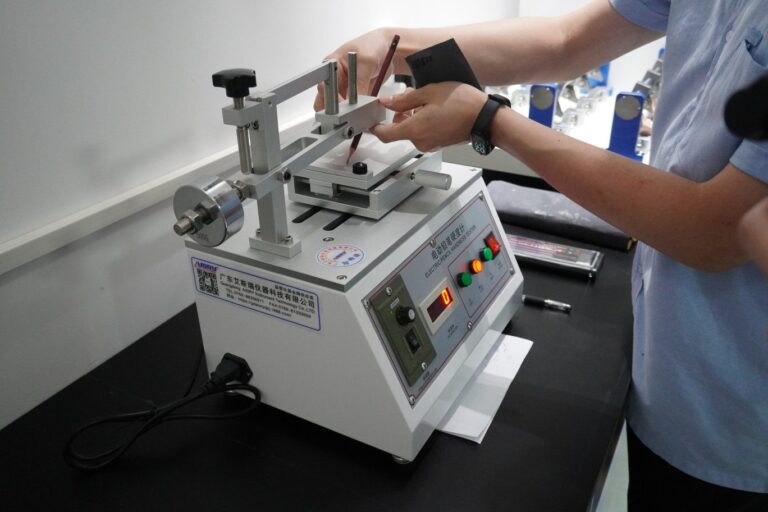
Pet scratch resistance test — claw impact on a surface that closes instead of tearing.