Children touch, chew, and breathe near their furniture every single day. A toddler gnawing on a sofa arm, a preschooler pressing their face into a cushion during naptime, a daycare room full of kids rubbing against chairs hour after hour—each moment is a potential exposure point. Hidden toxins in conventional upholstery, from phthalates and VOCs to heavy metals in pigments, pose real, documented health risks to developing bodies.
That is why sourcing children furniture non-toxic leather is not a marketing preference but a regulatory necessity. Silicone leather, built on a Si-O-Si backbone identical to the chemistry of glass and silica sand, is inherently non-toxic by composition rather than by additive removal. This guide walks through the standards, the risks, and the documentation your procurement team will need to specify with confidence—and for context on broader baby-product applications, our earlier piece on faux leather for baby products covers the use-case landscape in more detail.
The Hidden Risks in Children’s Furniture
Most kids furniture material on the market today is PVC (polyvinyl chloride) or PU (polyurethane) coated fabric. Both rely on chemistry that was never designed for close, daily contact with children—and both carry risks that specifiers need to understand before signing off on a product line.
PVC leaches phthalates, the plasticizers added to make a rigid polymer flexible. Phthalates are classified as endocrine disruptors, interfering with hormone systems during the developmental windows when children are most vulnerable. PU coatings, meanwhile, continue to emit volatile organic compounds (VOCs) long after manufacturing, contributing to respiratory irritation and poor indoor air quality in nurseries and classrooms. Heavy metals—lead, cadmium, chromium—still turn up in pigments used to hit bright, appealing colors.
The regulatory exposure is just as real as the health one. California’s Proposition 65 list now spans roughly 900 chemicals, and penalties run $2,500 per violation per day. A single non-compliant product line can rack up six-figure settlements before a manufacturer even reaches court—a risk no procurement team should absorb silently.
What ‘Non-Toxic’ Actually Means
‘Non-toxic’ is not a marketing claim anyone should take at face value. For non-toxic upholstery in children’s products, it means documented third-party certification against specific, measurable thresholds—not a supplier’s word. The frameworks that matter most:
- CPSIA (U.S. Consumer Product Safety Improvement Act): lead content ≤100 ppm, phthalates ≤0.1% in children’s products.
- EN 71-3:2019+A2:2024 (European toy safety standard): migration limits for 19 elements, with the A2:2024 amendment updating several thresholds as of December 2024.
- California Proposition 65: requires clear warnings before exposing consumers to any of ~900 listed chemicals. The full chemical list is maintained by OEHHA.
- OEKO-TEX STANDARD 100: a voluntary textile certification testing for hundreds of restricted substances across four product classes.
If a supplier cannot produce test reports against these frameworks, the word ‘non-toxic’ on their spec sheet is worth the paper it bypasses.

How Silicone Leather Meets Global Standards
Silicone leather’s safety profile is a function of its chemistry, not its additives. The Si-O-Si backbone—the same molecular structure found in glass and silica sand—contains no plasticizers that can leach, no phthalates to migrate out, and requires no heavy-metal pigments to achieve color. As a children safe fabric, it is non-toxic by composition.
This is a meaningful distinction. In our experience, we’ve seen manufacturers spend months reformulating PU coatings to pass Prop 65—silicone leather passes by default because the chemistry contains none of the regulated substances. That difference shows up in lead times, in reformulation costs, and in the predictability of compliance across markets. It is also why silicone is increasingly recognized as an eco-friendly faux leather beyond its safety profile alone.
TOPSUN’s silicone leather has been verified by SGS against the frameworks procurement teams actually ask for:
- REACH EC 1907/2006: all 247 SVHC substances below 0.1% (w/w).
- PAHs (AfPS GS 2019:01): all 8 polycyclic aromatic hydrocarbons ND, below 0.1 mg/kg.
- FDA 21 CFR 175.300: all food-contact simulants ND, below 1.0 mg/inch².
- EN 71 compliant for toy-adjacent applications.
Silicone leather passes CPSIA, EN 71, REACH, FDA 21 CFR 175.300, and California Prop 65—not by reformulating harmful additives away, but because its Si-O-Si chemistry never contained them in the first place.
Comparing Non-Toxic Material Options
Side by side, the differences become obvious. For daycare furniture material that must survive daily spills, frequent disinfection, and years of heavy use while staying compliant, the chemistry gap is hard to ignore—and the same durability logic scales to furniture and sofa applications where adult-use wear matters too.
| Material | Phthalate-free | VOC emissions | Heavy metals | Certifications | Cleanability |
|---|---|---|---|---|---|
| Silicone leather | Yes (inherent) | Zero | None needed | REACH, FDA, EN 71, ISO 10993 | Soap & water; disinfectant-safe |
| PVC | No (plasticizers) | Low–moderate | Possible in pigments | Limited | Wipeable; degrades over time |
| PU | Yes | Moderate (ongoing) | Possible | Limited | Wipeable; hydrolyzes |
| Genuine leather | Yes | Low | Possible (tanning) | Varies | Conditioner needed; stains |

Designing Safe Children’s Spaces
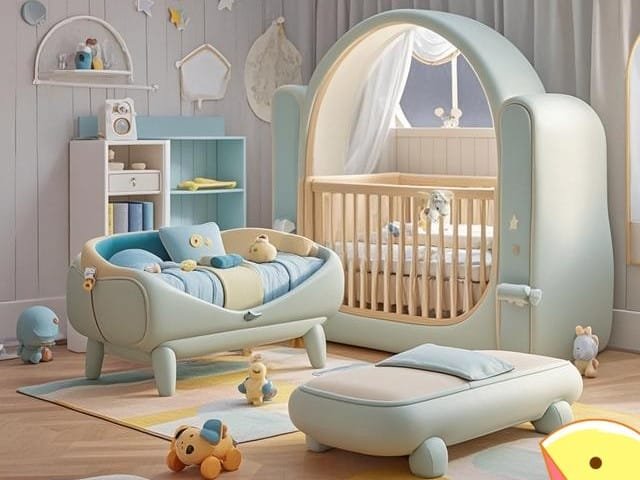
Specifying the right nursery furniture fabric means balancing safety, durability, and the realities of how children actually use a space. A few practical considerations that come up in nearly every project we quote:
- Thickness: 0.23–1.2mm covers the range for children’s furniture, from lightweight stroller and high-chair covers to denser daycare seating.
- Color strategy: light shades show stains quickly; dark colors hide wear but can feel heavy in small rooms. Mid-tones—sage, warm grey, soft teal—strike a balance and are currently the most specified in nursery and daycare projects.
- Cleanability: silicone’s closed, non-porous surface cleans with soap and water and tolerates hospital-grade disinfectants without degrading.
- Abrasion resistance: TOPSUN silicone leather tests at 200,000+ Martindale cycles, against 10,000–30,000 for typical PU/PVC. In a high-traffic daycare, that gap translates directly into replacement-cycle savings.
For a deeper look at application-specific specs across strollers, mats, and play surfaces, our baby & kids applications page lays out the full TDS ranges.
Documentation Your Buyers Will Ask For
Procurement teams specifying kids room upholstery for schools, hospitals, or retail nurseries will ask for documentation before they ask for a price quote. Be ready with:
- SGS test reports for lead and phthalates under CPSIA.
- REACH SVHC screening covering all 247 substances.
- CPSIA compliance certificates (Children’s Product Certificate).
- EN 71-3 test results showing migration compliance for all 19 elements.
- FDA 21 CFR 175.300 food-contact simulant data.
TOPSUN ships full documentation with every order, and our team supports custom test requests for project-specific standards. You can review the full certifications library before initiating a sample request.
Frequently Asked Questions
What makes silicone leather non-toxic?
Its Si-O-Si molecular backbone—the same chemistry as glass and silica sand—contains no plasticizers, no phthalates, and needs no heavy-metal pigments. It is non-toxic by composition, not by additive removal, which is why it passes CPSIA, EN 71, REACH, and Prop 65 without reformulation.
Does it meet California Prop 65?
Yes. Because silicone chemistry contains none of the roughly 900 substances on the OEHHA Prop 65 list, TOPSUN silicone leather passes without the warning labels that PVC and many PU materials require. SGS-verified REACH and PAHs reports confirm the absence of regulated substances.
What certifications should I request from suppliers?
At minimum, ask for CPSIA lead and phthalate test reports, REACH SVHC screening, EN 71-3 migration results, and FDA 21 CFR 175.300 food-contact data. For medical-adjacent or high-touch applications, add ISO 10993-5 biocompatibility. Any supplier unable to produce these on request is not a compliant source for children’s products.
Safe by Chemistry, Not by Compromise
When you specify children furniture non-toxic leather, you are not asking a supplier to remove harmful substances after the fact—you are choosing a material whose chemistry never included them. Silicone leather’s Si-O-Si backbone, verified against CPSIA, EN 71, REACH, FDA, and Prop 65, delivers safety by composition. That is the standard children’s spaces deserve, and the standard procurement teams can defend with documentation on every shipment.
About TOPSUN
TOPSUN has manufactured silicone leather since 2018, serving 100+ global clients across 30+ countries from 60,000+ m² of production space. Our children’s-grade material is engineered on a pure Si-O-Si chemistry and tested by SGS under IAF/ILAC mutual recognition for worldwide acceptance.
Relevant certifications: REACH (247 SVHC <0.1%), PAHs (all ND), FDA 21 CFR 175.300, EN 71, ISO 10993-5 biocompatibility.