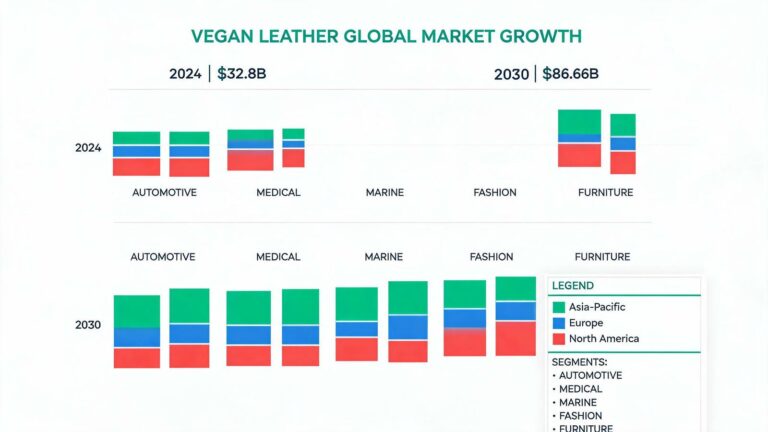
The global vegan leather market reached $4.07 billion in 2026, projected to double to $8.14 billion by 2035 at 7.8% CAGR. Plant-based leather alone grows at 12% CAGR, faster than any other material category. Yet beneath this growth narrative lies a material quality crisis: most vegan leather products still use PU coatings that fail in 3–5 years from hydrolysis. The market is expanding, but the materials powering 70% of it haven’t improved. For B2B brands, this creates both a risk and an opportunity — those who specify genuinely durable vegan leather will dominate the next decade.
Vegan leather has moved “from a niche cruelty-free alternative into a strategic materials category for fashion, footwear, automotive interiors, accessories, furniture, and consumer electronics”. The question is no longer whether to offer vegan leather alternatives — it’s which vegan leather material actually delivers on the promises brands make to consumers.
Request Vegan Leather Sample Kit

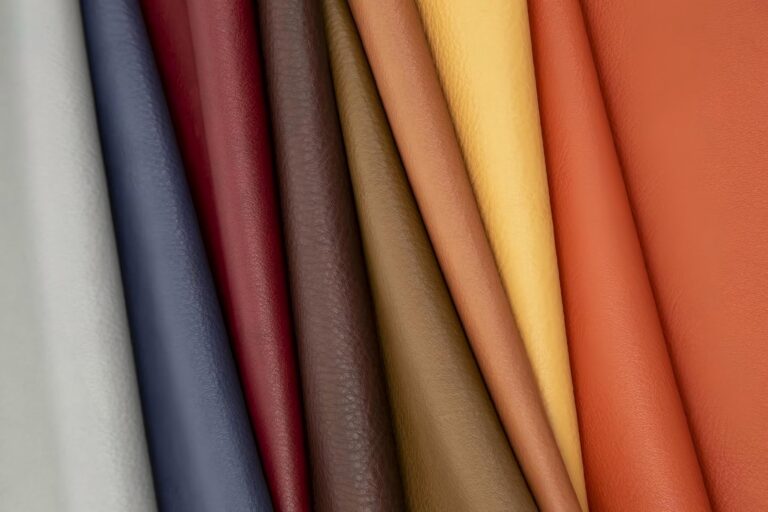
Material texture comparison — visual similarity between premium and commodity vegan leather hides quality differences
5 Vegan Leather Product Categories: Where B2B Demand Is Growing
The vegan leather products market spans five major categories, each with different growth drivers, performance requirements, and material specifications:
| Category | Market Driver | Key Spec Required | Growth Signal |
|---|---|---|---|
| Fashion & accessories | Brand sustainability commitments | Softness, color range, embossing | Fastest-growing category |
| Automotive interiors | OEM sustainability mandates | UV, VOC (VDA 277), abrasion | BMW, Tesla, BYD adopting |
| Furniture upholstery | Consumer demand for cruelty-free | Martindale 50,000+, cleanability | Hospitality specifying vegan |
| Footwear | Athletic brand sustainability | Flex resistance, breathability | Volume opportunity |
| Consumer electronics | Premium device accessories | Thin gauge (0.23mm), tactile | High-margin niche |
Automotive interiors represent the highest-value opportunity — a single vehicle program can require 500+ m² of material. BMW’s vegan leather interiors launched in 2023, Tesla uses synthetic upholstery across all models, and BYD specifies vegan car interior leather for its EV lineup. But automotive also demands the strictest specifications: VDA 277 VOC compliance, 1,000+ hour UV stability, and 100,000+ Martindale cycles. PU vegan leather fails these requirements; only silicone leather passes all three.

Furniture application — vegan leather upholstery requires 50,000+ Martindale cycles for residential, 100,000+ for contract use
Vegan Leather Material Types: PU vs Plant-Based vs Silicone
Not all vegan leather products use the same material. Three chemistry families dominate the market, each with different performance ceilings and sustainability profiles:
| Material | Chemistry | Martindale | Service Life | Sustainability | Cost/m² |
|---|---|---|---|---|---|
| PU vegan leather | Polyurethane | 30,000–80,000 | 3–5 years | Moderate (solvent-based) | $3–8 |
| Plant-based | Apple, cactus, grape | 15,000–25,000 | 2–4 years | High (bio-based) | $20–50 |
| Silicone leather | Silicone polymer | 200,000+ | 10+ years | High (zero VOC, recyclable) | $12–20 |
Plant-based leather commands the highest price ($20–50/m²) but delivers the lowest durability (15,000–25,000 Martindale cycles, 2–4 year lifespan). It’s the marketing hero — brands love the “made from apples” story — but the performance doesn’t match the price. PU vegan leather is cheap and widely available but fails from hydrolysis and emits VOCs. Silicone leather occupies the sweet spot: 200,000+ Martindale cycles, 10+ year lifespan, zero VOC, and $12–20/m² — premium performance at mid-range pricing.
The Durability Gap: Why Most Vegan Leather Products Fail
A consumer who buys a “vegan leather” handbag expects it to last as long as a genuine leather one. The reality: PU vegan leather fails in 3–5 years; plant-based often fails in 2. The vegan leather durability gap creates brand risk that compounds as the market grows — more products mean more failures mean more negative reviews.
The failure pattern is predictable: PU coatings hydrolyze in humid environments, causing surface tackiness within 12–18 months and visible cracking by Year 2. Plant-based leather delaminates because the bio-polymer coating doesn’t bond well to textile substrates. Neither material passes the 100,000 Martindale threshold required for contract furniture or automotive interiors. When a brand markets “sustainable leather” and the product fails in 2 years, the sustainability claim collapses — a product that lasts 2 years and ends up in landfill is less sustainable than one that lasts 10.
Positioning Vegan Leather Products for Premium B2B Markets
The brands winning in vegan leather aren’t competing on price — they’re competing on verified performance. Here’s what premium B2B positioning requires:
- Material transparency — Name the specific chemistry (PU, plant-based, silicone), not just “vegan leather.” Consumers and regulators increasingly demand material disclosure.
- Performance data — Publish Martindale ratings, flex cycles, and UV stability hours. If your material achieves 200,000 Martindale cycles, that’s a marketing advantage — not just a spec sheet footnote.
- Certifications — REACH, OEKO-TEX, ISO 10993-5, EN 71. Each certification opens a market: REACH for EU, ISO 10993 for medical, EN 71 for children’s products.
- End-of-life story — Silicone leather is 100% recyclable. PU is “limited recyclability.” Plant-based varies. The circular economy story matters for premium positioning.
- Warranty terms — A 5-year warranty signals confidence in material durability. If your supplier won’t back the material for 5 years, don’t promise it to consumers.

Application range — vegan leather products span fashion, automotive, furniture, and electronics with different performance requirements
5-Point Specification Checklist for Vegan Leather Product Sourcing
Before committing to a vegan leather supplier for product manufacturing, verify these five requirements:
| # | Requirement | Minimum Spec | Red Flag |
|---|---|---|---|
| 1 | Martindale Abrasion | ≥ 50,000 cycles (furniture/auto) | “Not tested” or < 30,000 |
| 2 | Hydrolysis Resistance | ISO 11507 pass report | No data provided |
| 3 | VOC Emission | ISO 16000-6: ≤ 100 μg/m³ | Exceeds EU E1 or VDA 277 |
| 4 | Material Chemistry Disclosure | FTIR confirmation of polymer type | “Proprietary blend” — no disclosure |
| 5 | Sustainability Verification | REACH + recyclability data | “Eco-friendly” with no certification |
About TOPSUN: TOPSUN manufactures silicone-based vegan leather that delivers the cruelty-free positioning consumers demand with the performance specifications B2B brands require. Our material achieves 200,000+ Martindale abrasion cycles, 10+ year service life, zero VOC emissions (ISO 16000-6), and is 100% recyclable. With certifications including ISO 10993-5, REACH, FDA 21 CFR 177.2600, and EN 71, we serve fashion, automotive, furniture, and consumer electronics brands positioning premium vegan leather products. 100+ textures, unlimited Pantone colors (Delta E ≤ 1.0), thicknesses from 0.23–2.0 mm. MOQ: 500 meters. Lead time: 7–15 days.
Consumer trends — how silicone vegan leather meets the durability expectations of premium brands
Request Vegan Samples
Get Material Data Sheet
Download Sustainability Report
Frequently Asked Questions
What are vegan leather products made of?
Vegan leather products are made from three primary material types: polyurethane (PU) — the most common and cheapest, plant-based polymers (apple, cactus, grape) — the most sustainable but least durable, and silicone polymer — the most durable with 200,000+ Martindale cycles and 10+ year service life. Silicone leather is both vegan (no animal products) and cruelty-free while delivering performance that matches or exceeds genuine leather.
Is vegan leather actually sustainable?
It depends on the material. PU vegan leather uses solvent-based production (DMF) and lasts only 3–5 years — a product that ends up in landfill after 3 years isn’t sustainable regardless of being animal-free. Plant-based leather is genuinely bio-sourced but has poor durability. Silicone leather is the most sustainable option: solvent-free production, zero VOC emissions, 10+ year lifespan (reducing replacement cycles), and 100% recyclable. True sustainability = long lifespan + clean production + recyclability.
How big is the vegan leather market?
The global vegan leather market was valued at approximately $4.07 billion in 2026 and is projected to reach $8.14 billion by 2035, growing at 7.8% CAGR. Plant-based leather, a sub-segment, grows even faster at 12% CAGR. The broader synthetic leather market (including PU and PVC) was $8.86 billion in 2026, growing at 5.94% CAGR.
Which vegan leather is best for automotive interiors?
Silicone leather is the best vegan leather for automotive interiors because it passes VDA 277 VOC compliance, achieves 1,000+ hours UV stability, and delivers 200,000+ Martindale cycles. PU vegan leather fails VDA 277 due to solvent emissions and degrades under dashboard heat exposure. Plant-based leather lacks the abrasion resistance required for seat surfaces.