New York has quietly become one of America’s densest leather-trading corridors. Twenty-three tannery and finishing establishments operate across the state, supplying materials for automotive interiors, furniture upholstery, and fashion accessories. But density brings noise. When we help B2B procurement teams vet new york leather suppliers in this market, the same gaps appear repeatedly: missing compliance documentation, vague material specs, and lead times that evaporate under pressure. Here is a practical checklist that separates reliable partners from risky ones — and why silicone leather is changing the sourcing calculus for NY-based buyers.
New York Leather Market at a Glance
New York’s leather sector spans two distinct layers: traditional hide tanners concentrated upstate and synthetic leather distributors clustered around the metro area. The state classifies these operations under NAICS 316110 — Leather and Hide Tanning and Finishing — and recent QCEW data shows 23 active private establishments. For procurement teams, that means plenty of options but wide quality variance.
New York legislation also defines “leather” strictly for consumer transparency: the term applies only to hide or skin products with intact original fibrous structure, tanned to prevent decay. This matters because some new york leather shops and distributors market synthetic composites under ambiguous labels. If you are sourcing for automotive or furniture applications, you need to know exactly what substrate you are buying — not what the sales sheet calls it.

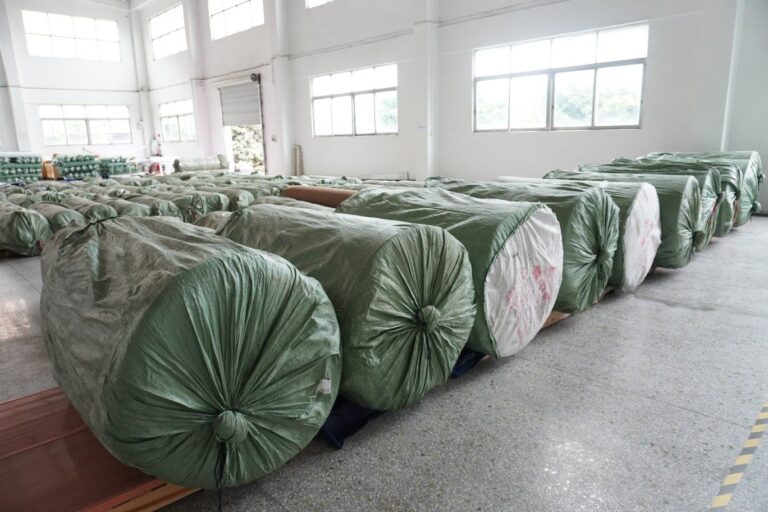
Finished leather rolls staged in a TOPSUN production facility — quality-controlled before shipment to NY-based buyers.
7 Specs to Verify Before Signing a PO
Before you commit to a supplier, require documentation on these seven specifications. Each one protects you from a specific failure mode we have seen in the field:
- Material composition — Is it genuine hide, PU-coated fabric, PVC, or silicone? Request a material data sheet with the exact substrate and coating chemistry.
- Compliance certifications — REACH, RoHS, Prop 65, and PAHs test reports should be current (within 12 months). Without these, your products cannot ship to California or the EU.
- Durability testing data — Martindale abrasion (target: 100K+ cycles), tensile strength (≥10 N/mm), and tear strength (≥15 N) per ISO standards. Ask for the actual test certificate, not a brochure claim.
- VOC and emission standards — Require ISO 16000-6 or VDA 277 results. Many suppliers skip VOC testing entirely — a major red flag when genuine vs faux leather cost differences are driven by hidden chemical shortcuts.
- MOQ and lead time — Confirm in writing. We have seen suppliers quote 500m MOQ with 7-day lead, then deliver in 21 days. Get the SLA before signing.
- Color consistency — Ask for Delta E data. Batch-to-batch color drift above ΔE 1.0 will cause visible mismatch in production runs.
- Warranty terms — 12 months minimum. If a supplier will not back their material for a year, ask why.

In-line fabric inspection station — every meter is checked for coating uniformity and color consistency before release.
Traditional Leather vs Silicone Leather: Cost and Compliance
For NY buyers weighing material options, the comparison extends beyond unit price. Total cost of ownership — including replacement cycles, compliance overhead, and cleaning labor — tells a different story. The table below compares four common material types against the metrics that matter most for B2B procurement:
| Material | Service Life | VOC Profile | Recyclable | Compliance Burden |
|---|---|---|---|---|
| Genuine Leather | 5–8 years | Variable | Limited | High (traceability required) |
| PU Leather | 3–5 years | Contains solvents | Limited | Moderate |
| PVC Leather | 2–3 years | Plasticizers | No | Moderate |
| Silicone Leather | 10+ years | Zero / near-zero | Yes | Low (inherently compliant) |
In our testing, silicone leather consistently hits 200K+ Martindale abrasion cycles with zero VOC emissions — a combination that PU and PVC cannot match. For silicone leather vs PU leather vs PVC leather comparisons in automotive or furniture applications, the service-life gap translates directly into fewer warranty claims and lower replacement costs over a five-year horizon.
Bottom line: A material that lasts 10+ years with zero VOCs costs less over its lifecycle than a cheaper alternative you replace every 3 years.

Supplier evaluation framework — the seven-spec checklist above helps procurement teams avoid costly sourcing mistakes.
Red Flags When Vetting New York Leather Suppliers
After auditing dozens of leather suppliers, we have cataloged the warning signs that predict trouble down the line:
- No third-party test reports — If a supplier claims “premium quality” but cannot produce SGS or Intertek documentation, walk away. Internal QC reports do not count.
- Vague origin claims — “Italian leather” without a tannery name or batch code is a marketing label, not a spec.
- Reluctance to provide samples — A supplier who will not send A4 swatches before a PO is hiding something — usually inconsistent quality or gaps in their own QC process. Any waterproof faux leather buyer guide worth reading will tell you the same.
- Price well below market — Leather that costs 40% less than competitors usually cuts corners on coating thickness, base fabric weight, or compliance testing.

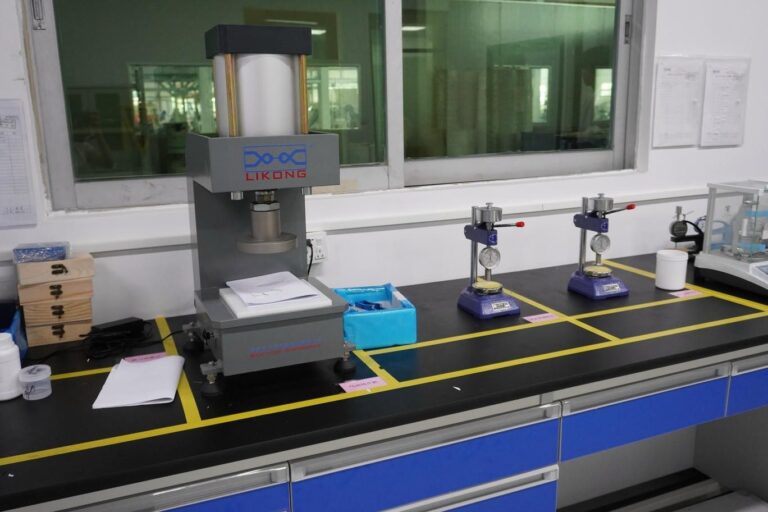
Physical testing laboratory — Martindale abrasion, tensile strength, and tear resistance equipment verify every production batch.
Frequently Asked Questions
Does New York require specific labeling for leather products?
Yes. New York legislation defines “leather” as hide or skin with intact original fibrous structure, tanned to prevent decay. Products marketed as “leather” that do not meet this definition must disclose their actual composition — typically as “bonded,” “genuine,” or “synthetic.” For B2B buyers, this means your purchase orders should specify the exact material grade to avoid labeling disputes downstream.
Can silicone leather meet the same performance standards as genuine leather for automotive and furniture applications?
In most performance metrics — abrasion resistance, UV stability, temperature range — silicone leather exceeds genuine leather. The 200K+ Martindale cycles and -40°C to 250°C operating range are verified by SGS and Intertek testing. The one area where genuine leather retains an edge is the natural grain aesthetic, though modern embossing techniques can replicate most textures with high fidelity.
Making the Right Call on New York Leather
Sourcing new york leather does not have to be a gamble. Verify these seven specs, demand third-party documentation, and compare materials on total cost — not unit price alone. Silicone leather offers a compliance-friendly alternative that eliminates many of the risks inherent in traditional hide sourcing, from environmental compliance to long-term durability. The suppliers who welcome scrutiny are the ones worth partnering with.
About TOPSUN
TOPSUN manufactures silicone leather for B2B buyers sourcing materials for automotive interiors, furniture upholstery, medical equipment, and fashion accessories distributed across North American markets including New York.
ISO 10993 biocompatibility certified · REACH compliant · FDA 21 CFR 177.2600 food-contact approved · 200K+ Martindale abrasion cycles verified by SGS and Intertek · Free A4 swatches shipped worldwide via DHL