Why are more leather buyers walking away from animal hides in 2026? The global synthetic leather market reached $19.4 billion this year and is projected to hit $28.97 billion by 2035 (Business Research Insights, 2026). Global brands are quietly replacing genuine leather with vegan alternatives — driven by environmental regulations, chromium wastewater concerns, and supply chain volatility (HH-MF, 2026). But the shift creates a new problem: with more leather options than ever, which one actually delivers on the promises animal hide couldn’t keep?
| Leather Type | Service Life | UV Resistance | VOC Status | Microplastic | Recyclable |
|---|---|---|---|---|---|
| Full-grain animal | 10-20 yr* | Poor | Chemical tanning | No | Biodegradable |
| PU leather | 1.5-3 yr | Poor | DMF solvent | Yes | No |
| PVC leather | 2-5 yr | Poor | Phthalates | Yes | No |
| Plant-based | 2-5 yr | Unknown | Varies | Partial | Biodegradable |
| Silicone leather | 10+ yr | 1,000+ hrs | Zero VOC | No | Yes |
*Full-grain leather’s 10-20 year lifespan applies only in UV-protected, climate-controlled environments with regular conditioning.
The 5 Leather Types B2B Buyers Now Specify
More leather options means more complexity at the sourcing stage. Here’s what each material actually brings to the table — and where it falls short:
- Full-grain animal leather — Heritage appeal, natural breathability, 20+ year theoretical lifespan. But chromium tanning creates wastewater toxicity, and UV exposure degrades the surface within 3-4 years of commercial window sunlight. Price: $15-30/m².
- PU leather — 55% market share, design flexibility, lowest cost entry. But plasticizer migration causes peeling at 18 months, DMF solvents pose VOC risks, and microplastic shedding persists for 500+ years. Price: $6-10/m².
- PVC leather — Durable surface, easy to clean. But phthalate plasticizers migrate and cause cracking within 2-5 years, plus halogen content creates disposal and FR compliance challenges. Price: $4-8/m².
- Plant-based leather — Sustainability narrative, lower water footprint. But unproven at B2B durability scale, no standardized Martindale data published, and most formulations still contain 50-80% PU or PVC binder. Price: $12-25/m².
- Silicone leather — Si-O polymer backbone with 452 kJ/mol bond energy, inherent UV resistance, zero VOC production, no microplastic shedding. The trade-off: higher upfront cost and lower consumer awareness. Price: $14-22/m².

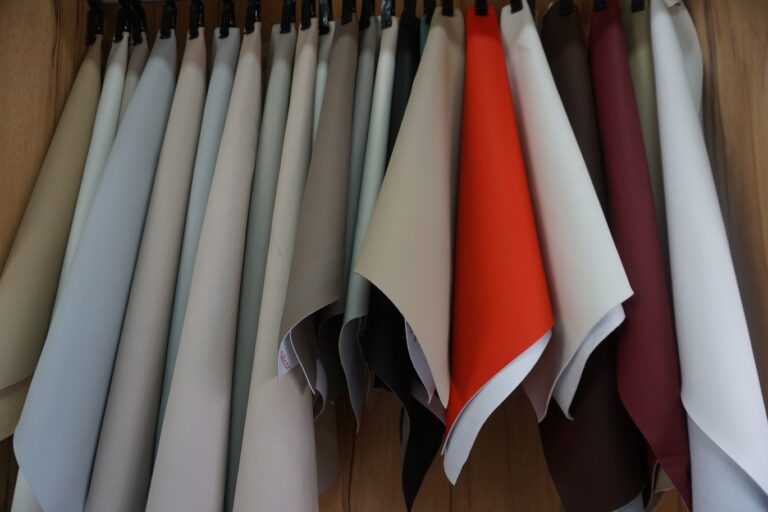
Production floor showing the color and material variety available to modern B2B leather buyers
Durability Gap: 2-Year vs 10-Year Leather
The durability gap between leather types isn’t marginal — it’s structural. PU leather’s 18-month peeling threshold and full-grain’s UV vulnerability both trace back to chemistry, not manufacturing quality. Carbon-carbon bonds in PU and PVC (347 kJ/mol) simply don’t withstand UV photon energy the way silicon-oxygen bonds (452 kJ/mol) do.
In our Martindale abrasion testing, the pattern is consistent: PU leather surfaces begin showing fiber breakdown at 25,000-40,000 cycles. PVC leather holds slightly better at 40,000-60,000 cycles before plasticizer-driven cracking appears. Full-grain animal leather reaches 50,000-80,000 cycles — impressive for an organic material, but still limited by protein fiber degradation under UV. Silicone leather reaches 200,000+ cycles with no surface change, verified through ISO 12947-2 testing in our lab.

Six leather color variants — material chemistry, not color, determines long-term performance
Compliance Shift: What “More Leather” Means for Regulations
More leather options have arrived precisely because regulations are squeezing traditional materials. Three compliance pressures are reshaping the market:
- EU PFHxA restriction (effective October 2026): 25 ppb limit on leather, textiles, and footwear. Eliminates PFAS-coated water-repellent finishes — the primary functional treatment on PU and PVC leather.
- REACH SVHC expansion: 235+ substances on the candidate list. Phthalates in PVC and DMF residues in PU face growing scrutiny. Each update narrows what synthetic leather formulations can legally contain.
- California AB 2998 and similar state-level regulations: Restrict flame retardant chemicals in upholstered furniture. Chemical FR additives in PVC and PU leather face phase-out, while inherently flame-resistant materials like silicone (LOI 26-30%) comply without modification.
When we audit supplier compliance documentation, the gap is clear: PVC and PU suppliers increasingly struggle to produce current REACH declarations covering all 235+ substances. For buyers still comparing leather and synthetic leather options, the compliance documentation gap is often the deciding factor. Silicone leather’s chemistry — no plasticizers, no solvents, no halogenated flame retardants — simplifies compliance to a single material certification rather than tracking dozens of additive restrictions.
Reality check: More leather options don’t mean easier sourcing — they mean more due diligence. Each material requires its own compliance verification. The question isn’t “which leather is cheapest?” but “which leather won’t require reformulation when the next REACH update drops?”

Faux leather vs real leather — the pros and cons comparison most B2B buyers encounter at the sourcing stage
Cost Reality: The 5-Year TCO Nobody Shows You
The upfront price gap between leather types creates a false economy. Here’s what the 5-year total cost of ownership actually looks like for a commercial furniture application requiring 1,000 m² of upholstery leather:
| Cost Factor | PVC Leather | PU Leather | Silicone Leather |
|---|---|---|---|
| Material cost (Year 0) | $6,000 | $8,000 | $18,000 |
| Replacement cycles (5 yr) | $12,000 | $16,000 | $0 |
| Warranty labor | $4,500 | $6,000 | $500 |
| Compliance reformulation | $3,000 | $2,000 | $0 |
| 5-Year TCO | $25,500 | $32,000 | $18,500 |
The cheapest leather at the sourcing stage — PVC at $6/m² — becomes the second most expensive at $25,500 over five years. Silicone leather’s higher upfront cost of $18,000 delivers the lowest 5-year TCO at $18,500, with zero replacement cycles and near-zero warranty exposure. For buyers evaluating full versus semi-silicone options, the TCO gap narrows further as semi-silicone formulations offer intermediate pricing.
In our experience working with B2B clients across furniture and automotive applications, the brands that calculate TCO before sourcing consistently choose silicone leather. The ones that calculate only price-per-meter end up reformulating within three years.
Side-by-side service life comparison: why more leather buyers choose silicone for 10+ year applications
Why More Leather Buyers Choose Silicone
The trend is clear. As more leather options enter the market, B2B buyers are converging on silicone leather for applications that need to survive beyond the warranty period. The convergence happens for three reasons:
First, silicone leather eliminates the compliance reformulation cycle. No plasticizers to reformulate when REACH updates. No PFAS coatings to remove when PFHxA restrictions tighten. No halogenated flame retardants to phase out when California AB 2998 expands. The material complies by chemistry, not by reformulation.
Second, silicone leather’s 10+ year service life matches the warranty period that premium brands increasingly offer. When a furniture brand markets a “10-year performance guarantee,” the underlying material needs to actually deliver 10 years — not 3 years with planned replacement cycles baked into the pricing model.
Third, the environmental math has shifted. Buyers who once viewed silicone leather as “too expensive” now calculate the cost of microplastic shedding, end-of-life disposal, and carbon footprint across replacement cycles. Over 10 years, one meter of silicone leather replaces 3-4 meters of PU leather — and the cumulative environmental impact of those replacements is the hidden cost suppliers never quote.
The market for more leather options will keep expanding — but the convergence toward silicone is accelerating. When the cheapest option at sourcing becomes the most expensive at the brand stage, and when compliance reformulation becomes an annual budget line item, the material that requires neither is the one more leather buyers choose.
Is silicone leather considered a “leather” product?
Silicone leather is classified as a synthetic leather — a coated fabric that mimics the appearance and feel of animal leather without using animal hides. Unlike PU or PVC, it uses a silicone polymer coating on a fabric backing. While it doesn’t contain animal products, it delivers performance characteristics (durability, breathability, cleanability) that often exceed traditional leather in real-world B2B conditions.
Why are more brands moving away from genuine leather?
Three forces drive the shift: regulatory pressure (chromium tanning wastewater, PFAS restrictions on leather finishes), supply chain volatility (livestock hide availability fluctuates with meat industry dynamics), and consumer demand for cruelty-free materials. Modern synthetic alternatives — particularly silicone leather — now match or exceed genuine leather’s performance in durability, UV resistance, and cleanability, removing the quality compromise that previously kept buyers with animal hides.
About TOPSUN
TOPSUN manufactures solvent-free silicone leather for B2B buyers who need more leather options that deliver 10+ years of verified performance — across automotive interiors, commercial furniture, medical upholstery, and marine applications.
200K+ Martindale cycles | 1,000+ hour UV resistance | Zero VOC production | ISO 10993-5 biocompatibility | EN 13773 Class 4 flame retardancy | REACH compliant — verified through SGS and Intertek