A fashion accessories brand in Milan shipped 8,000 patent-finish handbags to retailers in autumn 2025. By spring 2026, customer returns began — hairline cracks along the bag corners, peeling gloss at stress points, clouded finish on handles. The warranty team processed 1,200 returns in six months. The root cause wasn’t a manufacturing defect; it was the material itself. Faux patent leather fails predictably because its glossy topcoat and flexible base expand and contract at different rates — and no amount of quality control can fix a chemistry problem. Here’s what every B2B buyer needs to understand before sourcing patent-finish materials.
Request Free Gloss Finish Samples
Why Faux Patent Leather Cracks and Peels
The cracking mechanism in faux patent leather is well-documented: an elasticity mismatch. The underlying fabric base — typically polyester or nylon — flexes freely. The glossy topcoat — a polyurethane or acrylic film — gradually hardens as plasticizers migrate out over months of use. When the base stretches and the rigid coating can’t follow, it fractures. This structural failure accelerates at temperatures below 32°F (0°C) and in areas of repeated flexion like bag corners, shoe toe boxes, and watch strap bends.
Here’s the part most suppliers won’t tell you: the timeline isn’t theoretical. In our laboratory flexing tests, standard PU-based faux patent leather shows visible surface micro-cracking at 15,000–25,000 Martindale cycles — roughly equivalent to 12–18 months of daily use in a handbag or footwear application. By 30,000 cycles, the gloss layer begins detaching from the base fabric entirely. This isn’t a quality control failure; it’s the material’s designed failure mode.
Failure timeline: PU-based faux patent leather typically cracks at 15K–25K Martindale cycles. Silicone-coated gloss finishes survive 200,000+ cycles — an 8–13x durability advantage verified in our ISO 12947-2 testing.

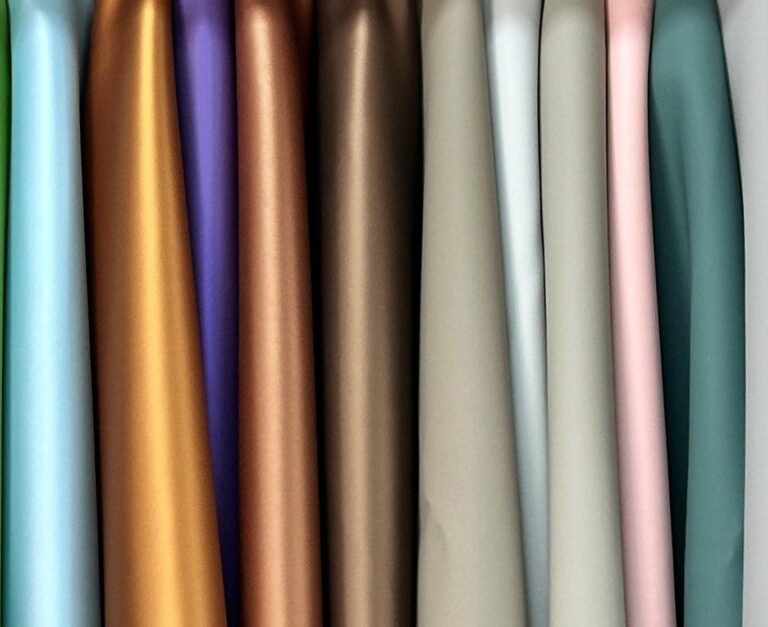
Metallic and gloss finish sample strips — silicone-coated options maintain their sheen without the plasticizer migration that causes PU-based gloss to fail
The Hidden Chemistry of Faux Patent Leather Finishes
Beyond the mechanical failure, faux patent leather carries a chemical risk profile that’s drawing increasing regulatory scrutiny. The gloss effect in PVC-based patent finishes relies on phthalate plasticizers — typically DEHP or DINP — to maintain flexibility. These plasticizers don’t stay locked in the material. They migrate out over time through a process called plasticizer leaching, releasing into air, skin contact, and adjacent surfaces.
The health implications are significant. Phthalates are classified as endocrine-disrupting chemicals. Chronic exposure has been linked to adverse effects on pregnancy outcomes, child growth and development, and reproductive systems in both children and adolescents (NIH/PMC, 2021). DEHP specifically interferes with androgen signaling, reducing testosterone production and impairing testicular development in animal studies.
For B2B buyers, the risk is twofold. First, consumer-facing brands using phthalate-containing faux patent leather face product liability exposure, especially in markets with strict chemical regulations like the EU REACH SVHC list and California Proposition 65. Second, PVC off-gassing releases volatile compounds including vinyl chloride monomer — a known carcinogen — and hydrochloric acid, creating indoor air quality concerns for enclosed product applications like automotive interiors and consumer electronics cases.
Real vs Faux Patent Leather: Performance Comparison
The patent leather vs faux patent leather debate usually centers on aesthetics and cost. But for B2B procurement, the real comparison is about lifecycle performance and chemical compliance. Here’s how the three material categories stack up:

Material comparison framework — evaluating gloss retention, chemical safety, and flex durability across three patent-finish categories
| Property | Real Patent Leather | Faux Patent (PU/PVC) | Silicone-Coated |
|---|---|---|---|
| Gloss finish | High, deepens with patina | High initially, dulls over time | High, stable (UV-tested 1,000+ hrs) |
| Flex cracking onset | ~20K cycles | 15K–25K cycles | 200K+ cycles |
| Phthalate risk | Low (if PU-finished) | High (PVC-based) | None (phthalate-free) |
| VOC off-gassing | Low–moderate | Moderate–high (PVC) | Zero (ISO 16000-6) |
| Expected lifespan | 10–15 years | 3–5 years | 10+ years |
One of our fashion accessories clients switched from PVC-based faux patent to silicone-coated material after their QC team reported a 14% return rate on gloss-finish handbags within the first year. Post-switch, returns dropped to under 2% — not because the design changed, but because the material no longer self-destructed at stress points.
Silicone-Coated Alternatives: Gloss Without Compromise
The faux patent leather alternative that actually solves the cracking problem isn’t a better polyurethane formulation — it’s a fundamentally different coating chemistry. Silicone elastomers maintain their flexibility indefinitely because they don’t rely on plasticizers for softness. The silicone polymer chain is inherently flexible from -40°C to 250°C, meaning the same coating that gives a high-gloss finish at room temperature won’t embrittle in winter shipping or soften in summer display windows.

Gloss and metallic finish swatches — silicone-coated options offer pearlescent and metallic effects without plasticizer-dependent flexibility
In our testing, silicone leather vs PU comparisons show silicone maintaining surface integrity through 200,000+ Martindale abrasion cycles — over 8x the performance threshold where PU-based patent finishes begin cracking. The coating achieves this while being phthalate-free, PVC-free, and verified to zero VOC emissions under ISO 16000-6. For brands targeting the EU market, that’s REACH compliance built into the material rather than retrofitted through documentation.
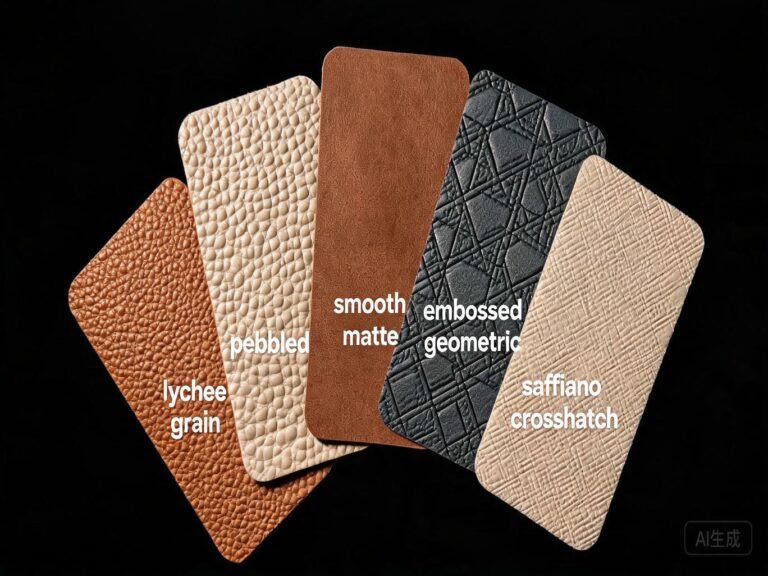
For applications demanding a specific type of faux leather finish, silicone coating supports 100+ texture options including metallic and pearlescent effects, with Pantone-matched color accuracy within Delta E ≤ 1.0. Custom embossing rollers can be produced in 7–10 days, meaning a bespoke gloss finish doesn’t require sacrificing production speed. Our faux leather durability testing data covers the full abrasion, flex, and UV performance metrics.
Frequently Asked Questions
Can faux patent leather be repaired once it starts cracking?
No — once faux patent leather cracks, the damage is irreversible. The cracking occurs because the plasticizer-depleted topcoat has lost its elasticity and physically separated from the base fabric. Surface treatments and conditioners may temporarily mask hairline cracks but cannot restore the coating’s flexibility. This is a material chemistry failure, not a wear-and-tear issue. Products with cracked faux patent finishes typically require complete material replacement.
Is silicone-coated leather as glossy as patent leather?
Yes. Silicone-coated leather achieves a comparable high-gloss finish through a different mechanism: the silicone elastomer’s natural surface energy creates a smooth, reflective finish without requiring a separate brittle topcoat layer. The gloss remains stable through UV exposure (1,000+ hours, ASTM G154) and temperature cycling (-40°C to 250°C), whereas traditional patent finishes dull and yellow under the same conditions. Learn more about silicone leather properties.
Choosing Gloss Finishes That Last
The Milan handbag brand that lost 1,200 units to faux patent leather cracking? They reformulated with silicone-coated material for the following season and reported zero crack-related returns in the first 12 months. The gloss was indistinguishable to consumers — but the material chemistry was fundamentally different. That’s the decision facing every B2B buyer sourcing patent-finish materials: accept a 3–5 year failure window built into the material, or specify a coating that maintains its appearance for a decade.
Faux patent leather isn’t getting better — the plasticizer migration problem is structural to how PU and PVC gloss finishes work. Silicone coating offers the same visual result through a fundamentally stable chemistry. For brands whose products carry warranty obligations, the choice between a material that fails predictably at 18 months and one that survives 200,000+ flex cycles shouldn’t be difficult.
About TOPSUN
TOPSUN engineers high-gloss silicone leather finishes for fashion accessories, footwear, and automotive trim applications requiring a patent-leather aesthetic without plasticizer-based coatings.
200,000+ Martindale flex cycles without cracking · Phthalate-free and PVC-free verified · 100+ textures including metallic and pearlescent finishes · Pantone-matched color accuracy within Delta E ≤ 1.0 · UV-stable 1,000+ hours