In our R&D lab, we’ve tested hundreds of coated fabrics. The difference between a silicone leather that lasts 10 years and one that delaminates in 18 months almost always comes down to three things: viscosity control, curing temperature, and tension management during the coating process. Get one wrong, and the entire substrate-to-surface bond fails.
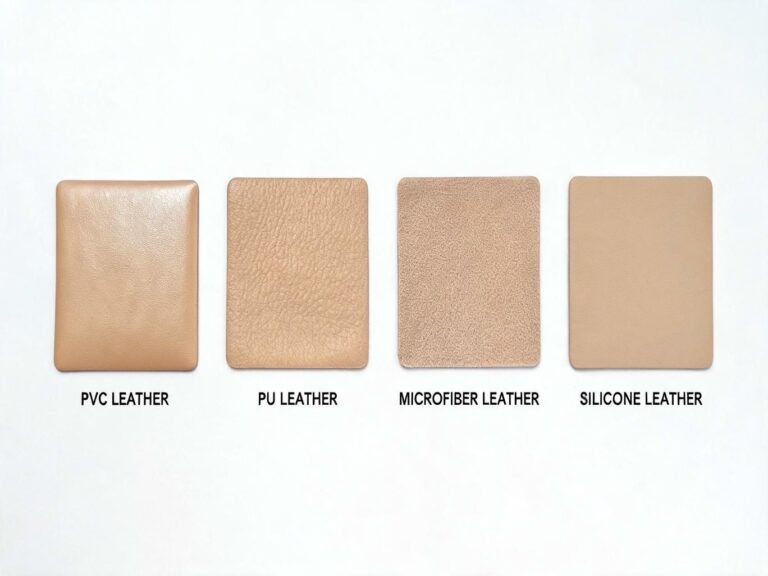
Silicone fabric coating is the manufacturing process that transforms a textile substrate — typically polyester, nylon, or cotton-based fabric — into a durable, waterproof, and chemically inert synthetic leather. Unlike PU coating, which uses solvent-based polyurethane that off-gasses VOCs and degrades under hydrolysis, silicone coating uses a solvent-free, addition-cured silicone elastomer that forms an inorganic Si-O backbone. The result is a material that withstands -40°C to 250°C, resists UV for 1,000+ hours, and maintains flexibility across a 10+ year service life.
Why this matters for B2B: Understanding the coating process isn’t just academic. The process parameters directly determine Martindale abrasion performance, color fastness, adhesion strength, and hydrolysis resistance — the four metrics your QA team will test against. A supplier who can articulate their process parameters is a supplier who controls their output.
The 5 Stages of Silicone Fabric Coating
1Material Compounding
The process begins with compounding liquid silicone rubber (LSR) or high-consistency rubber (HCR) with crosslinking agents, pigments, and performance additives. This is where the material’s fundamental properties are set: hardness (Shore A 40–80), elongation (250–300%), and tear strength (15–20 N). At TOPSUN, compounding happens under vacuum conditions (-0.095 MPa) to eliminate air bubbles that would create pinhole defects in the final coating. The target viscosity range is 8,000–15,000 mPa·s — thick enough to form a continuous film, thin enough to penetrate the fabric substrate for mechanical interlocking.
2Substrate Preparation and Unwinding
The base fabric — typically a woven or knitted polyester substrate (1350–1800mm width) — is unwound under controlled tension. Tension management is critical: too loose, and the fabric wrinkles, creating coating unevenness; too tight, and the fabric stretches beyond elastic recovery, causing dimensional instability in the finished product. The substrate passes through a leveling machine that removes creases and aligns the weave before it enters the coating station.

Dual-roll unwinder — fabric substrates feed into the coating line under controlled tension.
3Coating Application
Two primary methods dominate industrial silicone coating:
- Knife-over-roll (KOR) coating: A doctor blade spreads silicone compound across the fabric as it passes over a precision roller. The gap between blade and roller determines coating thickness — typically 0.15–0.50 mm per layer. KOR excels at producing uniform, heavy coatings and is the standard for leather-grade applications requiring 0.8–2.0mm finished thickness.
- Reverse roll coating: A counter-rotating roller picks up silicone compound and transfers it to the substrate. This method offers superior control over thin coatings (0.23–0.8mm) and is preferred for ultra-thin collection applications like phone cases and wearable straps.
For premium silicone leather, the coating is applied in 2–3 layers: a prime coat for adhesion, an intermediate coat for bulk and texture, and a top coat for surface finish and color. Each layer is individually cured before the next is applied.
4Curing and Cross-linking
The coated fabric enters a high-temperature curing oven — typically running at 150–200°C — where the addition-cure reaction cross-links the silicone polymer. This is where the inorganic Si-O backbone forms, creating the chemical structure responsible for silicone’s temperature resistance, UV stability, and hydrolysis immunity. Curing time depends on coating thickness: 30–60 seconds per layer for thin coats, up to 2–3 minutes for heavy multi-layer builds. Inadequate curing leaves under-crosslinked material that fails abrasion testing; over-curing causes surface hardening and loss of hand-feel.

High-temperature curing oven — cross-linking the silicone polymer backbone at 150–200°C.
5Embossing and Finishing
The cured surface passes through embossing rollers that imprint the desired texture — cowhide grain, pigskin, sheepskin, or custom patterns. TOPSUN maintains a library of 100+ embossing rollers and can produce custom rollers in 7–10 days. After embossing, the material is cooled, inspected under controlled lighting, slit to final width, and wound onto paper cores for shipment. Quality control checks include thickness (±0.05mm tolerance), color (Delta E ≤ 1.0), Martindale abrasion (≥200,000 cycles), and visual inspection for pinholes, streaks, or texture defects.
Silicone Coating vs. PU Coating: The Chemical Structure Difference
The fundamental performance difference between silicone-coated and PU-coated fabric comes down to the polymer backbone. Polyurethane has a carbon-carbon (C-C) organic backbone — essentially a chain of organic bonds susceptible to UV degradation, hydrolysis, and chemical attack. Silicone has a silicon-oxygen (Si-O) inorganic backbone — the same bond structure found in quartz and glass. The Si-O bond has a higher dissociation energy (452 kJ/mol vs. 346 kJ/mol for C-C), meaning it requires more energy to break. This is why silicone leather survives 1,000+ hours of UV exposure without cracking, while PU leather shows surface degradation in 200–400 hours.
| Property | Silicone Coating (Si-O) | PU Coating (C-C) | Engineering Impact |
|---|---|---|---|
| Bond dissociation energy | 452 kJ/mol | 346 kJ/mol | Silicone resists UV and thermal degradation 1.3× better |
| Hydrolysis resistance | Excellent — Si-O bond is inert to water | Poor — ester bonds hydrolyze under humidity | PU delaminates in 3–5 years; silicone lasts 10+ years |
| Temperature range | -40°C to 250°C | -20°C to 80°C | Silicone handles automotive cabin and EV battery environments |
| VOC emissions | Zero — solvent-free, addition-cured | Contains solvents — DMF, toluene, MEK | Silicone meets ISO 16000-6 and VDA 277 without abatement |
| Substrate penetration | Impregnates fiber structure — mechanical interlock | Sits on surface — adhesive bond only | Silicone resists delamination; PU peels at edges |
| Acid/chemical resistance | Inert Si-O framework resists acid attack | Organic C-C backbone susceptible to acid hydrolysis | Silicone survives 1,000+ hour salt spray; PU degrades |
| Flex resistance | ≥50,000–100,000 cycles | 10,000–30,000 cycles | Silicone handles repeated seating flex without cracking |

Full coating production line — from unwinding through coating, curing, embossing, and rewinding.
7 Industries Driving Demand for Silicone-Coated Fabrics
The applications for silicone-coated fabrics extend far beyond traditional leather upholstery. Here’s where B2B demand is growing fastest:
- Automotive / EV interiors: Battery thermal runaway barriers, seat upholstery, door panel trim, and dashboard surfaces requiring FAR 25.853 and FMVSS 302 flame retardancy. EV manufacturers need materials that won’t off-gas VOCs in enclosed cabin environments.
- Furniture and commercial seating: Office chairs, sofa upholstery, cinema and airport seating — applications requiring 200,000+ Martindale abrasion cycles and stain resistance for high-traffic environments.
- Medical and healthcare: Exam table upholstery, wheelchair seating, and patient room furniture requiring ISO 10993-5 biocompatibility certification and bleach-safe cleanability.
- Marine and outdoor: Yacht upholstery, outdoor furniture, and marine seating requiring 1,000+ hour UV resistance and salt-spray resistance. Silicone leather is inherently waterproof — no surface treatment needed.
- 3C electronics: Phone cases, tablet covers, smartwatch straps — ultra-thin (0.23mm) silicone leather with precision embossing and Pantone-matched color.
- Hospitality and public spaces: Hotel furniture, restaurant booth seating, and theater seating requiring fire safety (EN 13773 Class 4) and antimicrobial properties without chemical additives.
- Children’s products: High chairs, stroller upholstery, and baby mats requiring EN 71 toy safety compliance and FDA 21 CFR 177.2600 food-contact certification.
Release paper coating process — how TOPSUN creates 100+ textures through precision embossing technology.
Key Process Parameters Every B2B Buyer Should Verify
When evaluating a silicone leather supplier, these process parameters directly determine the quality of what you receive. Don’t accept vague assurances — ask for the numbers:
| Process Parameter | Industry Standard | TOPSUN Verified | Why It Matters |
|---|---|---|---|
| Compounding viscosity | 5,000–15,000 mPa·s | 8,000–15,000 mPa·s (vacuum) | Too low = pinholes; too high = uneven coating |
| Coating thickness per layer | 0.10–0.50 mm | 0.15–0.50 mm (2–3 layers) | Determines final thickness, abrasion, and hand-feel |
| Curing temperature | 120–200°C | 150–200°C (multi-zone oven) | Under-cure = poor abrasion; over-cure = hard surface |
| Thickness tolerance | ±0.10 mm | ±0.05 mm | Tighter tolerance = consistent die-cutting results |
| Color consistency (Delta E) | ≤2.0 | ≤1.0 (Pantone matched) | Invisible batch-to-batch color difference |
| Martindale abrasion | ≥25,000 cycles (furniture) | ≥200,000 cycles (SGS verified) | 8× minimum standard for commercial furniture |
Procurement checklist: Request the supplier’s process flow diagram, curing oven temperature logs from a recent production batch, and SGS/Intertek test reports for Martindale, color fastness, and hydrolysis resistance. A manufacturer who controls their process will have this documentation ready within 24 hours.
About TOPSUN
TOPSUN is a silicone leather manufacturer with a 60,000+ m² production facility across Dongguan, Yichang, and Xiangyang, China. We operate 10+ automated coating lines producing 500,000+ meters of silicone-coated fabric monthly, serving 100+ brands in automotive, furniture, medical, marine, 3C electronics, and children’s product applications.
Our coating process uses solvent-free, addition-cured silicone elastomer applied via knife-over-roll and reverse roll methods, cured in multi-zone ovens at 150–200°C, and finished with 100+ embossing textures. Key certifications include ISO 10993-5 biocompatibility, REACH compliance, FDA 21 CFR 177.2600 food-contact, EN 13733 Class 4 flame retardancy, and PAHs compliance — all verified by SGS-CSTC Guangzhou and Intertek. Technical parameters include Martindale abrasion ≥200,000 cycles, UV resistance 1,000+ hours, temperature range -40°C to 250°C, and thickness tolerance ±0.05mm with Delta E ≤1.0 color accuracy.
We offer free A4 swatch samples shipped worldwide via DHL/FedEx, 500-meter MOQ, 7–15 day lead times, and custom embossing roller production in 7–10 days. Compare silicone vs. PU leather | Download technical data sheets | Explore applications
Frequently Asked Questions
Does silicone coating make fabric feel stiff or rubbery?
No — when properly compounded and cured, silicone-coated fabric maintains a soft, leather-like hand-feel. The Shore A hardness ranges from 40–80, and the coating impregnates the fiber structure rather than sitting on top, preserving the substrate’s natural drape. TOPSUN offers softness levels from “buttery” (fashion applications) to “firm” (automotive trim) through formulation adjustments. Request our swatch kit to compare hand-feel across collections.
What’s the minimum order quantity for custom silicone-coated fabric?
Our standard MOQ is 500 meters. For custom colors (Pantone-matched with Delta E ≤1.0), the MOQ is 1,000 meters. Custom embossing patterns require a new roller, which we produce in-house within 7–10 days. Lead time for standard orders is 7–15 days; custom orders may extend to 15–20 days depending on formulation complexity. We ship free A4 samples worldwide so you can evaluate material properties before committing to volume.
How does silicone-coated fabric perform in hydrolysis testing?
Silicone leather is structurally hydrolysis-proof. The Si-O backbone is chemically inert to water — unlike PU’s ester bonds, which hydrolyze under heat and humidity. In ISO 11507 hydrolysis resistance testing, TOPSUN silicone leather shows no surface degradation, delamination, or tensile strength loss after extended exposure. This is why our material carries a 10+ year service life rating, compared to 3–5 years for PU and 2–3 years for PVC alternatives.
Request Process Documentation & Free Samples
Get our complete coating process flow diagram, SGS-verified test reports, and A4 swatch samples — shipped worldwide via DHL/FedEx.
Learn more about our factory production capabilities or read our silicone vs. PU technical comparison.