A furniture manufacturer in Guangdong shipped 2,000 conference chairs upholstered in premium PU leather to a client in Singapore. The spec sheet certified “hydrolysis-resistant, 50,000 Martindale cycles, 5-year warranty.” Twenty-six months later, the client sent photos: the armrest surfaces had turned tacky, the seat backs showed parallel hairline cracks along every flex line, and the edge piping was delaminating from the foam underneath. The warranty covered manufacturing defects — not “environmental degradation.” The client replaced all 2,000 chairs and switched suppliers.
This scenario repeats across every industry that uses leather pu material — furniture, automotive, marine, healthcare. The failure is not a quality control issue. It is a chemistry issue. Polyurethane leather fails because the molecular bonds that hold it together are structurally vulnerable to water, heat, and UV. Understanding that chemistry is the difference between specifying a material that lasts 3 years and one that lasts 15. Here is the molecular-level explanation of why PU leather fails — and what procurement teams should specify instead.
Request Material Comparison Samples

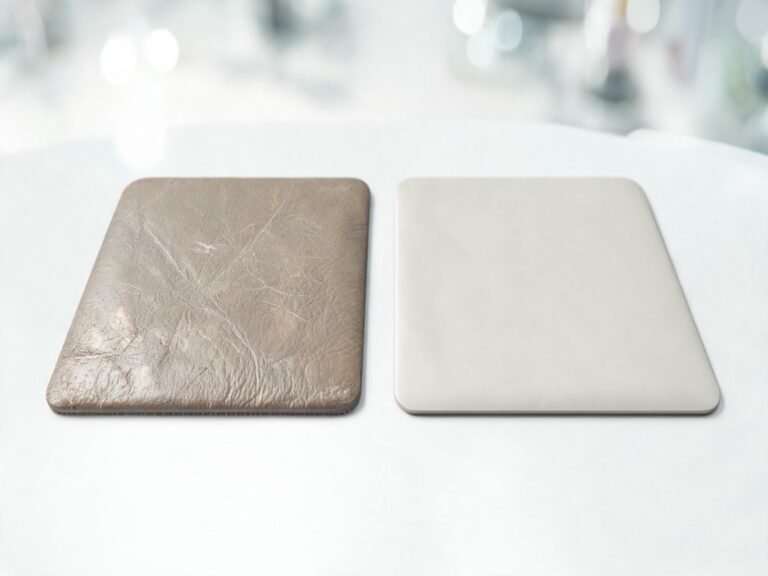
PU leather surface — the smooth appearance hides molecular vulnerabilities that surface in 2-5 years
How Polyurethane Leather Is Made: The Wet and Dry Process
To understand why PU leather fails, you need to understand how it is built. There are two manufacturing routes, and both embed structural weaknesses into the finished product.
The wet process dissolves polyurethane resin in DMF (dimethylformamide) — a solvent classified as a reproductive toxicant under EU REACH regulations. The base fabric — typically woven polyester or cotton — is immersed in this PU solution, then passed through a water coagulation bath where water displaces the DMF, creating a porous, cellular PU structure that mimics the feel of genuine leather. The residual DMF must be washed out, but trace amounts remain in the finished fabric, slowly off-gassing over the first months of use. This is the source of the “new car smell” that many people associate with new PU upholstery — and it is not a sign of quality. It is a sign of residual solvent.
The dry process avoids DMF. Instead, PU resin is coated onto release paper, partially cured, laminated to the base fabric, and then fully dried. The release paper is peeled away, leaving a textured surface. This process produces lighter, thinner PU leather with lower VOC emissions — but the resulting material has a thinner protective topcoat and typically lower abrasion resistance than wet-process PU. Both processes produce a material whose fundamental chemistry is the same: a polyurethane polymer bonded to a fabric backing through an adhesive layer.

Chemical mixing in PU leather production — the solvent-based process that creates residual VOC emissions
The Ester Bond Problem: Why PU Leather Hydrolyzes
The single most important molecule in this discussion is the ester bond. Most commercial PU leather is built on polyester-based polyurethane — meaning the polymer backbone contains ester linkages (C-O-C=O). These bonds have a bond energy of approximately 360 kJ/mol. Water molecules, particularly at elevated temperatures and humidity, can hydrolyze these bonds — breaking the ester linkage and shortening the polymer chain.
This is not a surface phenomenon. It happens throughout the PU layer and, critically, at the adhesive interface between the PU coating and the fabric backing. As the ester bonds break, the adhesive layer loses cohesive strength. The surface may still look intact from a distance — but the bond between the coating and the backing is quietly failing. This is why PU leather delamination often appears sudden: the surface holds together until the adhesive layer crosses a threshold, and then the topcoat peels away in sheets.
The rate of hydrolysis is climate-dependent. In environments with relative humidity above 70% — tropical markets, marine applications, uncontrolled warehouses — standard polyester PU leather begins visible degradation within 18 to 36 months. Even premium PU formulations, which may use polycarbonate diols instead of polyester diols to improve hydrolysis resistance, still contain urethane linkages that are fundamentally susceptible to water attack over a long enough timeline. The improvement is real but incremental — polycarbonate PU may last 5 to 7 years instead of 3, but it still fails. For a deeper analysis, our PU leather hidden problems guide breaks down each failure mechanism with field data.
The chemistry is the warranty. If the material’s core polymer bonds are vulnerable to water, no amount of quality control can prevent eventual failure. The question is not if PU leather will hydrolyze — it is when, and whether the timeline matches your project’s service life.
DMF Solvent and VOC Emissions: The Chemistry Behind the Smell
Dimethylformamide is the elephant in the PU leather factory. It is an effective solvent — it dissolves polyurethane resin cleanly and allows the wet coagulation process to create the porous, leather-like structure that consumers expect. But DMF is also a reproductive toxicant, a substance of very high concern under REACH, and a persistent VOC that off-gases from finished PU leather for months after production.
Modern PU factories have closed-loop DMF recovery systems that capture and recycle the solvent. But recovery is never 100%. Trace DMF remains trapped in the polymer matrix and migrates to the surface over the first 6 to 12 months of use. This is why newly installed PU upholstery has a characteristic chemical odor — and why that odor eventually fades. It is not because the material has “settled.” It is because the residual solvent has finished off-gassing into your indoor air.
The problem compounds over the material’s life. As PU leather hydrolyzes in years 3 to 5, the degradation of the polymer backbone releases additional VOCs — not just DMF, but breakdown products of the urethane linkages themselves. A material that passed indoor air quality testing on day one can become a sustained emission source as it ages. For specifiers who need verified eco-friendly leather solutions, this aging behavior is a critical factor that day-one VOC testing does not capture.
Material comparison — silicone leather vs PU leather performance and structural differences
Silicone’s Molecular Advantage: Si-O Bonds vs C-O Bonds
Silicone leather solves the hydrolysis problem at the molecular level. Its polymer backbone is polydimethylsiloxane (PDMS) — a chain of silicon-oxygen-silicon (Si-O-Si) bonds. The Si-O bond has a dissociation energy of approximately 452 kJ/mol, compared to the ~360 kJ/mol of the ester bonds in PU. That 25% difference in bond energy is the difference between a material that resists water indefinitely and one that is slowly consumed by it.
More importantly, the siloxane bond is non-polar and hydrophobic. Water molecules cannot attack the Si-O framework because the bond has no electrophilic carbon center for water to target. There is no hydrolysis reaction to initiate. This is not an additive or a coating — it is the fundamental polymer chemistry. Silicone leather does not resist hydrolysis better than PU. It is immune to hydrolysis, because the reaction that destroys PU cannot occur in silicone’s molecular structure.
The manufacturing process reflects this molecular stability. Silicone leather is produced through a solvent-free process — no DMF, no volatile solvents, no off-gassing. ISO 16000-6 testing confirms total VOC emissions below 0.01 mg/m³, effectively zero. The material is clean on day one and remains clean for 10 to 15 years because its polymer does not degrade into VOC-emitting fragments. For the full silicone vs PU comparison, our technical page provides 14 criteria scored side by side.
| Property | PU Leather | Silicone Leather |
|---|---|---|
| Core Polymer Bond | Ester (C-O-C=O), ~360 kJ/mol | Siloxane (Si-O-Si), ~452 kJ/mol |
| Hydrolysis Resistance | Poor — degrades in 2-5 years | Immune — no hydrolyzable bonds |
| Manufacturing Solvent | DMF (toxicant) | None — solvent-free |
| VOC Emissions (ISO 16000-6) | Moderate to high, increases with age | Below 0.01 mg/m³, stable |
| Martindale Abrasion | 30,000-80,000 cycles | 100,000-200,000+ cycles |
| Temperature Range | -20 to 80°C | -40 to 250°C |
| Service Life | 3-5 years | 10-15+ years |
5 Red Flags in a PU Leather Supplier’s Spec Sheet
If you are still sourcing PU leather — for cost reasons, for short-lived products, for markets where climate is forgiving — here are five spec sheet signals that should trigger concern:
- “Hydrolysis-resistant” without hours: If the spec sheet claims hydrolysis resistance but does not cite a specific test standard (ISO 1421, DIN 53508) or a specific exposure duration, the claim is marketing. Demand a number: “1,000+ hours” or nothing.
- No VOC test data: If the supplier cannot provide ISO 16000-6 or similar indoor air quality test results, assume the material off-gasses. The absence of data is not the absence of emissions.
- “Water-based PU” claimed without verification: Water-based PU genuinely reduces DMF use — but some suppliers use the term loosely. Verify with a REACH compliance certificate that confirms DMF is below the threshold of concern (1 ppm).
- Martindale cycles below 50,000: For commercial applications, 50,000 cycles is the minimum acceptable abrasion resistance. If the supplier’s spec sheet shows 30,000 or omits the test entirely, the material will not survive commercial traffic.
- No temperature range certification: PU leather rated only to 80°C will deform on a dashboard in direct sun. If the spec sheet does not state a temperature range, do not assume the material can handle heat.
For projects where these red flags are deal-breakers, the upgrade path is clear. Our PU and PVC material testing guide provides the test protocols and acceptance criteria that procurement teams should apply before signing a purchase order.
Frequently Asked Questions
Is all PU leather the same quality?
No. PU leather quality varies significantly based on the polyol type (polyester vs polycarbonate), the manufacturing process (wet vs dry), the density of the PU layer, and the quality of the base fabric. Polyester-based PU is the most common and the most vulnerable to hydrolysis. Polycarbonate-based PU offers better hydrolysis resistance — potentially 5 to 7 years instead of 3 — but commands a price premium that narrows the gap with silicone leather. The wet process produces thicker, more durable PU but uses DMF solvent. The dry process is solvent-free but produces thinner material with lower abrasion resistance. There is no single “PU leather” — there is a spectrum, and procurement teams need to know where on that spectrum their supplier’s product sits.
Can PU leather be recycled at end of life?
Technically, PU leather is a composite material — a polyurethane coating bonded to a fabric backing. Separating these layers for recycling is energy-intensive and rarely economically viable. Most end-of-life PU leather is landfilled or incinerated. Incineration of PU can release nitrogen oxides and, if the formulation contains chlorine-based additives, hydrogen chloride gas. Silicone leather, by contrast, is 100% recyclable — the silicone polymer can be recovered and repurposed without toxic byproducts because its Si-O backbone is thermally stable and chemically inert. For projects with circular economy requirements, this end-of-life difference is a decisive factor. Our synthetic leather vs PU leather comparison covers recyclability and other lifecycle metrics in detail.
When does PU leather still make sense as a material choice?
PU leather remains a rational choice for short-lifecycle products where the material will be replaced or discarded within 3 years — seasonal fashion accessories, promotional items, packaging, or products destined for markets with controlled climates and low humidity. It is also the lowest-cost option for applications where the aesthetic variety of 1,000+ texture and color options matters more than longevity. The decision framework is straightforward: if the product’s intended service life exceeds 3 years, if the operating environment includes humidity above 70%, or if the application involves enclosed spaces where VOC emissions matter — PU leather is the wrong material. For applications requiring hydrolysis-resistant silicone leather, the molecular immunity to water attack makes the upgrade cost recoverable within a single replacement cycle.
When PU Leather Still Makes Sense — and When It Does Not
PU leather is not a bad material. It is a material with known chemical limitations, manufactured through a process with known environmental costs, and suited for applications with short service lives and controlled climates. The problem is not PU leather itself — it is the mismatch between what PU leather can deliver and what procurement teams expect it to deliver.
When a spec sheet promises 5-year performance from a material whose ester bonds begin hydrolyzing in year two, the failure is not in the manufacturing — it is in the specification. When a supplier claims “eco-friendly” for a material manufactured with DMF solvent and landfilled at end of life, the gap between claim and reality is a procurement risk. Understanding the chemistry behind PU leather — the ester bonds, the DMF solvent, the plasticizer migration, the hydrolysis timeline — gives procurement teams the information they need to match the material to the application. Or to specify something better.
Read our complete polyurethane leather sourcing guide for the full procurement framework.
About TOPSUN
TOPSUN manufactures silicone leather through a solvent-free process that eliminates the DMF emissions, ester-bond hydrolysis, and plasticizer migration that define conventional PU leather failure modes — delivering materials with verified 10-15 year service lives across automotive, furniture, marine, healthcare, and consumer electronics applications.
Si-O bond energy 452 kJ/mol | ISO 16000-6 TVOC < 0.01 mg/m³ | 200,000+ Martindale cycles | -40 to 250°C range | Zero DMF | Zero plasticizers | 100% recyclable | ISO 10993 biocompatible