“Leather natural” sounds clean — a material from animals, not factories. But the word “natural” describes the raw material, not the finished product. Between the hide leaving the animal and arriving at your factory, it passes through chromium salts, formaldehyde, sulfides, and thousands of liters of water. None of that appears in the marketing copy. For B2B buyers specifying leather natural material, the question isn’t whether genuine leather has desirable properties — it does. The question is whether those properties justify the chemical residue, compliance risk, and environmental footprint that come attached. This article separates what’s real about leather natural from what’s hidden.
What “Leather Natural” Means in Material Specifications
In procurement language, “leather natural” refers to material made from animal hide — typically bovine — that has been tanned and finished but retains the original grain structure and fiber composition. It is distinct from “coated leather” (split hide with a polymer surface) and from synthetic leather (textile substrate with polymer coating). The natural designation implies the material’s surface is the actual grain of the hide, not an embossed imitation.
But here’s the nuance that matters for specification: “natural” describes the substrate, not the process. Chrome-tanned leather — which accounts for roughly 90% of global production — undergoes chemical treatment with chromium(III) salts that can oxidize to carcinogenic chromium(VI) under certain conditions. Vegetable-tanned leather, representing less than 10% of output, uses plant-derived tannins but takes 30–60 days versus 1–2 days for chrome tanning, making it prohibitively expensive for most B2B applications. When your spec says “leather natural,” you need to specify which tanning method — because the compliance profile changes entirely.
6 Properties That Make Natural Leather Worth Specifying
Genuine leather natural material has properties that no synthetic has fully replicated — though silicone comes close in several categories. These are the six characteristics that drive B2B demand for natural leather:
- Breathability: The collagen fiber structure of natural leather is porous at the molecular level. It absorbs moisture vapor and releases it to the environment — a property that synthetic coatings cannot replicate without compromising water resistance. For footwear and seating, this means real comfort advantages.
- Patina development: Natural leather ages visibly — oils from skin contact, sunlight exposure, and mechanical wear create a surface character that synthetic materials don’t develop. In luxury and heritage markets, this aging is a selling point, not a defect.
- Tensile strength: The random fiber orientation of hide gives natural leather a tear strength that is difficult to match with oriented textile substrates. Typical values: 200–400 N depending on hide origin and thickness.
- Thermal regulation: Leather natural material absorbs and releases heat gradually. It feels warm in cold conditions and cool in hot conditions — a property linked to its moisture-management behavior, not just insulation.
- Moldability: Under heat and moisture, natural leather can be shaped and holds its form permanently when dried. This is why leather is specified for contoured automotive seats and formed case goods.
- Tactile uniqueness: No two hides are identical. Grain pattern, pore distribution, and color variation make each piece distinct — a quality that mass-produced synthetics deliberately eliminate but that premium markets value.

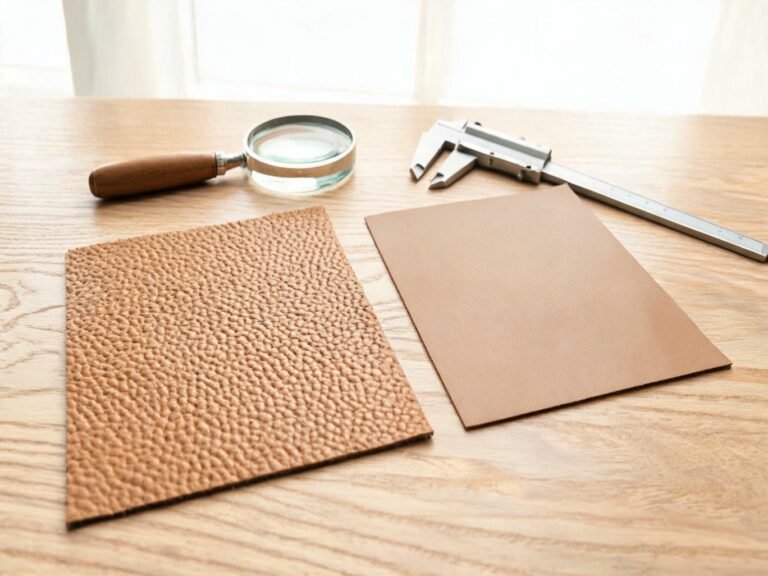
Tensile strength testing — one of the six measurable properties that justify specifying natural leather.
These properties are real and measurable. They explain why natural leather commands a premium in automotive, furniture, and accessories markets. But they come with a cost — not just financial, but chemical. For a broader view of how natural leather stacks up against alternatives, see our leather types guide covering traditional through advanced materials.
The Chemical Reality Behind the “Natural” Label
Here’s what the “natural” label doesn’t tell you. Animal hide, in its raw state, decomposes within days. To become leather, it must be preserved through a chemical-intensive process that fundamentally alters its composition. The four chemical categories that procurement teams need to audit:
| Chemical | Function | Compliance Risk |
|---|---|---|
| Chromium(III) salts | Primary tanning agent (90% of global production) | Can oxidize to Cr(VI) — restricted under REACH Annex XVII; Prop 65 listed |
| Formaldehyde | Preservative and finishing agent | Carcinogen; REACH restricted; OEKO-TEX limit 0.1% |
| Sulfides / Lime | Hair removal and hide preparation | Wastewater contaminant; COD/BOD load |
| Azo dyes & finishing resins | Coloring and surface treatment | Some azo dyes release carcinogenic amines; REACH Annex XVII banned list |
These are not theoretical risks — they are the reason leather tanneries face some of the strictest environmental regulations of any manufacturing sector.

Chemical processing equipment — the reality behind the “natural” label that most leather marketing omits.
Leather Working Group (LWG) certification helps — it audits tanneries for environmental management and chemical safety. But LWG certification audits the process, not the product. Your incoming material still needs substance-level testing for chromium(VI), formaldehyde, and restricted amines. For B2B buyers shipping to EU or California markets, this testing is not optional — it’s a customs requirement.
Environmental Footprint: 17,000 Liters and What’s in the Wastewater
The environmental case for natural leather rests on one argument: it’s a byproduct of the meat industry. That argument has merit — hides would otherwise be waste. But the tanning process itself carries an environmental burden that the “byproduct” framing doesn’t account for. According to industry data, producing a single leather hide requires approximately 17,000 liters of water, much of it contaminated with chromium, sulfides, and organic solids by the time it leaves the tannery. For more detailed sustainability data, see our 2026 leather sustainability report.
Vegetable tanning solves the chromium problem but creates a different one: 30–60 days of processing time, higher water consumption per hide, and limited scalability — less than 10% of global leather is vegetable-tanned. For B2B procurement at scale, neither option is clean: chrome tanning has the chemical burden, vegetable tanning has the cost and scalability burden. The choice between them is a trade-off, not a clear win.
When to Specify Natural Leather (and When Not To)
Based on the data above, here’s the decision framework we use with B2B clients:
| Application | Natural Leather? | Why / Why Not |
|---|---|---|
| Luxury automotive (premium brands) | Yes | Patina, breathability, and brand heritage justify the cost and compliance overhead. |
| Mass-market automotive / fleet | No | Cost, supply inconsistency, and UV fading (1–2 years) make natural leather impractical at scale. |
| Contract furniture (high-traffic) | No | Abrasion resistance (50K–100K cycles) is lower than silicone (150K+). Stain resistance is poor. |
| Medical / healthcare | No | Chemical residue (Cr, formaldehyde) is incompatible with skin-contact medical standards (ISO 10993). |
| Marine / outdoor | No | Natural leather has poor salt spray resistance and water damage susceptibility. |
| Fashion accessories (premium) | Yes | Tactile uniqueness, patina, and consumer expectations align with natural leather’s strengths. |
The pattern is clear: natural leather wins where its unique properties (patina, breathability, tactile uniqueness) directly serve the product’s value proposition. It loses where performance metrics (abrasion, UV, stain resistance, biocompatibility) are the primary spec requirements. For the performance-driven applications, silicone leather was engineered to deliver the “natural” feel without the chemical burden. See our synthetic leather vs genuine leather comparison for the full data set.

Natural vs. synthetic leather — the pros and cons that procurement teams need to weigh before specifying.
How Silicone Leather Delivers “Natural” Without the Chemical Burden
Silicone leather was developed specifically to solve the contradiction at the heart of leather natural material: the properties buyers want (tactile warmth, durability, breathability-adjacent comfort) are locked behind a process buyers don’t want (chrome tanning, formaldehyde, wastewater contamination). By replacing the animal hide substrate with a textile base and the tanning chemicals with a liquid silicone rubber coating, silicone leather achieves:
- Matched durability: 150,000+ Martindale cycles vs natural leather’s 50,000–100,000 — a 1.5–3x improvement in abrasion resistance.
- Superior UV stability: 1,500 hours (ASTM D329) vs natural leather’s fading within 1–2 years of sun exposure.
- Better hydrolysis resistance: 14 weeks (ASTM D3980) vs natural leather’s moisture sensitivity that causes mold and stiffness.
- Clean compliance: Zero chromium, zero formaldehyde, zero plasticizers. Compliant with REACH SVHC 181, RoHS 2.0, Prop 65, and ISO 10993 biocompatibility standards.
- Inherent flame retardancy: The silicone polymer is self-extinguishing without chemical additives — natural leather requires flame-retardant treatment to pass BS 5852 or CA TB 117.
Durability comparison — see how silicone leather performs against natural leather in standardized testing.
FAQ: Leather Natural
Q: Is leather a natural material?
A: The raw substrate (animal hide) is natural. The finished product is chemically transformed — tanning requires chromium salts, formaldehyde, or plant tannins that permanently alter the hide’s composition. “Natural” describes the origin, not the process.
Q: What is the difference between leather natural and genuine leather?
A: They are essentially the same category. “Leather natural” emphasizes the uncoated grain surface; “genuine leather” is the broader legal term for material made from animal hide. Both undergo chemical tanning. The distinction that matters for procurement is the tanning method (chrome vs vegetable), not the label.
Q: Does natural leather breathe better than synthetic leather?
A: Yes. The collagen fiber structure of natural leather is porous at the molecular level, allowing moisture vapor transmission that no polymer coating can fully replicate. However, in many B2B applications (upholstery, automotive), comfort is also influenced by thermal regulation and surface temperature, where silicone leather performs comparably despite lower breathability.
Q: How long does natural leather last compared to silicone leather?
A: Natural leather typically lasts 5–10 years. Silicone leather lasts 5–15 years. The key difference is failure mode: natural leather degrades through UV fading, mold, and cracking; silicone leather is inherently resistant to all three.
Q: Is vegetable-tanned leather more natural than chrome-tanned?
A: Yes, in the sense that it uses plant-derived tannins instead of heavy metal salts. But it represents less than 10% of global production, takes 30–60 days to produce (vs 1–2 days for chrome), and is significantly more expensive. For most B2B applications at scale, vegetable-tanned leather is not a practical specification.
About TOPSUN
TOPSUN manufactures silicone-coated leather that was engineered to solve the central contradiction of leather natural material: the properties B2B buyers want are locked behind a chemical process they can’t afford. Our silicone leather replaces animal hide substrates with woven and non-woven textiles, and replaces tanning chemicals with a liquid silicone rubber coating that is cured without solvents, plasticizers, or heavy metals.
Our facility operates a full dry-coating production line with inline quality monitoring, and our laboratory runs Martindale abrasion, UV stability, hydrolysis resistance, color fastness, and flame retardancy tests on every production batch. We work with procurement teams across automotive, furniture, medical, and marine sectors to specify silicone leather where performance data — not origin labels — should drive the material decision. Every shipment includes batch test reports mapped to your specification, and our formulation team adjusts coating thickness, substrate type, surface texture, and color to meet application-specific targets. If you’re evaluating whether natural leather or silicone leather is the right specification for your product, contact our technical team with your application requirements.