From three feet away, telling leather and faux leather apart is nearly impossible. Modern PU and PVC embossing technology has become that good at replicating grain patterns, sheen, and even the natural color variation of real hide. But when a B2B buyer specs the wrong material into a commercial furniture contract, the difference surfaces within 18 months — as peeling, cracking, and warranty claims.
We’ve spent years testing leather and faux leather samples submitted by buyers who got burned by mislabeled materials. The pattern is always the same: the data sheet says “genuine leather,” the burn test says otherwise. Here are six lab tests that cut through the marketing and reveal what you’re actually buying.
Request Material Comparison Samples
Why Visual Inspection Fails for Leather and Faux Leather
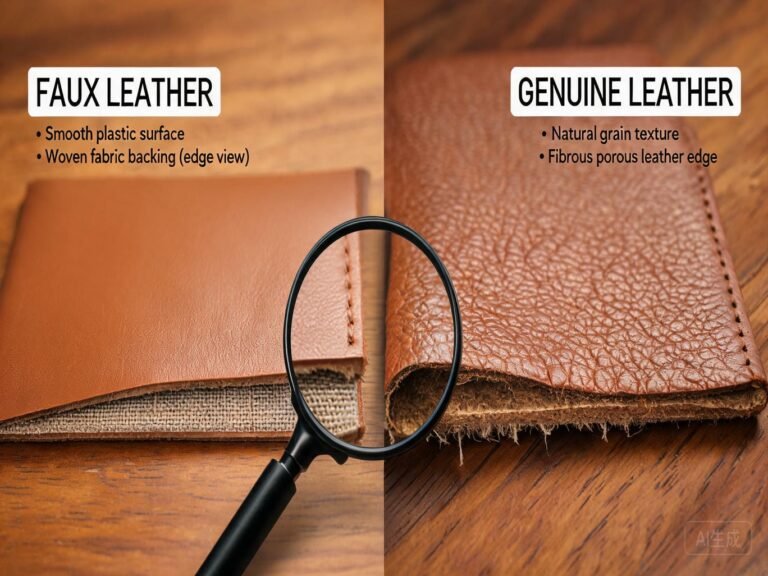
The traditional advice — “look for irregular pores” or “check the back for suede fibers” — worked fifteen years ago. Today’s high-end PU faux leather uses release paper technology that transfers a randomized grain pattern, breaking the repetition that used to be the dead giveaway. Under a 10x loupe, premium faux leather and corrected-grain genuine leather are nearly indistinguishable.
In our lab, we received a batch of “genuine leather” swatches from a supplier quoting 30% below market price. The pore pattern looked natural. The backing had fiber structure. But when we ran a cross-section under 50x magnification, the truth was visible: a 0.3mm polymer coating sat on top of a non-woven fabric substrate. It was PU faux leather dressed up as the real thing.

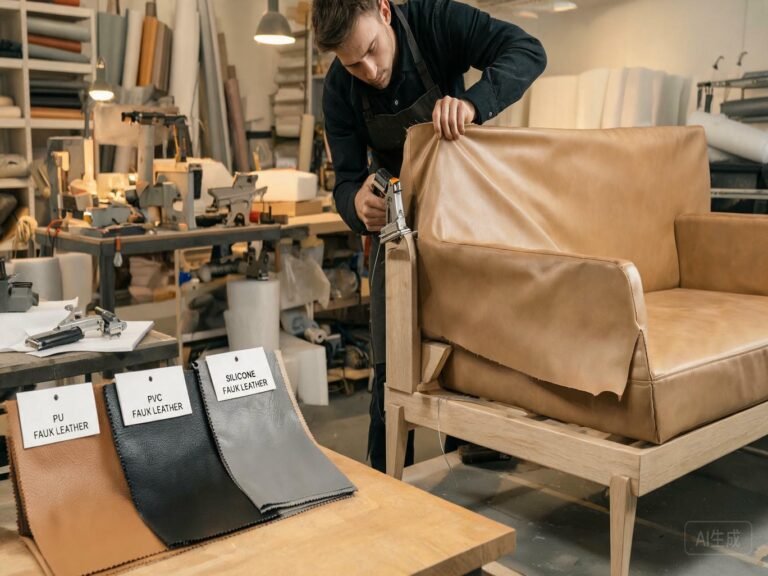
Material inspection station where incoming leather and faux leather samples are verified before production
6 Lab Tests That Separate Real From Synthetic
These tests range from 5-minute floor checks to 48-hour lab procedures. We recommend running at least three on any new supplier’s material before signing a contract.
| Test Method | What It Measures | Real Leather | Faux (PU/PVC) | Silicone Leather |
|---|---|---|---|---|
| Burn Test (offcut) | Combustion behavior | Smells like burnt hair | Smells like burning plastic, melts | Self-extinguishes, minimal smoke |
| Cross-Section Microscopy | Fiber structure at 50x | Collagen fiber bundles | Polymer layer on fabric | Silicone layer on substrate |
| FTIR Spectroscopy | Chemical fingerprint | Amide I/II/III collagen peaks | Carbonyl peak at 1730 cm⁻¹ | Si-O-Si absorption bands |
| Water Drop Test | Surface porosity | Slowly absorbs | Beads up, no absorption | Beads up, no absorption |
| Martindale Abrasion | Surface wear cycles | 50K–100K cycles | 25K–50K cycles | 200K+ cycles |
| UV Aging (ASTM G154) | Colorfastness + cracking | Fades at 300 hrs | Cracks at 200 hrs | No change at 1,000+ hrs |
FTIR spectroscopy is the definitive test. Collagen’s Amide I, II, and III bands at 1600, 1500, and 1200 cm⁻¹ are impossible to replicate in synthetic materials. One scan settles the question permanently.

Burn test on leather sample — combustion behavior reveals polymer vs protein composition
Where Silicone Leather Fits Between Leather and Faux Leather
Silicone leather occupies a third category that confuses the binary of leather and faux leather. It’s synthetic — no animal hide involved — but its performance profile aligns closer to genuine leather than to PU or PVC. In our testing, silicone leather passes the burn test with self-extinguishing behavior (genuine leather chars, PU melts), and its Martindale performance at 200,000+ cycles exceeds both categories.
The LIBS technique developed for leather identification can distinguish silicone leather from both genuine and PU in seconds, detecting silicon signatures that neither animal collagen nor polyurethane contains. For B2B buyers, this means silicone leather is verifiable, traceable, and impossible to misrepresent — a significant advantage when material authenticity audits are part of your compliance process.

Water drop test — genuine leather absorbs slowly; faux leather and silicone leather repel completely

Side-by-side comparison of leather and faux leather — visual similarity hides dramatically different lifespans
What B2B Buyers Should Spec Instead of “Genuine Leather”
The phrase “genuine leather” on a spec sheet is nearly meaningless — it covers everything from full-grain hides to heavily coated split leather that performs worse than mid-range PU. Instead of chasing the leather vs faux leather label, spec the performance metrics that actually matter: Martindale cycles, UV stability hours, temperature range, and VOC emission levels.
For commercial furniture applications, we’ve seen spec sheets listing “genuine leather” fail at 25,000 Martindale cycles — below the 30,000-cycle threshold for light-duty domestic use. A silicone leather spec at 200,000 cycles costs 15-20% more per meter but delivers 4-5x the service life. The math is straightforward when you model replacement labor and warranty exposure.
Watch silicone leather vs PU vs genuine leather side-by-side material comparison testing
Frequently Asked Questions
Is silicone leather considered real leather or faux leather?
Neither. Silicone leather is a synthetic material — it contains no animal hide — but it outperforms both genuine leather and traditional faux leather (PU/PVC) in Martindale abrasion (200K+ cycles), UV stability (1,000+ hours), and temperature resistance (-40°C to 250°C). FTIR spectroscopy identifies it instantly via its Si-O-Si absorption bands, making it fully traceable in supply chain audits.
What is the fastest way to test leather vs faux leather on a factory floor?
The burn test on an offcut takes 10 seconds: real leather chars and smells like burnt hair, while PU/PVC melts and smells like burning plastic. However, this test is destructive and should only be done on scrap material. For non-destructive verification, a water drop test takes 30 seconds — genuine leather absorbs slowly, while faux leather and silicone leather repel completely. For definitive results, FTIR spectroscopy provides a chemical fingerprint in under 2 minutes.
Specifying Materials That Survive Audits
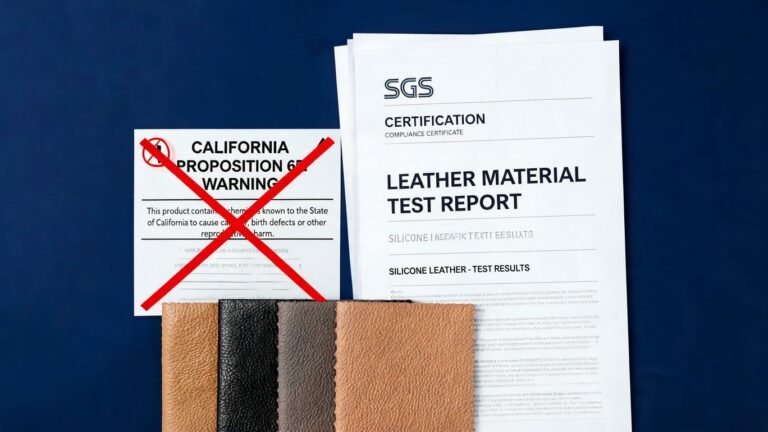
The leather and faux leather distinction matters less than the performance data behind it. A “genuine leather” label guarantees nothing without test reports backing it up. For a deeper analysis of how synthetic materials compare to real hide across cost, durability, and compliance dimensions, this faux leather vs real leather breakdown covers the full comparison framework.
If you’re auditing suppliers, request FTIR test reports alongside Martindale and UV data. Any supplier who can’t provide spectroscopic verification of their material composition is a risk. For more on synthetic material identification, this guide on synthetic leather vs genuine leather walks through the evaluation process step by step.
Get Free Leather Testing Swatches
About TOPSUN
TOPSUN manufactures silicone-based leather that bridges the gap between genuine leather and faux leather, delivering the durability and safety certifications B2B buyers expect from real hide with the consistency and customization only synthetic manufacturing can provide.
FTIR-verifiable material composition · 200K+ Martindale cycles · UV-stable 1,000+ hours · Zero VOC emissions · ISO 10993 biocompatibility certified