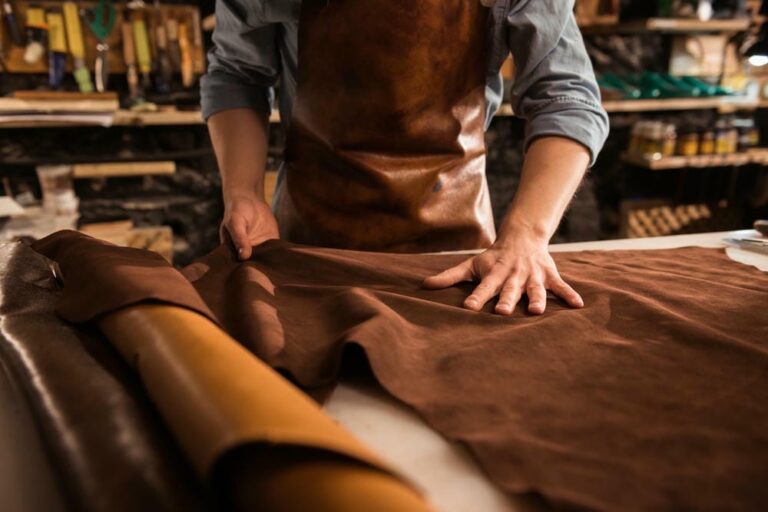
As a leatherworking process engineer who has optimized production lines for 40+ leather goods manufacturers across Asia and Europe, I can tell you that 80% of production defects trace not to material quality, but to workability mismatches — specifying leather by its end-use properties (durability, color, thickness) without considering how it responds to the tools that shape it. A purchase order that says “full-grain cowhide, 1.5mm, black” tells you what the finished product should look like. It says nothing about whether the material will hold a stamped impression, skive cleanly at 10 degrees, or accept edge paint without peeling. Those are the workability properties — and they’re the red lines that separate a smooth production run from a 15% defect rate.
Request Workability Test Samples
What “Leather for Leather Working” Really Means in B2B Manufacturing
In the hobbyist leatherworking market, “leather for leather working” means buying veg-tan cowhide sheets for stamping and carving. In B2B manufacturing, it means something fundamentally different: selecting a material whose physical properties — fiber structure, surface energy, thermal response, moisture behavior — are compatible with the production tools and processes that will transform flat stock into finished goods. A material that performs beautifully in service but fights every tool on the production line creates cost overruns, defect rates, and delivery delays that erase any material cost savings.

Coating production line — the manufacturing process that determines a material’s workability properties begins here, at the polymer-fiber interface where surface energy, density, and flexibility are engineered.
The leatherworking process for B2B goods involves five primary operations: cutting (die-cut or knife-cut), skiving (thinning edges for folding or stitching), tooling/stamping (creating surface impressions), stitching (sewing panels together), and edge finishing (painting, burnishing, or folding raw edges). Each operation imposes specific physical demands on the material — and each demand is a workability property that must be specified, not assumed. When a purchase order specifies only thickness, color, and quantity, it leaves every workability parameter to chance — and chance is the most expensive line item in leather goods manufacturing.
The 3 Workability Red Lines
After auditing production defects across hundreds of leather goods programs, I’ve identified three workability properties that, when violated, consistently cause production failures. I call them red lines because crossing any one of them — by specifying the wrong tanning method, the wrong fiber structure, or the wrong surface chemistry — creates a defect rate that no amount of process adjustment can recover. These properties must be specified at the material sourcing stage, not discovered on the production floor.
| Workability Property | Veg-Tan Leather | Chrome-Tan Leather | Silicone Leather | Production Impact | How to Test |
|---|---|---|---|---|---|
| 1. Tooling Response (stamping/carving) | Excellent — dense fiber structure holds impressions permanently when wet-molded | Fails — open fiber structure won’t hold impressions; stays too soft when wet | Good — holds embossed textures through heat-press process; no wet-molding required | Chrome-tan cannot be tooled/stamped — limits design options; requires separate tooling-grade material | Stamp sample with 5kg weight; measure impression depth retention after 24 hrs |
| 2. Skiving Behavior (edge thinning) | Clean skive when slightly damp — fibers compress and cut at 10-20° angle | Tears and frays — open fiber structure produces ragged edges; skives dry only | Clean, consistent skive — uniform polymer structure cuts cleanly at any angle, dry or damp | Rough skive = visible edge defects; rework adds 15-30 seconds per panel × thousands of panels | Skive 5 samples at 15° angle; inspect edge quality under 10× magnification |
| 3. Edge Finishing (paint/burnish compatibility) | Accepts edge paint and burnishes well — fiber content allows mechanical smoothing | Edge paint peels within 3-6 months — surface energy mismatch; burnishing produces fuzzy edges | Excellent paint adhesion — silicone surface energy allows polymer edge paint bonding; no burnishing needed | Edge paint failure = product return; warranty claim cost averages €25-45 per unit | Apply 3-layer edge paint; cross-hatch adhesion test (ASTM D3359) after 72 hrs |

Inspection station — workability verification begins at material intake. A 10-minute workability test on incoming stock can prevent a 10-day production delay from defective material.
The Veg-Tan Bottleneck: Why Workability Creates Production Risk
The traditional leatherworking industry has a structural bottleneck: tooling — the process of stamping, carving, and embossing designs into leather — requires vegetable-tanned leather. No other tanning method produces a fiber structure dense enough to hold permanent impressions. This means any product with tooled or stamped decoration must use veg-tan, regardless of whether veg-tan’s other properties (limited color range, moisture sensitivity, higher cost) are appropriate for the application.
Veg-tan leather is tanned using plant-based tannins from tree bark — a process that takes 30-60 days and produces a firm, dense, moldable material with a limited color palette (primarily natural, brown, and black). It develops a patina over time, which some markets value but others see as undesirable color drift. It’s sensitive to moisture — water spots and stains are permanent unless treated. And because it’s a natural product, the same tanning process produces different firmness and tooling response from hide to hide, creating workability inconsistency that translates to variable impression depth, tooling clarity, and production speed.
The workability bottleneck manifests in three ways on the production floor: First, tooling operations require a separate material specification from the rest of the product, increasing sourcing complexity and MOQ thresholds. Second, wet-molding — the process of dampening veg-tan to make it pliable for shaping — adds a process step that takes 2-4 hours per batch and introduces moisture variability that affects downstream operations. Third, natural variation in veg-tan firmness means the same stamping pressure produces different impression depths on different hides, requiring per-hide pressure adjustment that slows automated tooling lines.
Manufacturing process — silicone leather’s workability properties are engineered at the coating stage, creating consistent behavior across every batch and eliminating the natural variation that plagues veg-tan tooling.
How Silicone Leather Changes the Leatherworking Equation
TOPSUN’s silicone leather addresses all three workability red lines through material engineering rather than tanning chemistry. For tooling response, silicone leather holds embossed textures through a heat-press process — no wet-molding required. The polymer’s thermal memory allows textures to be embossed at elevated temperature and retained permanently at room temperature, eliminating the veg-tan dependency for tooled or textured surfaces. TOPSUN offers 100+ texture options (cowhide, pigskin, sheepskin patterns) with custom embossing rollers produced in 7-10 days.

Calendering line operator — the production process where silicone leather’s uniform polymer structure is engineered, creating consistent skiving and edge-finishing behavior across every meter of output.
For skiving behavior, silicone leather’s uniform polymer matrix cuts cleanly at any angle — dry or damp — without the tearing and fraying that plagues chrome-tan’s open fiber structure. This consistency reduces edge-defect rates to under 2% (vs 8-12% for natural leather variants) and eliminates the per-hide pressure adjustments that slow automated tooling lines. Edge finishing benefits from silicone’s surface energy, which allows polymer-based edge paint to bond at the molecular level — no burnishing required, and paint adhesion passes ASTM D3359 cross-hatch testing after 72 hours of curing.
For B2B buyers who need workability documentation, TOPSUN provides: process parameter guides for cutting, skiving, stitching, and edge finishing silicone leather; technical data sheets specifying Martindale abrasion resistance of ≥ 200,000 cycles, flex resistance of ≥ 50,000-100,000 cycles, and tensile strength of ≥ 10-15 N/mm; and free A4 swatches shipped worldwide for in-house workability testing before production commitment. The material is available in thicknesses from 0.23mm (Ultra Thin Collection for 3C accessories) to 2.0mm (Classic Collection for furniture and bags), with MOQ of 500 meters and lead time of 7-15 days — production parameters that support both sample development and full-scale manufacturing.

Lamination process — silicone leather’s engineered surface properties ensure consistent bonding, cutting, and finishing behavior that natural leather’s variability cannot match.
Frequently Asked Questions
Can you tool silicone leather the same way as veg-tan leather?
Not identically — the processes differ. Veg-tan leather is tooled by wet-molding and stamping with hand tools, using the material’s moisture-responsive fiber structure to create permanent impressions. Silicone leather is embossed through a heat-press process, where the polymer’s thermal memory captures textures at elevated temperature and retains them permanently at room temperature. The result is similar — permanent surface texture — but the process is faster, more consistent, and doesn’t require the 2-4 hour wet-molding step. Custom embossing rollers can be produced in 7-10 days for brand-specific patterns.
What thickness is best for leather working projects?
Thickness depends on the application. For tooling and stamping, 1.2-1.6mm (3-4 oz) provides enough material depth for crisp impressions without excessive bulk. For belts and structural components, 3.2-3.8mm (8-10 oz) is standard. For wallets and small goods, 0.8-1.2mm maintains a slim profile. For phone cases and 3C accessories, 0.5-0.8mm is ideal. Silicone leather is available from 0.23mm to 2.0mm, covering the full range of leatherworking applications without the natural hide thickness variation that complicates cutting and yield planning.
Does silicone leather require different stitching needles or thread?
Silicone leather stitches with standard leatherworking needles and thread — no specialized equipment required. The material’s uniform density provides consistent needle penetration resistance, which actually improves stitching speed compared to natural leather’s variable density. Edge skiving for folded seams is cleaner and more consistent, reducing the preparation time before stitching. For machine stitching, the lower coefficient of friction on the silicone surface reduces needle heat buildup, allowing faster stitching speeds without thread breakage.