Why does one laminated seat panel age gracefully while its twin delaminates in a year? The answer rarely sits in the fabric you can see. It sits between the layers, where fabric and fabric meet.
A laminated textile is several materials shipping as one. Each layer carries a separate job, with a separate supplier behind it. This piece walks the three-layer stack, the bonding methods, and the checks that keep the stack together in service.
One Material, Actually Several
Lamination is the specialized process of bonding multiple layers, typically face fabric, foam, and backing, into a unified composite. Done well, it lifts durability, water resistance, breathability, and dimensional stability all at once. Done casually, it produces a product whose layers argue with each other until one walks away.
From a supply chain view, a laminate is also a coordination problem. Three layers can come from three mills, two bonders, and one finisher. Every handoff is a place where someone else’s tolerance becomes your failure. That is why the questions worth asking sit between the layers, not on the face.
What Each Layer Contributes
The classic automotive upholstery build makes the division of labor explicit. Technical reviews of automotive textiles describe a three-layer assembly. The face fabric handles appearance and abrasion. A foam layer adds cushioning, and a backing holds dimensional stability. Foam thickness in that literature runs from 0.1 to 12 mm, selected to suit the application. Knitted, nonwoven, or film backs keep the assembly from growing or shrinking on the line.
| Layer | Job | What to Verify |
|---|---|---|
| Face fabric | Appearance, abrasion, stain behavior | Wyzenbeek or Martindale score with test report |
| Foam or adhesive core | Cushioning, drape over curves, sound damping | Thickness tolerance and compression set |
| Backing | Dimensional stability, seam strength | Knit, nonwoven, or film type and shrinkage data |
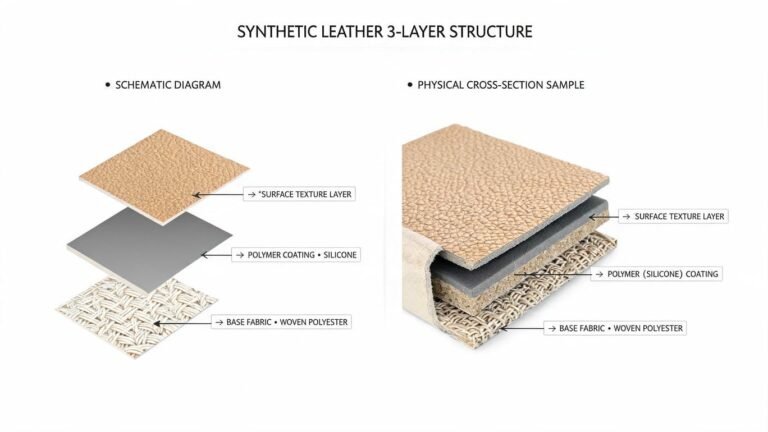
Bonding services add a fourth reason the stack exists: reinforcement. Bonding gives thin face fabrics body. It lifts tear and puncture resistance. It also lets one layer carry aesthetics while another carries function. On coated material the stack collapses to two: the base fabric and the functional coating. Our silicone microfiber leather is exactly that build, a microfiber base doing stability work under a silicone face doing everything the user touches.
Peel Strength and Compression Set: The Numbers That Hold a Stack
Two lab numbers predict how a laminate behaves in year three. The first is peel strength, tested by pulling bonded layers apart at a controlled angle and speed. Adhesive lamination suppliers verify it on test samples before full production, and repeat it on every run. The second is compression set, the share of thickness a foam core never recovers after long compression. A core that sets badly turns a plush seat into a flat one, even though the face fabric looks untouched.
Ask for both numbers with their methods. Peel data quoted without an angle and speed is not comparable between suppliers. Compression set quoted without time and temperature, typically hours at elevated temperature in the standard methods, is not a promise at all. A supplier who publishes both, on production lots rather than lab sheets, is telling you where their process really runs.

Two rolls at the unwinder: the point where fabric and fabric become one product.
Flame Lamination or Glue Lamination
Two bonding routes dominate. Flame lamination passes foam past an open flame to soften its surface. The foam then presses to the fabric and bonds as it cools. Glue lamination uses an adhesive layer instead. Upholstery mills running both report options from 2 to 10 mm of lamination thickness. Working widths of 140 and 170 cm are standard, and flame bonding is favored for foam-on-fabric work. Ask which route your supplier runs before the sample leaves the mill, because the two feel different on curved work.
Each route carries a chemistry trade-off. Adhesives can leave solvent residues that show up later as odor or emissions, which matters in cabins and bedrooms. Coating chemistry offers a different answer: build the functional layer directly on the fabric with no glue line at all. The eco-friendly silicone leather approach eliminates the adhesive question by not creating it. VOC results are tested to ISO 16000-6 rather than assumed.

Calender nip: pressure and heat making two layers act as one.
The production line: where base fabric and coating are bonded in a single pass.
Why the Bond Line Is Where Batches Fail
Laminates rarely fail in the middle of a layer. They fail at the interface, where peel strength lives. Professional bonding shops verify bond strength on test samples before full production, then inspect every run for adhesion consistency. The verification habit matters more than the bonding method, because a perfect face fabric on a tired adhesive line still ships failures.
For buyers, two practices catch most of the risk. First, ask which layers are bonded in-house and which were bought pre-laminated, because handoffs hide process drift. Second, request peel or adhesion data from the actual production lot, not from a brochure. Automotive interiors, where seat laminates face heat, flex, and years of load, live or die on exactly this number. Our automotive interiors applications page shows how those requirements translate into coated builds.
Where the Laminate Logic Shows Up in Orders
The same stack logic runs through nearly every B2B category, only the layers change. Contract furniture bonds decorative fabric to foam so cushions keep their crown after a season of banquets. Curtain programs laminate blackout layers to face cloth for dimensional stability. Footwear bonds linings to uppers for form retention. Wall panels and acoustical treatments bond fabric to rigid substrates, which is where the acoustic benefit of a soft interlayer earns its line item.

Layers in the wild: upholstery programs live and die by the bond between them.
Coated programs simplify the stack but keep the logic. A silicone-coated build for a healthcare waiting room pairs a stable base with a sealed, wipeable face, and the bond between them is the coating line itself. For hospital and clinic seating, cleaning agents attack glue lines as fast as they attack surfaces. Removing the adhesive is not a styling choice there. It is a maintenance decision that shows up in the floor schedule.
What a Laminate Weighs Against a Coated Build
Thickness is where the two architectures part ways. Foam laminates commonly run 2 to 10 mm overall, while coated builds sit between 0.8 and 2.0 mm. That gap decides fit. A channel-tufted headboard welcomes the bulk of a foam laminate. A wrapped armrest, a stitched automotive door insert, or a rolled edge does not, because extra thickness fights the seam allowance and the staple line. Weight runs the same way: coated builds start near 400 g/m², while foam laminates climb past 1,000 g/m² quickly.
Cost structure separates them too. A three-layer laminate carries three material purchases and at least two bonding passes, each with its own scrap rate. A coated build buys one base fabric and one coating pass on the same invoice, which is why supply chain teams keep it as the default until a program genuinely needs foam. The saving is not the face fabric price. It is the two handoffs you never schedule.
The Judgment Call: One Layer or Three
Not every product needs a three-layer laminate, and paying for layers you do not need is its own failure mode. The table below is the short version of the decision.
| If Your Priority Is | Specify |
|---|---|
| Comfort over curves | Face fabric with foam lamination, 2 mm or thicker |
| Dimensional stability in frames | Knit or nonwoven backing, shrinkage data attached |
| Low odor and low VOC | Adhesive-free coated build with ISO 16000-6 results |
| Long service life in wet zones | Hydrolysis-resistant coated fabric, ISO 11507 tested |
Fabric and fabric is a partnership, and partnerships are specified, not assumed. Name the layers, verify the bond, and the laminate ships as one material for its whole service life. One habit keeps it honest. File the retention swatches and peel reports with the PO. Year-three disputes then have a reference to argue from.
Frequently Asked Questions
Is a laminated fabric stronger than a single-layer fabric?
Usually yes in tear, puncture, and dimensional stability, because layers share the load. But the laminate is only as strong as its bond line. Ask for peel strength data from the production lot before judging the stack by its face.
What is the difference between flame lamination and glue lamination?
Flame lamination softens a foam surface with heat and presses it to fabric, while glue lamination bonds layers with an adhesive. Flame work avoids adhesive residues; glue work offers broader material pairings. Coated builds skip both by forming the functional layer directly on the base fabric.
About TOPSUN
TOPSUN builds fabric-and-coating laminates on in-house lines. Woven base fabrics enter the coater and leave with a silicone functional layer bonded without adhesives, in 0.8 to 2.0 mm builds for furniture, automotive, marine, and medical programs. Custom runs start from 500 meters, and bond-relevant test reports travel with every sample card.
Talk to Our Team About Your Laminate
Request Laminated Fabric Samples
References
1. dmtextiles.com: fabric lamination process