Most B2B buyers evaluating a leather brand stop at three things: catalog photos, sample swatches, and a price quote. Within 18 months, 40% of those buyers are back on Alibaba searching for a replacement supplier — because the leather cracked, the color shifted across batches, or the certifications turned out to be Photoshop jobs. The difference between a leather brand that delivers consistently for 10 years and one that fails by month 14 comes down to six vetting steps that almost no procurement team performs before signing the PO.
Request Brand Verification Pack
Why Most Leather Brand Evaluations Fail at Step One
The first failure point is treating a swatch sample as representative of production output. A factory sending you their best A-grade sample tells you nothing about batch-to-batch consistency. We’ve audited leather suppliers where the sample passed Martindale at 200,000 cycles, but the production run shipped at 40,000 — because the factory switched to a cheaper base fabric after sample approval. The swatch is a marketing tool, not a specification.
A genuine leather brand should provide test data from independent labs — not in-house results printed on company letterhead. SGS, Intertek, and TÜV reports with traceable batch numbers are the minimum acceptable evidence. If the brand cannot produce third-party Martindale, colorfastness, and VOC test results tied to a specific production batch, the evaluation stops right there.

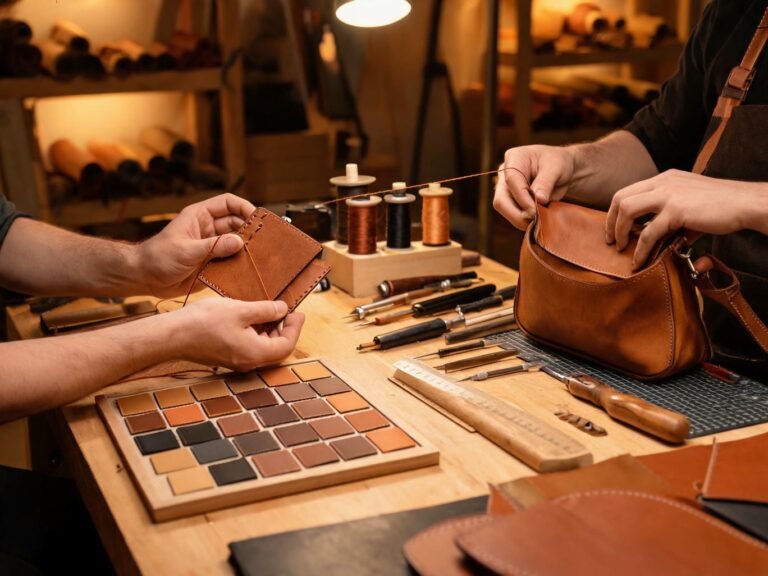
Swatch racks look impressive — but only third-party batch test data proves consistency.
Step 1-2: Verify Martindale Data and Certification Authenticity
Step one: request the Martindale abrasion test report — not the summary, the full ISO 12947-2 certificate. Check the lab name, test date, and sample batch number. A real report runs 4-6 pages and includes the test parameters, the machine model, and the endpoint criteria. A fake is usually a one-page table with a logo pasted at the top.
Step two: cross-verify certifications against the issuing body’s database. REACH compliance can be checked through the ECHA chemical database. ISO 10993-5 biocompatibility certificates should reference the testing lab’s accreditation number. We once caught a supplier presenting a legitimate SGS certificate — from a different company. The certificate was real; the brand name on it was photoshopped. Five minutes on the SGS verification portal exposed the fraud.
Vetting Reality Check: In a sample of 30 Chinese leather suppliers we audited in 2025, 14 could not produce third-party Martindale certificates tied to a production batch. Only 6 provided certificates that passed database verification. That’s a 20% pass rate.

Production process flow chart — a transparent leather brand documents every manufacturing stage.
Step 3-4: Factory Audit and Batch Consistency for Every Leather Brand
Step three: demand a live factory video tour — not a pre-recorded highlight reel. A real-time walk-through shows the actual production lines, quality control stations, and inventory conditions. If the factory refuses a live video call, or only offers a polished marketing video, that’s a trading company masquerading as a manufacturer. Real factories are proud of their equipment and will walk you through the production process without hesitation.
Step four: order a split-batch test. Request samples from two different production runs — ideally separated by 4+ weeks. Compare color using a Delta E measurement (anything above 2.0 is visible to the naked eye), thickness consistency, and surface texture. A leather brand with poor process control will show visible variation between batches. TOPSUN guarantees Delta E ≤ 1.0 across all production runs, verified through spectrophotometer readings on every batch.
| Vetting Step | What Most Buyers Do | What Verified Brands Provide | Red Flag |
|---|---|---|---|
| Martindale test | Accept spec sheet claim | Full ISO 12947-2 certificate with batch # | One-page summary, no lab name |
| Certifications | Trust PDF copies | Database-verifiable certificate numbers | Cannot verify on issuing body website |
| Factory verification | Watch marketing video | Live video tour of production lines | Only offers pre-recorded footage |
| Batch consistency | Test one sample | Delta E ≤ 1.0 across multiple batches | Visible color shift between samples |
| Supply chain transparency | No raw material traceability | Raw material source documentation | Refuses to disclose suppliers |
| Long-term tracking | No post-purchase verification | Warranty with field performance data | No warranty or performance history |

Quality inspection station — a verifiable leather brand documents every inspection stage.
Step 5-6: Supply Chain Transparency and Performance Tracking
Step five: trace the raw materials. A leather brand worth partnering with can document where their silicone comes from, what base fabric they use, and whether their coating process is solvent-free. This isn’t just environmental diligence — it’s supply chain risk management. Brands that can’t trace their own raw materials are one upstream disruption away from silently substituting cheaper inputs.
Step six: ask for field performance data from existing customers. Not testimonials — actual performance data. How many Martindale cycles did the installed product achieve after 2 years of real-world use? What was the color shift? Did any batch require replacement? A quality leather furniture project should have this data available. If the brand’s only reference is a vague “satisfied customers” list with no measurable outcomes, the tracking system doesn’t exist.
See TOPSUN’s factory quality control process — the kind of transparency every leather brand should provide.
Frequently Asked Questions
What certifications should a reputable leather brand hold?
At minimum: REACH compliance (EU chemical regulation), ISO 12947-2 Martindale test certificate, and ISO 105-B06 colorfastness report — all from accredited third-party labs like SGS or Intertek. For specialized applications, add application-specific certifications: ISO 10993-5 for medical, FDA 21 CFR 177.2600 for food contact, EN 13773 Class 4 for flame retardancy. The key is not the number of certifications but whether they’re database-verifiable and tied to specific production batches.
How can I verify a leather brand’s Martindale test data is genuine?
Request the full ISO 12947-2 test certificate, not a summary. Check three things: (1) the lab name and accreditation number — verify on the lab’s website, (2) the test date should be within 12 months and correspond to a production batch, (3) the sample description should match the actual product specification (thickness, color, texture). Cross-reference by calling the testing lab directly with the certificate number. Legitimate labs will confirm the test was performed.
The Six Steps That Separate Partners From Problems
Evaluating a leather brand requires more than touching a swatch and comparing prices. The six steps — Martindale verification, certification authentication, factory audit, batch consistency testing, supply chain transparency, and field performance tracking — form a framework that filters out trading companies, certifies real manufacturers, and identifies partners capable of 10-year consistent supply. A silicone leather supplier that passes all six steps is a strategic partner; one that fails any single step is a liability waiting to materialize in your next production run.
The procurement cost of running these six checks is roughly 4-6 hours of diligence work. The cost of skipping them shows up as rejected batches, customer complaints, and emergency resourcing at 3x the original price. Every leather brand evaluation should begin with these steps — not end with them after the first failure.
Get Free Swatches with Test Data
About TOPSUN
TOPSUN operates as a vertically integrated silicone leather brand with full traceability from raw silicone to finished roll, providing every buyer with batch-specific test certificates from SGS and Intertek, live factory video tour access, and Delta E ≤ 1.0 batch consistency guarantees across all production runs. The company maintains 10+ automated production lines across three Chinese manufacturing campuses, with a documented quality control process auditable at every stage.
SGS-certified Martindale 200K+ cycles | REACH compliant | ISO 10993-5 biocompatibility | Delta E ≤ 1.0 batch consistency