Lab grown leather sounds like the perfect procurement story: animal-free, bio-based, sustainable, and cutting-edge. Investors have poured hundreds of millions into the category — VitroLabs alone raised $46 million to build pilot production of cell-cultivated leather. But here’s what the press releases don’t mention: after a decade of development, no lab grown leather product is available at B2B production scale. MycoWorks closed its South Carolina cultivation facility. Bolt Threads paused Microsilk. Modern Meadow’s Zoa never reached commercial volumes. For sourcing managers who need animal-free leather today — not in five years — understanding why lab grown leather keeps stalling is essential to choosing a viable alternative.
Request Free Silicone Leather Samples
The Lab Grown Leather Promise: What the Technology Actually Delivers
Lab grown leather encompasses several technologies — cell-cultivated collagen, mycelium-based materials, and bio-fabricated polymers. The lab grown leather market is projected to grow from $1.8 billion in 2025 to $7.4 billion by 2034 at 17% CAGR. That growth rate looks impressive on paper, but it reflects investment hype more than commercial output. The broader bio-based leather market tells a more sobering story: $142.5 million in 2025, reaching $605.5 million by 2034.
In theory, lab grown leather offers genuine advantages. Cell-cultivated collagen can replicate the fiber structure of animal hide without raising animals. Mycelium-based materials like MycoWorks’ Reishi can achieve carbon footprints as low as 2.76 kg CO2e. The sustainability narrative is compelling — but narrative doesn’t fill purchase orders. What matters for B2B buyers is whether the material can be specified, tested, ordered, delivered, and installed at the scale their projects require.

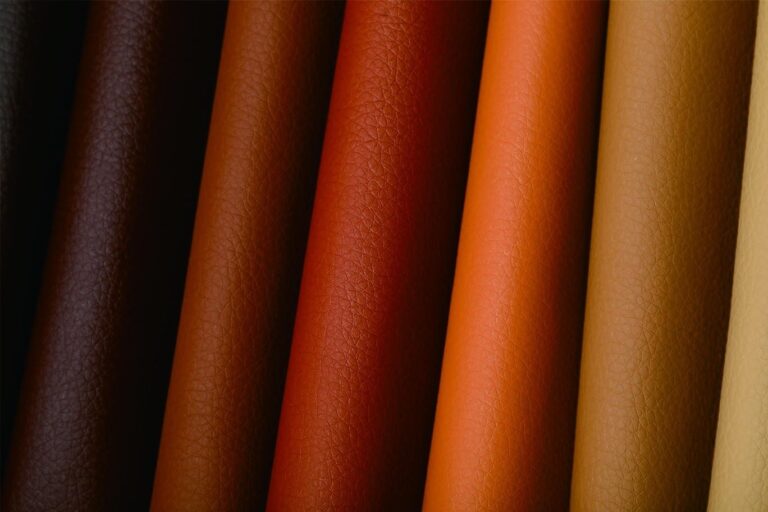
Finished leather rolls ready for shipment — the scale of production that lab grown leather cannot yet match
Why Lab Grown Leather Keeps Stalling at Commercial Scale
Three structural barriers prevent lab grown leather from reaching B2B production volumes — and none of them are close to being solved.
Cost remains prohibitive. Mycelium leather dropped from $85–110 per square foot in 2023 to approximately $38–45 — still well above traditional full-grain leather at $6–25 per square foot. Cell-cultivated collagen estimates run even higher at $15–30 per square foot. For B2B buyers sourcing 500+ meters, that price gap isn’t a premium — it’s a non-starter.
Production biology doesn’t scale linearly. Bioreactors require sterile environments, nutrient media, temperature control, and post-processing that have no economies of scale yet. MycoWorks’ pivot away from in-house cultivation to third-party mycelium processing signals that even well-funded companies can’t make the biology work at industrial volumes.
Performance data is thin. Most lab grown leather companies cannot provide Martindale abrasion data, ISO 105 color fastness reports, or hydrolysis resistance testing at B2B specification levels. Without standardized test data, procurement teams can’t write material specs — and without specs, you can’t place a PO.
In our experience reviewing alternative leather materials for B2B clients, the conversation always reaches the same wall: lab grown leather companies can provide prototypes but not production volumes, marketing materials but not test reports, sustainability claims but not Delta E color consistency data.

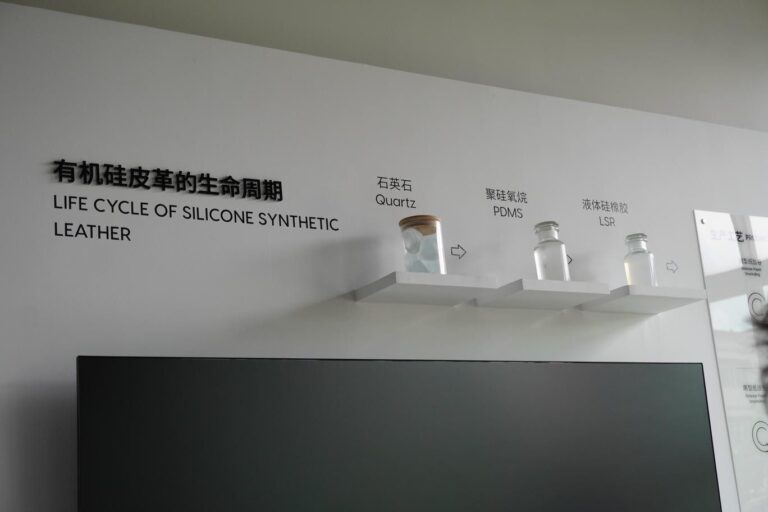
Production process flow — silicone leather has a mature, documented manufacturing chain that lab grown leather lacks
Lab Grown Leather vs Silicone Leather: An Honest Comparison
Both materials are animal-free. Both serve brands looking to eliminate animal leather from their supply chains. But the similarities end there. For B2B buyers who need eco-friendly leather alternatives with verifiable performance data, the comparison is stark.
| B2B Factor | Lab Grown Leather | Silicone Leather |
|---|---|---|
| Commercial availability | Prototype / pilot only | Full production, 500K+ m/month |
| Cost per m² | $160–320+ (estimated) | $10–25 |
| Martindale abrasion data | Not published | 200,000+ cycles (SGS verified) |
| REACH / FDA compliance | Unknown / untested | Fully compliant |
| Lead time | Indeterminate | 7–15 days |
| Animal-free | Yes | Yes |

Swatch rack with production-ready silicone leather — every color is Pantone-matched and spectrophotometer-verified
What to Specify When Animal-Free Leather Is Non-Negotiable
If your sustainability mandate requires animal-free leather and your production schedule requires material this quarter, here’s what to put in your specification document:
- Material chemistry: Specify silicone-coated fabric with zero VOC emissions and solvent-free production — verifiable via REACH compliance documentation
- Durability benchmarks: Require ISO 12947 Martindale ≥ 200,000 cycles, ISO 5402 flex ≥ 50,000 cycles, and ISO 105-B06 light fastness ≥ Grade 4.5
- Batch consistency: Specify Delta E ≤ 1.0 for color matching across all production runs, with spectrophotometer verification
- Compliance package: Require REACH, RoHS, FDA 21 CFR 177.2600, and ISO 10993-5 biocompatibility test reports from third-party labs (SGS or Intertek)
- Supply commitment: Lock in minimum 500-meter MOQ with 7–15 day lead time and 12-month warranty
This specification eliminates lab grown leather (which can’t meet supply or testing requirements) and filters PU/PVC (which can’t meet VOC or durability requirements). What remains is silicone leather — the only animal-free material that checks every box for production-ready B2B procurement. Learn more about the material in our silicone leather introduction, or explore application-specific requirements across industries.

Plant-based and lab grown leather alternatives show promise in fashion — but B2B production requires proven supply chains
Frequently Asked Questions
Is lab grown leather commercially available in 2026?
No. While several companies — VitroLabs, MycoWorks, Modern Meadow — have produced prototypes and small-batch samples, none offer lab grown leather at B2B production scale. MycoWorks pivoted away from in-house cultivation, and most cell-cultivated leather remains at pilot stage. For context, even mycelium leather (the most mature lab grown category) costs $38–45 per square foot — roughly 4–6× the price of premium silicone leather. If your project timeline requires delivery in 2026, lab grown leather is not a viable option. See our coverage of bio leather alternatives for more detail.
Is silicone leather a better animal-free alternative than lab grown leather for B2B?
For B2B manufacturing, yes — by every measurable criterion except bio-based content. Silicone leather is animal-free, commercially available at 500,000+ meters monthly capacity, priced at $10–25/m², and backed by SGS/Intertek-verified test data. Lab grown leather is animal-free but unavailable at scale, costs 10–20× more, and lacks standardized performance data. The vegan leather innovation landscape in 2026 makes clear that silicone leather is the pragmatic choice for buyers who need animal-free materials today.
The Bottom Line on Lab Grown Leather
Lab grown leather may eventually deliver on its promise — but “eventually” doesn’t ship product. B2B buyers who need animal-free leather with verifiable performance, compliance documentation, and predictable supply in 2026 have one production-ready option: silicone leather. It’s not bio-based, and it doesn’t have the scientific novelty of cultivated collagen. But it ships on time, passes every test, and costs less than one-tenth of what lab grown leather would if you could even place an order. When your production schedule is real, your material choice needs to be real too.
Get a Custom Silicone Leather Quote
About TOPSUN
TOPSUN produces animal-free silicone leather as a production-ready alternative to lab grown leather, supplying B2B manufacturers who need sustainable materials with verifiable performance data and immediate availability.
Every order ships with REACH, RoHS, FDA, and ISO 10993 compliance documentation — plus Martindale 200K+ cycles, UV 1,000+ hours, and Delta E ≤ 1.0 color consistency verified by SGS and Intertek. Free A4 swatches available worldwide.