A B2B accessories brand in Berlin launched a “fully natural” line using cork leather for wallets and cardholders in 2025. The sustainability story was compelling — bark harvested from living cork oaks, regrown over nine years, zero animal materials. But by month eight, the brand’s warranty inbox was filling up. Surfaces were scuffing at corners. The laminated cork layer was delaminating from its fabric backing at flex points. The product hadn’t changed; the material had simply reached its performance ceiling. For B2B buyers evaluating plant-based and natural leather alternatives, cork leather represents the best and worst of the category: genuinely renewable, genuinely limited in mechanical performance.
Request Free Material Comparison Kit
What Is Cork Leather and How Is It Made
Cork leather is made by taking thin sheets of cork — typically one to two millimeters thick — harvested from the bark of cork oak trees (Quercus suber), and bonding them to a natural fabric backing, usually cotton, linen, or microfiber. The trees must be at least 25 years old before the first harvest, and subsequent harvests occur once every nine years throughout the tree’s 200+ year lifespan. The bark regrows completely, making cork one of the few genuinely renewable materials in the leather alternatives space.
The production process sounds beautifully simple: strip bark, dry it outdoors for months, boil it to sterilize and expand the cell structure, slice into thin sheets, laminate to fabric. But this is also where the performance limitations begin. Cork is, at its core, a tree bark. It has inherent rigidity, a cellular structure that doesn’t flex like leather, and a surface that — while naturally water-resistant — scratches and scuffs more readily than engineered coatings. The fabric backing provides structural integrity, but the bond between cork and backing is the material’s weakest link under repeated flexion.

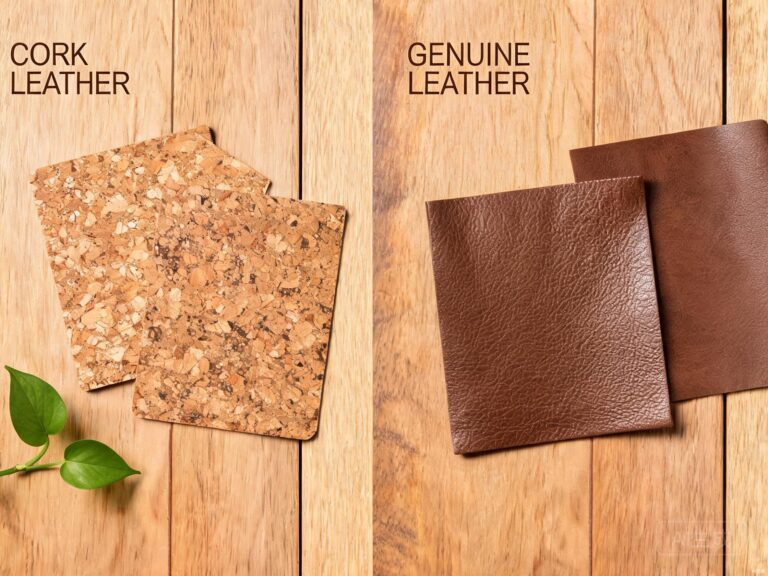
Warm earth-tone swatches — natural material palettes appeal to eco-conscious brands, but surface performance must match the aesthetic promise
Cork Leather Performance: Tested Limits in Commercial Use
When we ran cork leather durability testing alongside silicone-coated material in our laboratory, the performance gap was stark. Cork leather achieves approximately 50,000 double rubs in abrasion testing — a respectable number for a natural material, but roughly four times below the 200,000+ Martindale cycles that silicone leather sustains without surface degradation. In flex testing, cork’s laminated structure begins delaminating at stress points after 15,000–20,000 flex cycles, while silicone coating maintains structural integrity through 200,000+ cycles.
Testing summary: Cork leather: 50K abrasion rubs, 15K–20K flex cycles before delamination. Silicone leather: 200K+ abrasion cycles (ISO 12947-2), 200K+ flex cycles (ISO 5402). The 4x and 10x gaps directly determine product replacement cycles in commercial applications.
The cork leather vs silicone leather comparison reveals a pattern we see across natural vs engineered material pairings: the natural material excels in origin story and carbon footprint, but the engineered material wins decisively in mechanical longevity. Cork leather’s water usage is just 0.3 m³/m² — impressively low compared to genuine leather’s 4.5 m³/m² and even PU’s 2.1 m³/m² (Eco-Leather, 2025). But in applications where the material experiences daily abrasion, flexion, and UV exposure — handbags, footwear, furniture trim — cork’s 50K rub threshold translates to visible wear within 12–18 months.

Natural and eco-focused swatches — cork and silicone can be evaluated side by side for color matching and surface texture
Where Cork Leather Excels and Where It Fails
Not every application demands 200,000 abrasion cycles. The Berlin accessories brand’s problem wasn’t that cork leather is bad material — it’s that they specified it for a product (everyday wallets) that subjects the surface to constant edge-abrasion and corner-flex. Cork leather’s strengths and weaknesses map to specific use cases:
| Property | Cork Leather | Silicone Leather |
|---|---|---|
| Abrasion resistance | ~50,000 rubs | 200,000+ cycles |
| Flex resistance | 15K–20K (delamination) | 200K+ cycles |
| Water usage | 0.3 m³/m² | 0 (dry process) |
| UV stability | Moderate (natural fade) | 1,000+ hrs (ASTM G154) |
| Temperature range | -10°C to 60°C | -40°C to 250°C |
| Best application | Static decor, low-wear accessories | High-wear commercial, automotive, furniture |
Cork leather excels in static applications — wall panels, notebook covers, decorative accents, and display pieces where the surface experiences minimal abrasion. In these contexts, its natural texture, lightweight feel, and sustainability story create genuine value. The problem arises when brands specify cork for dynamic applications — everyday bags, wallets, footwear, furniture — where the 50K abrasion threshold becomes a warranty liability. For a deeper analysis of these trade-offs, see our cork and leather trade-offs guide.

Plant-based leather in fashion — cork and other natural materials offer sustainability stories, but performance varies dramatically by application
Specifying the Right Eco Leather for Your Application
The decision framework isn’t cork versus silicone — it’s about matching material properties to application demands. If your product is a decorative wall panel that will never be scratched, cork leather’s natural aesthetic and carbon story make it a legitimate choice. If your product is a handbag that goes into a daily commute, or furniture that receives 8 hours of daily contact, or automotive trim exposed to UV and temperature cycling, the 4x abrasion gap and 10x flex gap between cork and silicone translate directly into replacement costs and warranty claims.
Our eco-friendly silicone leather offers 100+ textures including cork-grain embossing — meaning you can achieve the visual character of cork without its mechanical limitations. The material is 100% recyclable, PVC-free, phthalate-free, and manufactured through a solvent-free dry coating process that uses zero water. For brands that need both the sustainability story and the performance numbers, silicone coating with a cork-grain texture is the specification that satisfies both procurement and design teams.
For brands exploring the full spectrum of plant-based leather and sustainable materials, the evaluation should always include abrasion, flex, and UV testing data alongside the origin story. A material that cracks in 18 months isn’t sustainable — it’s just a different kind of waste. The silicone leather introduction page covers the complete technical specification set for comparison.
Frequently Asked Questions
Can cork leather be used for automotive interiors?
Not recommended. Automotive interiors require materials that withstand UV exposure, temperature cycling from -20°C to 80°C, and daily abrasion from passenger contact. Cork leather’s moderate UV stability, narrow temperature range (-10°C to 60°C), and 50K abrasion threshold fall well below automotive interior requirements. Silicone leather, tested at 1,000+ hours UV resistance (ASTM G154), -40°C to 250°C thermal stability, and 200K+ abrasion cycles, meets or exceeds automotive OEM specifications including FMVSS 302 flame retardancy.
Does cork leather peel or crack over time?
Yes — cork leather’s primary failure mode is delamination, where the cork surface layer separates from the fabric backing at flex points. This typically occurs after 15,000–20,000 flex cycles, equivalent to 12–18 months of daily use in high-flex applications like wallets and bag corners. The cork surface itself can also scuff and scratch more readily than engineered coatings. Unlike silicone leather, which maintains surface integrity through 200,000+ flex cycles, cork leather cannot be specified for applications with repeated mechanical stress without accepting a short replacement cycle.
Matching Material Choice to Product Reality
The Berlin accessories brand didn’t fail because cork leather is a bad material. They failed because they specified a 50K-rub material for a daily-wear product. The lesson for B2B buyers is straightforward: evaluate every eco leather alternative against the mechanical demands of the end application, not just the sustainability story. Cork leather has a legitimate place in the materials landscape — for static, low-wear applications where its natural texture and renewable origin create genuine value.
For applications where the material will be touched, flexed, abraded, and exposed to sunlight on a daily basis, the 4x abrasion gap and 10x flex gap between cork and silicone leather aren’t abstract testing numbers — they’re the difference between a product that lasts 18 months and one that lasts a decade. Specify accordingly.
About TOPSUN
TOPSUN manufactures silicone-coated leather for B2B brands evaluating plant-based and natural material alternatives, offering a performance benchmark against cork, mushroom, and cactus leather in furniture, fashion, and consumer goods applications.
200,000+ Martindale abrasion cycles (ISO 12947-2) · -40°C to 250°C thermal stability · 1,000+ hour UV resistance (ASTM G154) · 100+ textures including cork-grain embossing · 100% recyclable, solvent-free manufacturing