An ISO certified leather factory should mean more than a framed certificate in the reception area. In our factory audit preparation work with B2B clients, we’ve walked procurement teams through every stage of our 60,000+ m² facility — from incoming raw material inspection to outgoing shipment QC — and the same observation recurs: buyers confuse certificate possession with quality system operation. An ISO 9001 certificate confirms a factory documented its processes. It doesn’t confirm those processes are followed on the production floor at 2 AM on a Sunday shift. The seven audit points below are what separate an ISO certified leather factory that maintains real quality systems from one that holds paper but cuts corners in practice.
What ISO Certification Actually Means for a Leather Factory
ISO 9001 certification for a leather factory means the facility has a documented quality management system (QMS) covering process control, traceability, corrective action procedures, and management review cycles. The ISO 9001 standard doesn’t specify what your leather quality should be — it specifies that your factory has a consistent system for achieving and verifying whatever quality you claim. The distinction matters because two factories can hold identical ISO 9001 certificates while producing dramatically different material quality.
The certification audit itself is a snapshot. An auditor visits for 2-3 days, samples records, interviews staff, and issues or renews the certificate. What happens between audits — process drift, staff turnover, cost-cutting under price pressure — is invisible to the certificate and visible only on the production floor. For more on how this applies to material sourcing, our overview of TOPSUN’s company profile includes our full certification list and quality management approach.

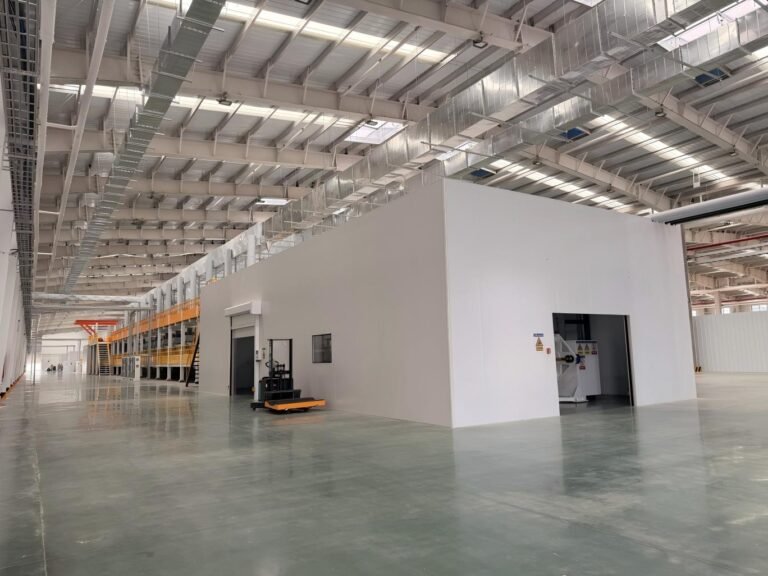
Production line with overhead crane — the physical infrastructure that an ISO certified leather factory audit should verify is operational, not just documented.
7 Audit Points for Evaluating an ISO Certified Leather Factory
When we review competitor audit reports — which we do regularly to benchmark our own QC processes — the pattern is consistent: factories that pass on paper often fail on 3-4 of these 7 points. Each point has a document you can request and a floor-level behavior you can verify.
1. Incoming material inspection records (IQC). Request the last 6 months of IQC logs. A real ISO certified leather factory records every incoming batch — substrate weight, coating weight, width, visual defects — with pass/fail signatures. A certificate-only factory shows you a blank template and says “we check everything.”
2. In-process quality control checkpoints (IPQC). Ask how many IPQC stations exist on the coating line and what each station measures. Our line has 4 stations checking coating weight, adhesion force, surface temperature, and color match at set intervals. If the answer is “we check at the end,” that’s final inspection — not in-process control.

Quality and safety banner on the production floor — visible commitment that an ISO certified leather factory should back with documented daily practice.
3. Final QC inspection protocol (FQC). Verify whether the factory performs 100% inspection or AQL sampling for custom orders. For orders under 1,000m, 100% inspection should be standard. Request the FQC report from a recent shipment — it should list roll-by-roll results, not a single pass/fail for the batch.
4. Outgoing quality audit (OQC). The OQC step is a random audit of packed goods before shipment. Ask for OQC rejection rates over the past 12 months. A factory that claims 0% rejection is either not auditing or not recording. Real rejection rates for a well-run facility sit at 0.5-1.5%.
5. Calibration records for testing equipment. Every Martindale tester, spectrophotometer, and tensile strength machine must have current calibration certificates. If the factory can’t produce calibration records, their test data is meaningless. For a broader perspective on evaluating leather manufacturers, this is one of the most overlooked audit points.
6. Corrective action log (CAPA). When a defect is found, what happens? A real QMS documents the root cause analysis and corrective action. Request the CAPA log from the last 6 months. If it’s empty, the factory isn’t documenting problems — which means it isn’t fixing them systematically either.
7. Traceability system. Can the factory trace a finished roll back to the specific raw material batch, coating line, shift, and operator? This is the ultimate test of QMS maturity. If traceability stops at “batch 1234” without linking to raw material lots and production parameters, the system has gaps that become critical during a recall or warranty claim.
| Audit Point | What to Verify | Certificate-Only Factory | ISO-Certified Factory |
|---|---|---|---|
| IQC records | 6 months of batch logs | Blank templates | Signed pass/fail per batch |
| IPQC stations | Count + parameters measured | “We check at the end” | 4+ stations with interval data |
| FQC protocol | 100% or AQL sampling | Single batch pass/fail | Roll-by-roll results |
| Calibration | Current certificates | Expired or missing | All equipment current |
| CAPA log | Root cause + corrective action | Empty or verbal only | Documented, dated, closed |
Inside an ISO Certified Leather Factory: Production Floor Reality
The difference between a certificate wall and a quality system becomes obvious the moment you walk the production floor. Our facility in Dongguan runs 10+ automated coating lines producing 500,000+ meters per month. The ISO 9001 system means every line operator follows documented work instructions, every coating batch is logged with temperature and speed data, and every roll ships with a QC report matching the approved prototype spec. For additional context on how to choose a silicone leather factory, the production floor walkthrough is where marketing claims meet manufacturing reality.

Finished goods warehouse — where traceability systems are tested. Every roll should link to a production batch, raw material lot, and QC report.
Factory quality control overview — see how TOPSUN’s ISO 9001 system operates on the production floor, not just on paper.
A factory tour reveals what a certificate can’t: whether the quality system runs the factory, or whether the factory runs around the quality system. The 7 audit points above can be verified in a single 2-hour floor walk.
Beyond ISO: Additional Certifications That Matter
ISO 9001 is the foundation, not the ceiling. Depending on your industry and target markets, additional certifications determine whether the factory can actually ship to your customers. For automotive applications, the ELV Directive and FMVSS 302 are non-negotiable. For furniture, REACH and CA Prop 65 compliance documentation is required. For medical devices, ISO 10993-5 biocompatibility testing. For consumer products, EN 71 toy safety and RoHS heavy metal screening.

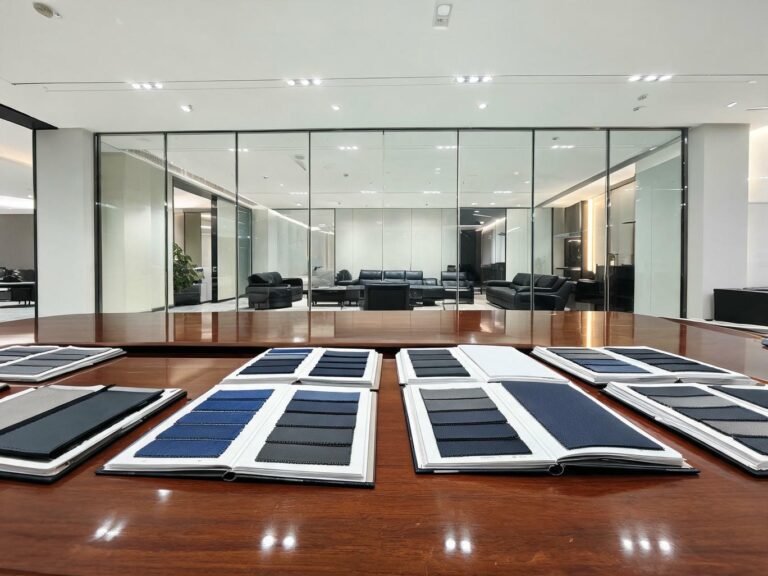
Supplier evaluation materials — the documentation package your ISO certified leather factory should provide before you place a PO.
A factory that holds ISO 9001 plus industry-specific certifications — and can produce current test reports from accredited labs like SGS or Intertek — is a factory that has invested in compliance as a system, not a marketing expense. Our application-specific certifications cover automotive (FMVSS 302, EN 13773 Class 4, ELV), medical (ISO 10993-5), food contact (FDA 21 CFR 177.2600), and fire safety (FAR 25.853 aviation). Each certification comes with third-party test reports — not self-declarations.
Frequently Asked Questions
What ISO certifications should a leather factory have?
At minimum, a B2B leather factory should hold ISO 9001 (quality management). For environmental management, ISO 14001 is increasingly expected by EU buyers. For medical-grade production, ISO 13485 (medical devices) may be required. Beyond ISO, industry-specific certifications matter: REACH and RoHS for chemical compliance, SGS/Intertek test reports for performance claims, and for silicone leather specifically, ISO 10993-5 for biocompatibility in medical applications. TOPSUN holds ISO 9001 quality management with SGS-verified testing across all product lines.
How can I verify if a leather factory’s ISO certification is valid?
Three verification steps: First, request the certificate number and issuing body — then verify directly on the certification body’s website (SGS, Bureau Veritas, Intertek all maintain public databases). Second, check the certificate’s scope: it should explicitly cover the product category you’re sourcing, not just “general manufacturing.” Third, request the most recent surveillance audit report — annual surveillance audits are required to maintain ISO 9001 certification, and the report shows whether the system is being actively maintained or just renewed every three years.
The Certificate Gets You in the Door; The System Ships the Order
An ISO certified leather factory earns trust through its quality management system, not through its certificate frame. The 7 audit points above — IQC records, IPQC stations, FQC protocol, OQC rejection rates, calibration, CAPA logs, and traceability — can be verified in a single factory visit and tell you more about a supplier’s reliability than any certificate ever will. When procurement teams audit the system, not the paper, they find the factories that ship on spec, on time, and without surprises. That’s what ISO certification is supposed to mean. The factories that operate that way are the ones worth specifying.
Download Certification Summary
About TOPSUN
TOPSUN operates an ISO-certified silicone leather factory across 60,000+ m² in Dongguan, Yichang, and Xiangyang — with 10+ automated coating lines, 500,000+ m monthly capacity, and documented IQC/IPQC/FQC/OQC quality management for automotive, furniture, and medical OEM customers.
ISO 9001 quality management · 10+ automated lines · 500,000+ m/month · 7-15 day lead time · SGS and Intertek tested · Free A4 swatches worldwide