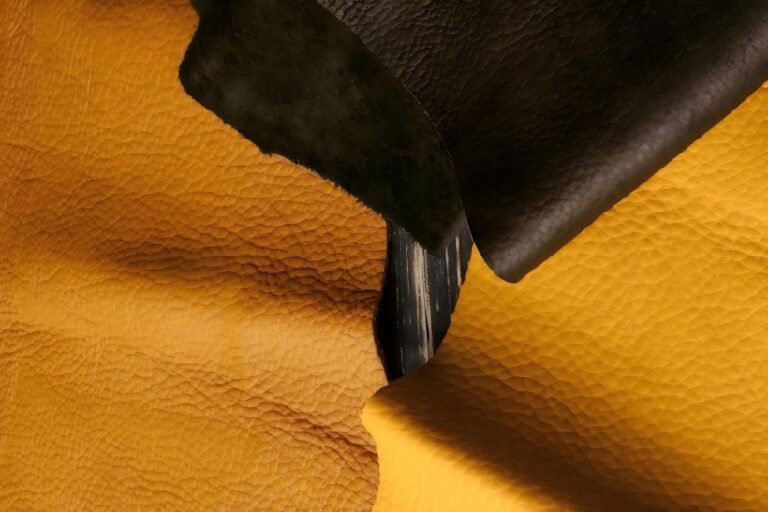
Chinese leather manufacturing is not one market — it’s three markets sharing a passport. The first tier produces automotive-grade silicone and PU leather in ISO-certified facilities with automated coating lines, serving BMW, NIO, and Mercedes-Benz. The second tier makes serviceable furniture and fashion leather for mid-range brands, with partial compliance and inconsistent batch quality. The third tier operates behind trading company fronts, quoting prices 40% below market with no production facility of their own. China accounts for over 30% of global leather product exports, but only about 37% of export enterprises hold both ISO 14001 environmental management and OEKO-TEX Standard 100 certifications. That gap — between the volume China produces and the share that meets international compliance — is where most B2B sourcing decisions go wrong. The price is right; the factory behind it might not be.
Read Our China Manufacturers Guide

Quality inspection at a Chinese leather factory — the audit checkpoint that separates compliant manufacturers from the rest
Chinese Leather: Three Tiers, Three Risk Profiles
Before we get into the audit framework, you need to understand which tier you’re actually sourcing from. A quote sheet tells you nothing — the same PDF arrives whether it came from a factory with 10 automated lines or a trading company that subcontracted to a workshop. Here’s how the three tiers actually differ:
| Attribute | Tier 1: OEM Grade | Tier 2: Mid-Market | Tier 3: Low-End / Trading |
|---|---|---|---|
| Facility Type | Own factory, 10+ automated lines, 50,000+ m² | Own factory, 3–5 semi-auto lines, 5,000–20,000 m² | No factory — showroom + subcontracted workshops |
| Certifications | ISO 9001, ISO 14001, REACH, OEKO-TEX, sector-specific | ISO 9001 (may be partial), REACH (self-declared) | None verifiable, or forged documents |
| Price vs Market | Market price or 5–10% premium | 10–20% below market | 30–45% below market |
| QC Protocol | In-line + final inspection, CMM data, FAI per batch | Final inspection only, visual standard | No QC protocol — “quality checked before shipment” |
| Batch Consistency | Delta E ≤ 1.0 color, tolerance ±0.1mm | Color varies within batch, tolerance unspecified | Inconsistent — different workshops per batch |
| Typical Clients | Automotive OEMs, global furniture brands, medical | Regional furniture, fashion accessories, promotional | One-off buyers, price-driven importers |
The pricing column is the most diagnostic. If a quote comes in 30%+ below comparable Tier 1 manufacturers, the supplier is either subcontracting to uncontrolled workshops, using non-compliant chemical formulations, or doesn’t actually make the product. In 15 years of auditing Chinese leather suppliers, we have never seen a Tier 3 supplier deliver consistent quality at scale — the price gap exists because something fundamental is missing from the process.

Tier 1 Chinese leather factory — automated production line with overhead material handling, the infrastructure that Tier 3 trading companies claim but don’t have
The 12-Point Chinese Leather Factory Audit
If you’re sourcing Chinese leather, a physical factory audit — or at minimum a video audit with live equipment demonstration — is non-negotiable. Here are the 12 checkpoints our team verifies when auditing a Chinese leather manufacturer for TOPSUN’s supply chain qualification program:
Business Verification (Checkpoints 1–3)
- Business license scope — Verify the registered business scope includes manufacturing (生产), not just trading (贸易). Trading companies register as “import/export” and cannot show a manufacturing license. Cross-check the registration number on the National Enterprise Credit Information Publicity System.
- Factory address verification — The registered address on the business license must match the physical factory. Send the audit team to the exact GPS coordinates. Trading companies list office addresses and claim “factory visits by appointment only” — meaning they’ll bus you to a subcontractor’s facility.
- Export records — Request customs declaration forms (报关单) showing shipments to your target market. Real manufacturers have shipping records; trading companies broker shipments from other factories’ records.
Production Capability (Checkpoints 4–7)
- Equipment list and condition — Photograph every machine with its model plate visible. Verify the equipment matches the claimed capacity: a factory claiming 500,000m/month needs at least 3–4 coating lines running, not 1 line with a theoretical maximum.
- Raw material storage — Inspect the warehouse for silicone/polyurethane resin drums, base fabric rolls, and release paper. Verify lot numbers match recent purchases. Empty warehouses indicate subcontracting — the factory doesn’t actually stock materials because it doesn’t actually produce.
- In-process quality control stations — Walk the production line and identify where QC happens. Is there an in-line thickness gauge? A color-matching spectrophotometer? A Martindale abrasion tester? These tools cost money and only exist in factories that actually test.
- Finished goods inspection area — There should be a dedicated inspection zone with adequate lighting (1,000+ lux), inspection standards posted, and rejected material segregated. A factory with no rejects on the floor is either perfect (unlikely) or shipping everything regardless of quality.
Compliance & Documentation (Checkpoints 8–10)
- Certification verification — Don’t accept PDFs. Every certification (ISO 9001, ISO 14001, REACH, OEKO-TEX) has a number that can be verified on the issuing body’s website. Forged certificates are common — the certificate looks real but the number doesn’t exist in the registrar’s database.
- MSDS and TDS sheets — Material Safety Data Sheets and Technical Data Sheets must list actual chemical composition, not generic descriptions. If the MSDS says “proprietary formulation” for every ingredient, the factory doesn’t know what’s in their own product — because someone else formulated it.
- Environmental compliance — Check for wastewater treatment permits, VOC emission monitoring records, and hazardous waste disposal contracts. Chinese environmental enforcement tightened significantly after 2020, and compliant factories have the paperwork to prove it. Non-compliant factories are one inspection away from shutdown.
Commercial Terms (Checkpoints 11–12)
- Payment terms — Legitimate manufacturers accept 30% deposit, 70% against bill of lading copy. Suppliers demanding 100% upfront or Western Union are high-risk — this is the #1 fraud indicator in Chinese leather sourcing.
- Client references — Request 3+ references in your industry sector. Call them. If the supplier can’t provide references in your industry, they either don’t have experience in it or their previous clients won’t endorse them.
TOPSUN factory production capacity — 60,000+ m², 10+ automated lines, 500,000+ meters monthly output.
Chinese Leather: 2026 Regulatory Shifts
The regulatory landscape for Chinese leather is shifting on two fronts simultaneously — domestic standards are tightening, and export markets are closing loopholes. Here’s what changes in 2026:
- Seven new national standards effective May 2026 — Covering raw material quality, physical properties, and color fastness testing. Two standards completely replace 2008 versions, raising technical requirements for tear strength, flex resistance, and light fastness. Chinese factories that haven’t updated their QC protocols to the new standards will produce material that passes their own tests but fails yours.
- ISO 20686:2025 — China-led international standard — China authored the first international standard for organic solvent determination in footwear leather, using GC-MS to detect 15 restricted solvent residues. This standard becomes the reference for footwear leather compliance globally — and Chinese factories that can’t meet it lose their largest export category.
- EU PFAS restriction — July 2026 — The broad PFAS restriction under REACH covers most fluoropolymer-based water and stain repellent treatments still used by mid-tier Chinese leather producers. Only factories with silicone-based or solvent-free coating processes can ship to the EU after this date.
- EU VOC emission limits tightened — Indoor air quality standards (EN 717-1, ISO 16000-6) now require formaldehyde emission ≤0.05mg/m³h and total VOC ≤0.06mg/m³h for leather used in enclosed spaces (furniture, automotive interiors). Only solvent-free coating processes meet this — factories still using DMF-based PU coatings cannot comply.
The practical implication: Tier 2 and Tier 3 Chinese leather suppliers who haven’t invested in solvent-free coating technology and PFAS-free water repellent systems will lose EU market access in 2026. The factories that survive this regulatory filter are the ones who invested in compliance — and they’re the ones you want to source from regardless of price.
About TOPSUN: Where We Sit in the Chinese Leather Landscape
TOPSUN is a Tier 1 Chinese leather manufacturer — not a trading company. We operate 60,000+ m² of production space across three facilities (Dongguan, Yichang, Xiangyang), with 10+ automated coating lines and a monthly capacity of 500,000+ meters. Our solvent-free dry coating process produces zero VOC emissions, meeting the tightened EU indoor air quality standards without modification. We hold ISO 10993-5 biocompatibility certification, REACH compliance, FDA 21 CFR 177.2600 food-contact compliance, and EN 13773 Class 4 flame retardant certification — all verifiable through issuing body databases. Our clients include automotive OEMs, global furniture brands, and medical device manufacturers who audit our facility annually. Tour our production lines or read our manufacturer evaluation guide to see how we compare against the audit criteria above.
Chinese Leather: Frequently Asked Questions
Is Chinese leather lower quality than Italian or American leather?
Quality is determined by the manufacturing process, not the country of origin. Tier 1 Chinese leather factories produce material that meets or exceeds European standards — the same ISO test methods apply globally. The perception gap exists because Tier 2 and Tier 3 producers export large volumes of lower-quality material. Audit the factory, not the passport.
How do I verify a Chinese leather manufacturer is real?
Three methods: (1) Check the business license on the National Enterprise Credit Information Publicity System (国家企业信用信息公示系统). (2) Request a live video call showing the production floor with today’s date visible. (3) Send a third-party auditor (SGS, Bureau Veritas, TUV) for a factory inspection — cost is $500–$1,500 and saves you from a $50,000 mistake.
What’s the difference between a trading company and a manufacturer?
A manufacturer owns the production facility, controls the process, and is accountable for quality. A trading company brokers orders between buyers and factories, adding a 10–20% margin. Trading companies can’t provide in-process QC data, can’t customize formulations, and can’t guarantee batch consistency. Their advantage: they can source multiple product types from different factories. If you need one specific material at consistent quality, work with a manufacturer.
What payment terms are standard for Chinese leather orders?
Standard terms are 30% T/T deposit with order confirmation, 70% balance against bill of lading copy (for sea freight) or before shipment release (for air freight). Letter of credit (L/C at sight) is accepted by most Tier 1 manufacturers for orders above $50,000. Any supplier requesting 100% upfront payment via Western Union or personal account is high fraud risk.
The Bottom Line on Chinese Leather Sourcing
Chinese leather is the world’s largest supply pool — and it contains the full quality spectrum from world-class to unregulated. The 37% certification rate means that nearly two-thirds of Chinese leather exporters cannot provide the compliance documentation that EU and North American markets require in 2026. Your job as a B2B buyer isn’t to avoid Chinese leather — it’s to identify which 37% you’re dealing with. Run the 12-point audit. Verify every certification number. Insist on 30/70 payment terms. Send an auditor. These steps cost $1,500 and two weeks; skipping them costs $50,000+ in a single bad order. The Chinese leather market rewards buyers who do due diligence and punishes buyers who chase the lowest quote. Be the former.
Audit-ready Chinese leather manufacturer?
TOPSUN welcomes factory audits — business license, ISO certifications, and production capacity all verifiable on-site. Free A4 samples shipped worldwide via DHL/FedEx. Contact info@topsunsiliconeleather.com or WhatsApp +44 744 461 7933.
Related: China Leather Manufacturers Guide | How to Evaluate a Leather Manufacturer | Fabric Supplier China Audit | Silicone Leather Supplier China