Sourcing automotive interior leather is not a procurement exercise — it is a quality engineering exercise. A single batch of out-of-spec leather can trigger a recall affecting hundreds of thousands of vehicles, cost an OEM millions in warranty claims, and damage a brand’s reputation for cabin quality. Yet many Tier 1 suppliers still evaluate auto leather factories based on sample swatches and price quotes, skipping the systematic factory audit that would reveal whether the supplier can sustain OEM-grade production over a multi-year vehicle program.
The shift to electric vehicles has made this audit even more critical. EV interiors demand materials with lower VOC emissions (cabin air quality is a differentiator EV buyers actually pay for), lighter weight (range optimization), and superior thermal stability (no engine heat masking interior thermal loads). Factories that have been producing PU automotive leather for a decade may not have the capability, testing infrastructure, or material expertise to produce silicone leather — the material increasingly specified for next-generation EV interiors.
This guide provides seven audit checkpoints that separate a qualified auto leather factory from a sample-maker. Each checkpoint includes the specific documents to request, the test data to verify, and the red flags that should end the evaluation. Use it as a structured framework for your next supplier audit.
Request Automotive Leather Samples
What Makes an Auto Leather Factory “Automotive Grade”?
An automotive-grade leather factory is not simply a synthetic leather manufacturer that happens to sell to automotive customers. “Automotive grade” means the factory operates under a quality management system designed specifically for the automotive industry’s requirements: documented process control, traceability, PPAP (Production Part Approval Process) capability, and continuous improvement protocols mandated by OEM purchasing standards.
The distinction matters because automotive interior materials face the most demanding service environment of any leather application. A car seat surface experiences 10+ years of daily occupancy, UV exposure through windows, temperature swings from -30°C to 95°C, friction from clothing and cargo, chemical exposure from sunscreen and food spills, and regulatory scrutiny on fire safety and cabin air quality. A factory without automotive-grade quality systems cannot consistently produce material that survives this environment across millions of units.

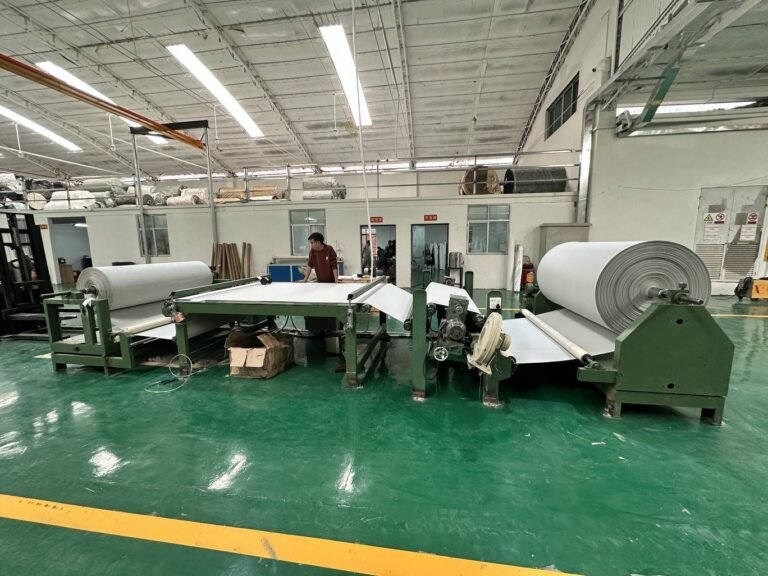
Automotive-grade leather production requires integrated quality control at every stage of the manufacturing line
IATF 16949: The Non-Negotiable Certification
IATF 16949 is the automotive industry’s unified quality management standard, developed by the International Automotive Task Force in collaboration with ISO. It supersedes ISO/TS 16949 and is recognized by all major OEMs globally — GM, Ford, Stellantis, Volkswagen, Toyota, Honda, BMW, and Mercedes-Benz. No auto leather factory can supply OEM programs without it.
IATF 16949 is not a documentation exercise. It mandates specific process controls that directly affect product quality: risk-based thinking (FMEA for every process step), defect prevention (Poka-Yoke systems on critical operations), supplier development (the factory must audit its own raw material suppliers), and continuous improvement (documented KPIs with year-over-year targets). The certification audit takes 3-6 months and includes on-site assessment by IATF-recognized certification bodies.
When auditing an auto leather factory, request the IATF 16949 certificate and verify three things: (1) the certificate covers the specific facility you are auditing (not a corporate headquarters), (2) the scope includes “manufacturing of synthetic leather for automotive applications” or equivalent, and (3) the certificate is current — IATF certificates expire and require surveillance audits every 6-12 months. For a deeper understanding of automotive leather requirements, our automotive grade leather standard guide breaks down each requirement with acceptance thresholds.
Red flag: If a factory claims “IATF compliant” but cannot produce a certificate from an IATF-recognized certification body, walk away. “Compliant” is not “certified.” OEM purchasing departments will reject any supplier without a valid IATF 16949 certificate — no exceptions.
7 Critical Audit Checkpoints
These seven checkpoints form the core of a systematic auto leather factory audit. Each should be verified through document review, on-site observation, and independent testing — not supplier self-declaration.
| Checkpoint | What to Verify | Acceptance Threshold |
|---|---|---|
| 1. IATF 16949 certificate | Scope covers this facility; current and valid | Valid certificate from IATF-recognized body |
| 2. PPAP documentation | Level 3 PPAP package for current programs | All 18 elements present and current |
| 3. VOC test data | VDA 278 or ISO 12219 at cabin temperature | TVOC < 100 μg/m³ (silicone: < 50 μg/m³) |
| 4. Abrasion + flex data | Martindale + low-temp flex test reports | 100,000+ Martindale; 200,000 flex @ -30°C |
| 5. Flame retardancy certs | FMVSS 302, DIN 75200, or equivalent | Pass with documented margin |
| 6. Raw material traceability | Lot tracking from resin to finished roll | Full traceability per IATF 8.5.2.1 |
| 7. In-house testing lab | Calibrated equipment for all key tests | ISO 17025 calibration certificates |
Checkpoint 1 — IATF 16949: Covered above. Verify the certificate covers the specific production facility, not just corporate headquarters. Request the most recent surveillance audit report — it will show any non-conformities found during the last audit and the corrective actions taken.
Checkpoint 2 — PPAP capability: Production Part Approval Process is the automotive industry’s method for validating that a supplier can produce parts meeting all engineering requirements at production volume. A qualified auto leather factory should be able to produce a Level 3 PPAP package on demand — including design records, engineering change documents, customer engineering approval, design FMEA, process flow diagrams, process FMEA, control plan, measurement system analysis, dimensional results, and material/performance test results. If the factory has never completed a PPAP submission, they cannot supply OEM programs.

An in-house testing lab with calibrated equipment is a non-negotiable requirement for automotive-grade leather production
Checkpoint 3 — VOC test data: Request VDA 278 (thermal desorption) or ISO 12219 (cabin simulation) test reports. The data should be from a third-party accredited lab, not the factory’s own testing. For silicone leather, TVOC values should be below 50 μg/m³ — an order of magnitude below typical PU leather values. If the factory cannot provide VOC data, they have not tested for it — and OEM cabin air quality requirements (VDA 270, GB/T 27630) will reject the material.
Checkpoint 4 — Abrasion and flex data: Automotive leather must demonstrate 100,000+ Martindale abrasion cycles (ISO 12947-2) and 200,000 low-temperature flex cycles at -30°C (ISO 1764). Request test reports that include the specific material grade being quoted — not generic data for a different product line. Verify that the test specimens were taken from production rolls, not specially prepared lab samples.
Checkpoint 5 — Flame retardancy: For the US market, FMVSS 302 (Federal Motor Vehicle Safety Standard) is mandatory. For Europe, DIN 75200 applies. Request certificates with documented test margins — a “pass” with a burn rate of 50 mm/min when the limit is 100 mm/min is acceptable but offers no safety buffer, while a burn rate of 20 mm/min provides significant margin. Silicone leather passes inherently; PU and PVC require flame retardant additives that may degrade over service life.
Checkpoint 6 — Raw material traceability: IATF 16949 clause 8.5.2.1 requires lot-level traceability from raw material receipt through finished product shipment. The factory should be able to trace any finished roll back to the specific resin lot, fabric lot, and production date. Ask to see the traceability system in action during the audit — pick a finished roll at random and request the full material genealogy. Full technical data sheets should include lot-specific test results.
Checkpoint 7 — In-house testing laboratory: The factory must have calibrated testing equipment for all key performance parameters — Martindale abrasion, Taber abrasion, tensile strength, tear strength, flex resistance, color fastness, flame retardancy, and VOC. Equipment must carry ISO 17025 calibration certificates. A factory that outsources all testing cannot provide real-time quality control — they learn about defects only after the batch is finished.

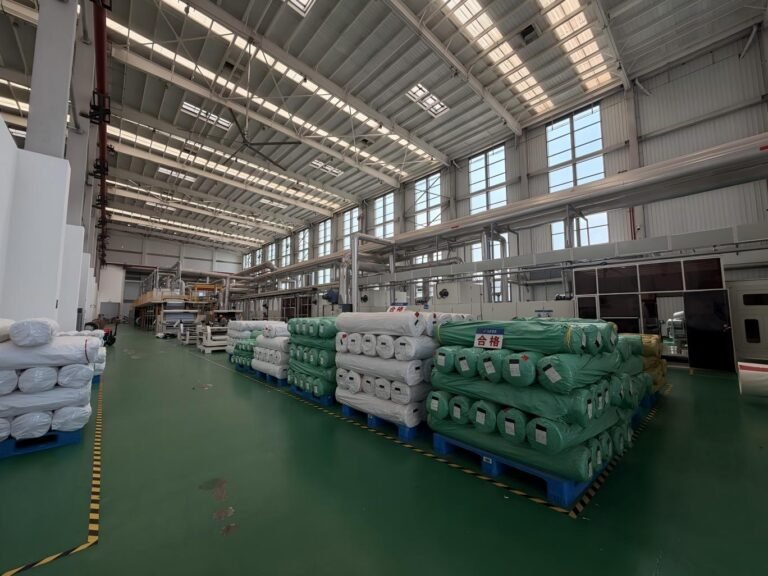
Quality and safety standards must be visibly embedded in daily production operations, not just documented in manuals
EV Transition: Why Factory Capabilities Matter More Now
The automotive industry’s shift to electric vehicles has changed what “automotive grade” means for interior leather. Three new requirements have emerged that traditional auto leather factories may not be equipped to meet:
Cabin air quality: EV buyers associate cabin air quality with the vehicle’s premium positioning. OEMs are imposing stricter VOC limits — many now require VDA 278 TVOC below 50 μg/m³, a threshold that PU leather (with residual DMF) struggles to meet consistently. Silicone leather, produced through a solvent-free process, meets this requirement by design.
Weight optimization: Every gram saved extends EV range. Silicone leather can be produced at 0.23 mm thickness while maintaining structural integrity — significantly thinner than typical PU automotive leather at 0.8-1.2 mm. Factories must have precision coating equipment capable of ±0.05 mm thickness tolerance to produce at these specifications.
Sustainability reporting: ESG disclosure requirements mean OEMs must report the carbon footprint of their supply chain. Silicone leather’s carbon emissions are approximately one-ninth of traditional leather materials. Factories that can provide lifecycle assessment (LCA) data and environmental product declarations (EPD) will have a competitive advantage as OEMs formalize their ESG reporting. For more on this transition, see our electric vehicle interior leather analysis.

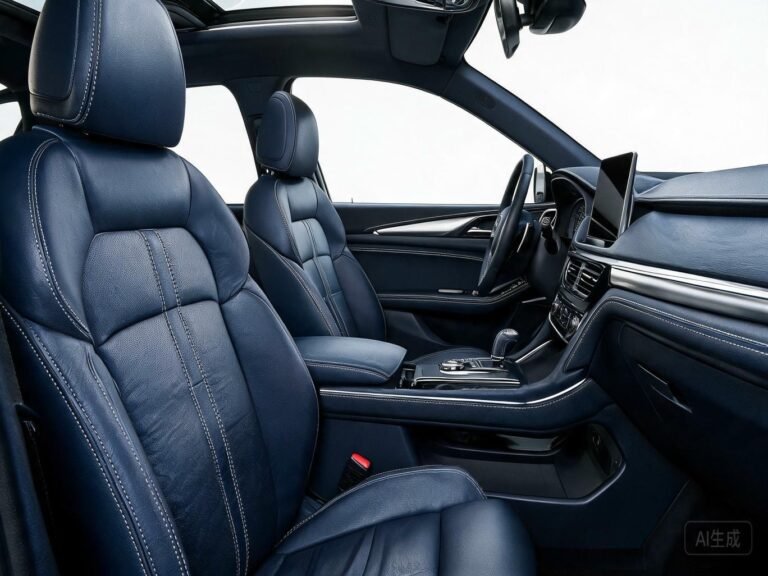
2026 automotive interiors prioritize cabin air quality, lightweight materials, and sustainable sourcing — driving demand for silicone leather
Questions to Ask During Your Factory Audit
Beyond document review, the on-site audit is where you discover whether the factory’s documented systems match their actual operations. These questions are designed to surface gaps between what the factory claims and what they do:
“Show me the last three non-conformity reports and their corrective actions.” A factory with zero non-conformities is either not inspecting or not reporting. A factory with documented non-conformities and evidence of root-cause analysis and corrective action is operating the system correctly. Look for the 8D (eight discipline) problem-solving methodology.
“What is your process for material change notification?” When the factory changes a raw material supplier, coating formulation, or process parameter, they must notify their automotive customers per IATF requirements. The answer should reference documented change control procedures with customer notification timelines. Vague answers indicate the system exists on paper but not in practice.
“Walk me through your batch release process.” The factory should demonstrate a clear chain: production → in-process testing → final testing → quality release → shipment. Each step should have documented acceptance criteria and sign-off authority. Ask who has the authority to stop a shipment — and verify that the quality department, not the sales department, holds that authority. Learn more about our factory production process to see what a well-designed system looks like.
About TOPSUN Silicone Leather
TOPSUN operates a silicone synthetic leather manufacturing facility equipped for automotive-grade production. Our production line integrates precision coating, multi-zone thermal lamination, automated quality inspection, and in-house physical testing — including Martindale abrasion (150,000+ cycles), UV stability (ASTM D329, 1,500 hours), hydrolysis resistance (14 weeks), and low-temperature flex (200,000 cycles at -30°C).
Our silicone leather is certified to FMVSS 302 (US automotive flammability), BS5852 (UK furniture fire safety, crib 5), DIN EN 1021 (European upholstered furniture), and CAL TB 117-2013 (California). VOC emissions are near-zero due to the solvent-free manufacturing process — meeting the most stringent EV cabin air quality requirements. The material is used in automotive seat, dashboard, door panel, and steering wheel applications. For a real-world application, see our silicone leather automotive case study.
We support custom development for automotive OEMs and Tier 1 suppliers — including color matching to OEM standards, texture design, substrate selection for weight optimization, and thickness specification down to 0.23 mm. To understand the material technology behind our automotive-grade silicone leather, visit our silicone leather introduction page.
Request Automotive-Grade Samples
Frequently Asked Questions
What certification does an auto leather factory need?
IATF 16949 is the mandatory quality management certification for any supplier to automotive OEM programs. It is recognized by all major automakers globally. Additionally, the factory’s products must meet material-specific certifications: FMVSS 302 (US flammability), DIN 75200 (European flammability), VDA 278 (VOC emissions), and REACH SVHC (chemical compliance). For silicone leather specifically, ISO 10993 biocompatibility certifications may also apply for healthcare-adjacent automotive applications.
Can an auto leather factory produce both PU and silicone leather?
Some factories can, but the manufacturing processes are fundamentally different. PU leather uses solvent-based wet coating; silicone leather uses solvent-free heat transfer lamination. A factory converting from PU to silicone production requires new coating equipment, different curing oven configurations, and different quality control test protocols. Verify that the factory has dedicated silicone production lines — not converted PU lines running silicone material, which can introduce contamination and consistency issues.
What VOC level should automotive leather meet?
Most OEMs require TVOC below 100 μg/m³ per VDA 278 testing. Premium EV programs are tightening this to below 50 μg/m³. Silicone leather typically measures below 50 μg/m³ because the manufacturing process uses no solvents — there are no residual VOCs to off-gas. PU leather, even when properly cured, typically measures 80-200 μg/m³ due to residual DMF and other solvent traces from the wet coating process.
How thin can automotive silicone leather be produced?
Silicone leather can be produced as thin as 0.23 mm while maintaining structural integrity and meeting automotive performance requirements. This is significantly thinner than typical PU automotive leather (0.8-1.2 mm) and represents a weight savings of 60-80% per square meter — directly contributing to EV range optimization. The factory must have precision coating equipment with ±0.05 mm thickness tolerance to produce at this specification consistently.