There’s a reason designers still reach for genuine leather when a project calls for warmth, status, and tactile authenticity. The material breathes. It ages. A full-grain hide on a well-used sofa tells a story that no synthetic can replicate — and for certain clients, that story is the product. But here’s the catch: genuine leather upholstery also demands quarterly conditioning, cracks in sustained cold, and loses its appeal the moment consistency matters more than character. Knowing when patina is a selling point — and when it’s a liability — is the single most important specification decision a designer or specifier makes. This guide breaks down where genuine leather earns its premium, where it quietly costs more than the line item suggests, and what the silicone alternative actually delivers.
Why Genuine Leather Upholstery Still Commands a Premium
Not all genuine leather is equal — and that’s the first thing specifiers get wrong. Full-grain leather, the highest grade, uses the entire outermost layer of the hide without sanding or buffing. It’s the densest, most breathable, most durable upholstery leather available, and it’s the only grade that develops a rich patina over years of use. Top-grain, the next tier down, is lightly sanded for a more uniform appearance — easier to dye, slightly less durable, but still a premium material.
Below those two sit corrected-grain and split leather, which are real hide but heavily processed, coated, and embossed to mask imperfections. When a supplier says “genuine leather” without specifying the grade, they’re almost always selling corrected or split — the mid-tier that sounds premium but performs like a coated synthetic. In our experience sourcing for luxury furniture brands, the difference between a full-grain European hide and a commodity split isn’t 10 or 20 percent. It’s 2-3x in price and 2x in service life.

Warm-tone swatch selection: color and grain depth vary dramatically between full-grain and corrected-grain hides.
The Patina Question: Feature or Flaw?
This is where the design intent matters most. A full-grain leather sofa in a private residence is supposed to age — the wear patterns, the softening, the deepening color are features, not defects. That patina signals use, comfort, and permanence. It’s why a 10-year-old leather chair in a study looks better than a new one. For that application, genuine leather upholstery is the right call and worth every dollar of its $1,000+ entry price.
Now put that same leather in a 200-room hotel. Every guest experiences the furniture differently. Some seats get daily use, others sit empty for weeks. The leather ages unevenly — one chair looks brand new, the one next to it shows visible wear after six months. That inconsistency reads as “shabby,” not “characterful.” And in a commercial setting, the conditioning regime that genuine leather demands — quarterly treatments with dedicated leather conditioners — becomes an operational cost line that most facilities teams don’t budget for. The result is dry, cracked leather by year three in environments where genuine leather was supposed to signal luxury.

Tensile testing: even full-grain hides vary in strength depending on tannery, animal origin, and processing.
| Factor | Genuine Leather | Silicone Leather |
|---|---|---|
| Service life (commercial) | 8-12 years (with maintenance) | 10-15+ years (no conditioning) |
| Maintenance cost | $15-30/m²/yr | $5-10/m²/yr |
| Aging behavior | Patina (uneven in commercial) | Stable, consistent appearance |
| Cold crack resistance | Moderate (-4°F / -20°C) | Excellent (-40°F / -40°C) |
| 10-year survival rate | 70-80% (with upkeep) | 85-95% |
When Genuine Leather Upholstery Becomes a Specification Risk
The risk isn’t in choosing genuine leather — it’s in choosing it for the wrong application. In sustained cold, full-grain leather rates only 6.2 out of 10 on crack resistance. It stiffens, then splits along stress lines, requiring bi-weekly conditioning just to stay functional. In high-humidity environments, the tanning agents can attract mold if the conditioning regimen lapses. And in hospitality settings where furniture gets 12+ hours of daily use, the uneven aging we discussed becomes a guest-experience problem: the room looks worn before the contract term ends.
A luxury hotel group we supply wanted the tactile warmth of full-grain leather for their suite seating but couldn’t justify the $15-30/m²/yr conditioning cost across 400 rooms. We matched their specified hide grain and color in silicone leather. The suites are now in year 4 — no conditioning, no cracking, and guests can’t distinguish it from the genuine leather sample by touch alone. For designers weighing this trade-off, the hydrolysis-resistant silicone leather spec sheet shows exactly where the material holds up and genuine leather doesn’t.

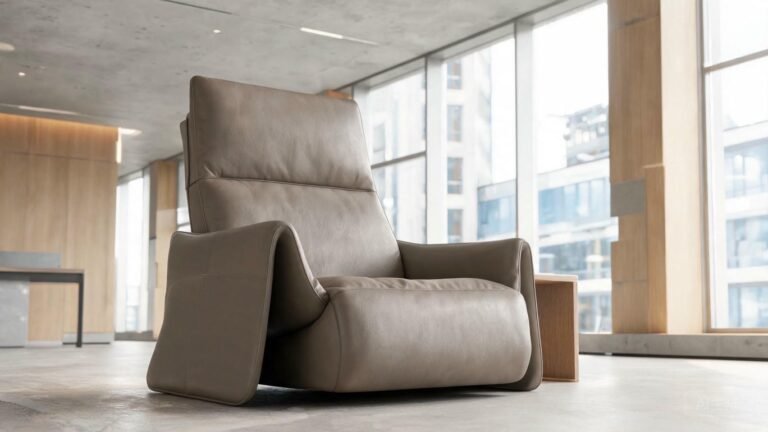
Genuine leather sofa: the right choice for residential warmth, the wrong one for a 400-room hotel without a conditioning budget.
The Silicone Alternative: Same Look, Zero Upkeep
Here’s what changes when you specify silicone leather instead of genuine hide. You keep the hand — the supple, warm feel that makes leather desirable in the first place. You keep the grain — embossed to match any genuine leather texture, from smooth full-grain to pebbled lychee. You keep the color range, the breathability, and the visual warmth. What you lose is the conditioning regime, the cold-crack risk, and the uneven aging.
Silicone leather wipes clean with a damp cloth. It doesn’t absorb oils, doesn’t stiffen in winter, and doesn’t develop wear patterns that read as damage in a commercial setting. Its 10-year survival rate runs 85-95% compared to genuine leather’s 70-80% — and that gap widens when you factor in the maintenance that genuine leather requires just to reach 70%. For projects where the full vs semi silicone distinction matters, the full-silicone formulation is the one that most closely replicates genuine leather’s tactile profile.

Texture closeup: modern silicone leather can match genuine hide grain so closely that touch alone rarely distinguishes them.
Silicone leather on luxury furniture frames: the look and hand of genuine hide, without the conditioning and cracking.
Over 10 years, genuine leather’s maintenance cost ($150-300/m²) exceeds the price gap with silicone leather — while delivering a lower survival rate.
Frequently Asked Questions
Does genuine leather upholstery actually outlast silicone leather?
In residential settings with diligent conditioning, full-grain genuine leather can last 8-12 years and arguably looks better at year 10 than at year 1. But its 10-year survival rate in commercial settings sits at 70-80% — and that assumes the maintenance regime is followed. Silicone leather, which needs no conditioning, runs 85-95% survival over the same period. The durability gap isn’t in the material’s inherent strength; it’s in the upkeep. For a side-by-side breakdown, see our 10-year durability comparison.
Can silicone leather replicate the patina of genuine leather?
No — and that’s intentional. Patina is the visible record of uneven wear, which is desirable in a single-owner residential chair but reads as damage in a 200-room hotel. Silicone leather is engineered to maintain its original appearance, not to age. If your spec calls for the look and hand of genuine leather without the aging, silicone is the match. If the aging is the point — a private study, a heritage brand — genuine full-grain remains the right material. For more on this distinction, our genuine leather vs synthetic guide covers when each wins.
Specify for the Application, Not the Label
Genuine leather upholstery earns its premium when the patina is the product — private residences, heritage interiors, luxury suites with a dedicated maintenance budget. It becomes a specification risk when consistency, low upkeep, and predictable aging matter more than character — commercial hospitality, healthcare, transit, and any project where the furniture gets used by different people every day. The honest design decision isn’t “leather or synthetic.” It’s “does this application want a material that ages, or one that doesn’t?” Specify genuine leather when the aging is the story. Specify silicone when it isn’t.
About TOPSUN
TOPSUN supplies silicone leather that replicates the hand and grain of genuine leather upholstery for B2B furniture and automotive brands who want the look without the conditioning regime — across luxury residential, hospitality, and OEM seating programs.
Full-silicone formulation · Custom grain and color matching to genuine hide specs · 85-95% 10-year survival rate · Zero conditioning required · REACH / FDA compliant.