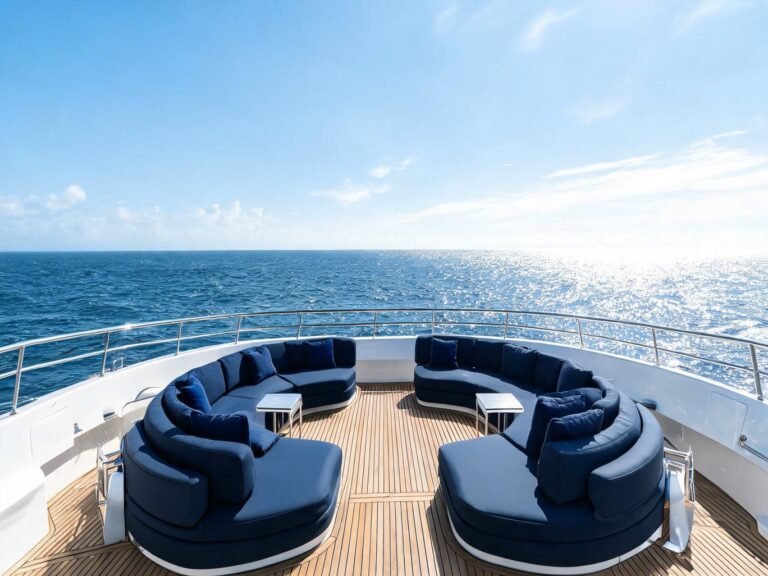
For procurement teams, flybridge seating material faces the most unforgiving environment on any yacht. Open-air UV, wind stress, rapid temperature swings, and direct salt spray exposure attack every square centimeter without relief. The surface must stay supple in morning cold, resist fading at noon, and shed rain before nightfall. This guide explains how to evaluate boat deck seating for these extreme open-air conditions and where silicone leather can deliver durable performance without constant upkeep.
Download Material Specifications
Open-Air UV, Wind Stress, and Temperature Swings on Flybridges
Flybridge seating fails differently than any other marine upholstery because it lives in completely unprotected air. Wind-driven spray, thermal shock from direct sun to evening dew, and UV radiation reflected off water and white gelcoat all accelerate degradation. For boat deck seating, the buyer should look beyond basic waterproof claims and ask how the material behaves after prolonged tropical UV exposure, repeated thermal cycling, and wind-flap stress at seams.
Accelerated weathering methods such as ASTM G154 UV exposure practice are essential for flybridge materials because open-air seating receives the full solar spectrum without canopy filtering. They do not replace dockside observation, but they help purchasing teams identify surfaces that will chalk, crack, or lose tensile strength after a season of direct exposure. Wind-load and seam-fatigue testing are equally relevant, since flybridge cushions often act as sails when the vessel is running or moored in breeze.
Exposure geometry matters. A flybridge lounge on an expedition yacht, a forward-facing bench on a center console, and a wrap-around sofa on a luxury cruiser may all be called deck seating, but each has a different mix of sun angle, wind speed, spray trajectory, and temperature amplitude. Good specifications describe the real exposure profile, not only the product category. This prevents selecting a cabin-grade fabric for an open bridge, or over-specifying a rigid technical cover for a sheltered aft-deck.

Tensile strength testing — flybridge seating must resist wind, sun, and mechanical stress.
Waterproofing in Unprotected Deck Environments
Waterproofing on a flybridge must work in real time, not just in theory. A silicone leather surface must reject rain, spray, and washdown water instantly while the cushion system drains before the next wave hits. This is important for cockpit cushion material because standing water on open decks evaporates slowly in humid climates and can penetrate seams, accelerating hydrolysis and backing separation.
In our discussions with yacht builders and deck-equipment suppliers, the most useful flybridge specification is practical: a surface that beads water under pressure, color that does not shift when viewed against open sky and white deck, no surface cracking after thermal shock, and stitching that does not fray under wind flutter. Materials used on fully exposed flybridges should also carry tensile-strength retention data after combined UV and moisture cycling, since wind stress on large cushions can tear weakened substrates before the surface shows visible wear.

Waterproof droplet test — open-air flybridge seating faces direct exposure to rain and sea spray.
Color Stability and Visual Impact from Above
Flybridge seating cannot look faded or tired when viewed from the dock or a passing tender. Designers need saturated color, consistent grain, and a finish that reads as premium under direct sunlight. Silicone leather allows OEM teams to develop crisp whites, warm sands, slate grays, or custom brand colors that hold their depth without relying on coatings that chalk or peel. The result is a flybridge that presents a unified visual statement from every angle.
There is also a commercial reason to choose a stable synthetic surface on open decks. Charter guests expect social-space perfection for photography and entertaining. A material that recovers from spilled cocktails, bird droppings, and morning dew without staining or watermarking protects the vessel’s reputation and reduces detailing labor before every departure. In our experience, buyers who test color shift under tropical UV, water-beading after detergent exposure, and wind-flap seam behavior before approval make better long-term decisions.
| Decision Area | What to Specify | Best Fit |
|---|---|---|
| UV and thermal shock | Specify maximum UV resistance and low-temperature flexibility | Tropical flybridges, open decks |
| Wind and seam stress | Use high-tensile substrates with reinforced stitching patterns | Large cushions, expedition yachts |
| Water shedding | Require hydrophobic surface and rapid-drain cushion construction | Exposed lounges, sportfish bridges |
| Color stability | Request accelerated UV color data and sky-view visual approval | Luxury cruisers, charter fleets |
TOPSUN Open-Air Deck Solutions
TOPSUN supplies silicone leather for flybridge cushions, open deck seating, and unprotected marine loungers where maximum UV, wind, and salt spray create the most demanding material requirements. Our marine and outdoor silicone leather applications page shows where UV-stable, hydrolysis-resistant surfaces are commonly used in open-air yacht environments. Buyers comparing flybridge alternatives can also review our marine faux leather guide and outdoor furniture waterproof leather for related exterior seating guidance.
For custom flybridge projects, the practical starting point is the exposure profile: latitude, sun hours, prevailing wind speed, cushion size and geometry, and cleaning protocol. Once these are documented, TOPSUN can adjust UV-stabilizer load, tensile strength, grain texture, and color tolerance to match the production schedule and deck design scheme.

Open-air boat deck seating.
UV resistance overview — how silicone leather protects against sun damage on exposed flybridge seating.
Specifying Flybridge Seating Material for Production
Include flybridge layout drawings, cushion dimensions, target color references, expected environmental exposure, and required sample size in the RFQ. If the project involves tropical charter yachts or expedition vessels, request additional documentation on UV-aging hours, hydrolysis resistance after wet-dry cycling, and tensile strength retention. A small pre-production trial with combined UV-moisture chamber testing often prevents costly replacement after the first equatorial season.
For large marine deck programs, approve both appearance and structural behavior under real wind and sun loads. Ask the workshop to cut, wrap, stitch, and weather-test the sample under the same exposure angles the finished cushions will face. If the material shows color shift against the deck, seam gapping under tension, or stiffness after cold storage, adjust the substrate, grain, or color batch before issuing the purchase order.
Frequently Asked Questions
How does flybridge seating differ from cabin upholstery in material requirements?
Flybridge seating faces unfiltered UV, wind stress, and rapid temperature swings that cabin upholstery never encounters. The surface must resist chalking and cracking under direct sun, maintain flexibility after cold nights, and hold shape when wind presses against large cushion surfaces. Backing and seam strength become critical because open-air cushions act as sails in breeze and during vessel operation.
What accelerated tests matter most for open-air deck seating?
Buyers should prioritize ASTM G154 UV exposure with high radiant dosage, hydrolysis resistance after wet-dry cycling, tensile strength retention after combined UV and moisture aging, and low-temperature flexibility if the vessel operates in seasonal climates. Wind-load seam fatigue testing is also valuable for large flybridge cushions.
Next Step for Buyers
Flybridge seating faces the harshest exposure on any yacht: direct sun, wind-driven rain, salt spray, and temperature extremes. TOPSUN engineers marine silicone leather with enhanced UV stabilizers, salt-spray resistance, and quick-dry surface properties. We support custom backing for drainage, color matching to yacht livery, and ergonomic texture tuning for open-air seating.
About TOPSUN
TOPSUN engineers silicone leather for flybridge seating, open-air helm stations, and exposed deck lounging on yachts and superyachts.
Relevant capabilities include enhanced UV blocking for tropical cruising, salt-spray resistance, quick-dry foam-compatible backing, and custom color development to match yacht livery.