“Soft” is the single most requested attribute when B2B buyers specify faux leather for furniture, automotive, and fashion applications. But here is what spec sheets rarely mention: the initial softness of faux soft leather fabric tells you almost nothing about how that material will feel after 20,000 seating cycles, 500 hours of UV exposure, or two years in a humid warehouse. The materials that feel softest on day one — typically plasticized PU — are often the ones that turn brittle, tacky, or cracked by year three. This guide breaks down what “soft” actually means in material science terms, how different faux leather types compare on hand feel retention, and what procurement teams should specify to get softness that lasts.
Request Soft Leather Sample Kit
What Defines Soft Hand Feel in Faux Leather
Hand feel is not a single property. It is a composite tactile experience that material engineers break into three measurable components: flexibility (how easily the material bends under light pressure), pliability (how it conforms to curved surfaces without springing back), and surface glide (the friction coefficient when a fingertip moves across the face). Together, these determine whether a buyer describes a sample as “buttery,” “supple,” or “rubbery.”
In our testing lab, we evaluate faux leather fabric hand feel specifications using a flexibility bending tester that measures the force required to fold a sample 180 degrees. Softer materials register lower bending force values — typically below 0.5N for premium-grade upholstery. We also run cyclical bending tests (10,000+ folds) to see whether the material maintains its original flexibility or stiffens over time. This is where the gap between materials becomes visible: a PU sample that starts at 0.4N may climb to 1.2N after accelerated aging, while silicone leather holds steady.

Flexibility bending tester measuring hand feel retention across faux leather samples
The problem for procurement teams is that most suppliers quote only initial hand feel — the day-one sensation. They do not provide aged flexibility data. That gap costs buyers money when soft furniture turns stiff after one season in a sunlit lobby.
Types of Faux Soft Leather Fabric: PU, PVC, and Silicone
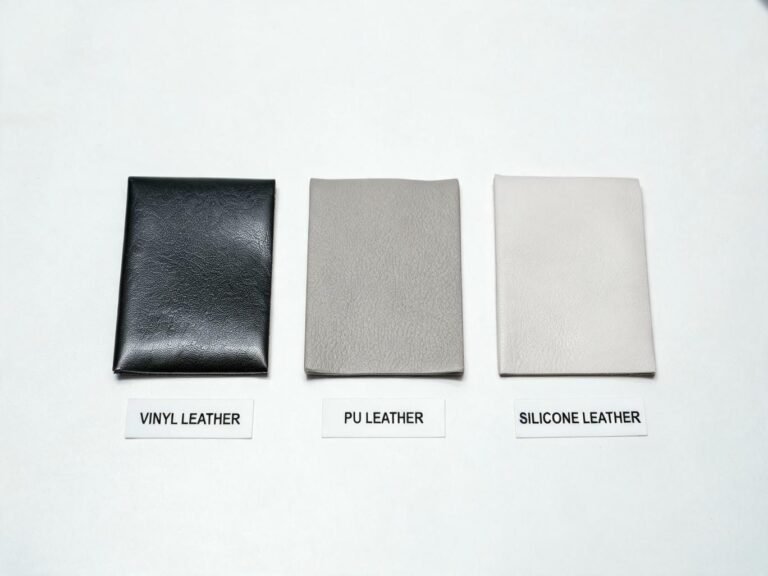
Three material families dominate the faux leather fabric types PU PVC silicone landscape, and each achieves softness through fundamentally different chemistry. Understanding these differences is the first step toward specifying a material that stays soft for years, not months.
PU (polyurethane) faux leather achieves softness through polymer formulation. Solvent-based PU tends to produce the softest initial hand feel — warm, leather-like, and pliable. Water-based PU is slightly firmer but carries lower VOC risk. The trade-off: PU’s softness depends on polymer chains that break down under UV and hydrolysis, meaning the material stiffens and cracks within 3-5 years. For a deeper look at the PU production process and its limitations, see our detailed silicone vs PU comparison.

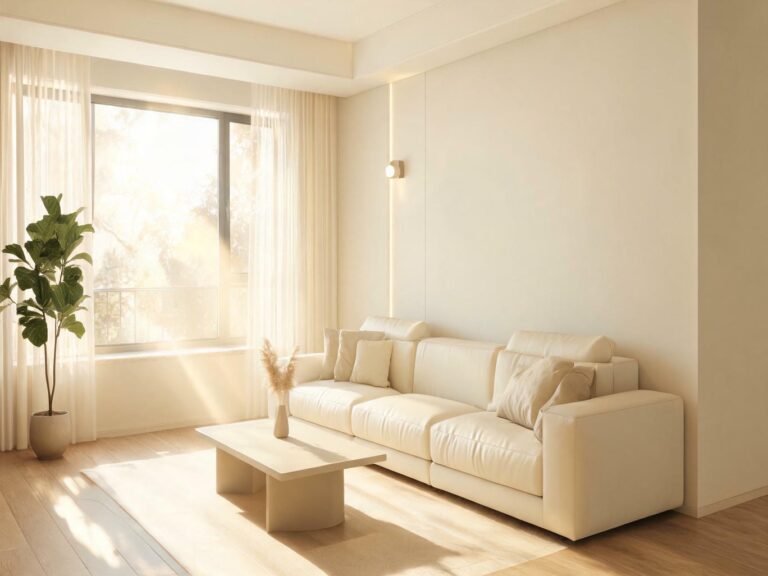
Off-white leather softness fold display — visual evaluation of pliability and surface drape
PVC (vinyl) fabric relies on plasticizer additives for flexibility. It starts moderately soft but hardens progressively as plasticizers migrate and evaporate. The material also develops a characteristic “sticky” surface feel as it degrades — a common complaint in restaurant seating and medical waiting rooms. Silicone leather takes a different path entirely. PDMS (polydimethylsiloxane) polymer is inherently flexible at the molecular level — no additives, no plasticizers, no migration. The material feels plush and smooth from day one and maintains that tactile profile for 10-15+ years because the softness is built into the chemistry, not bolted on.

Surface texture comparison of soft faux leather — grain pattern affects perceived softness
Durability of Soft Faux Leather in Real-World Use
Here is the paradox that catches buyers off guard: the additives that make faux leather soft initially are the same compounds that drive premature failure. Plasticizers in PVC and certain softening agents in solvent-based PU migrate out of the material over time — accelerated by heat, UV, and humidity. As these compounds leave, the material loses both softness and structural integrity.
The data tells the story clearly. When we track soft faux leather fabric durability across material types, the spread is dramatic. PU starts at 30,000-80,000 Martindale cycles and degrades from there. PVC vinyl holds 30,000-50,000 cycles but loses flexibility faster than any other type. Silicone leather rates 100,000-200,000+ cycles and, critically, retains its original bending flexibility throughout that range because no additives are migrating out.
One of our furniture clients specified PU faux leather for a 300-seat auditorium. After 18 months, 40% of seats showed visible cracking and stiffening. The replacement cost — material plus labor plus venue downtime — exceeded the original budget by 60%. The client has since switched to silicone leather for all subsequent projects.
| Property | PU Faux Leather | PVC Vinyl | Silicone Leather |
|---|---|---|---|
| Initial Softness | High (warm, supple) | Moderate (plastic-like) | High (plush, smooth) |
| Softness Retention | Degrades in 2-3 yrs | Degrades in 1-2 yrs | Stable 10-15+ yrs |
| Martindale Abrasion | 30K-80K cycles | 30K-50K cycles | 100K-200K+ cycles |
| UV Resistance | 300-500 hrs | 200-500 hrs | 1,500+ hrs |
| Lifespan | 3-5 years | 2-4 years | 10-15+ years |
Where Faux Soft Leather Fabric Performs Best
Application context determines which faux soft leather fabric for upholstery makes sense. A material that excels in a climate-controlled office may fail rapidly in a sunlit restaurant or a marine cockpit. Matching the material’s softness profile to the application’s environmental stressors is where procurement adds real value.
In furniture and sofa applications, soft hand feel directly impacts perceived value. Buyers evaluating upholstery for hospitality projects — hotel lobbies, restaurant booths, waiting areas — need materials that maintain softness under daily seating abuse and chemical cleaning. PU delivers initial softness at low cost but requires replacement within 3-4 years. Silicone leather costs more upfront but eliminates the replacement cycle entirely for a decade or more.

Furniture upholstered in soft faux leather — hand feel drives perceived quality in hospitality settings
In automotive interiors, the stakes are higher. Cabin materials face temperature cycling from -20°C to 80°C, direct UV through windows, and constant friction from clothing. A faux soft leather fabric for automotive interiors must retain its hand feel under all three stressors simultaneously. The global synthetic leather market, valued at USD 45.5 billion in 2025, continues to grow as automotive OEMs shift from genuine leather to synthetic alternatives [$TRAE_REF](https://www.grandviewresearch.com/industry-analysis/synthetic-leather-market). But not all synthetics perform equally — PU stiffens in cold weather, PVC turns brittle under UV, and only silicone maintains consistent tactile quality across the full temperature range.
Breathable performance test — see how silicone leather maintains softness and air permeability under stress
Talk to Our Material Engineers
Silicone Leather: Redefining Soft Faux Leather Fabric
Silicone leather solves the softness-durability paradox by eliminating the root cause of degradation: additive migration. Because PDMS polymer is inherently flexible — its molecular chains rotate freely at room temperature without any plasticizer assistance — the material starts soft and stays soft. No compounds to migrate. No chemistry to break down. No tactile surprise after year three.
For B2B buyers, this means the hand feel you approve in the sample stage is the hand feel your end users experience in year five, year eight, year ten. That consistency matters for brand reputation, warranty cost management, and sustainability commitments. The faux leather fundamentals and our PU leather guide provide additional context for procurement teams evaluating material specifications.

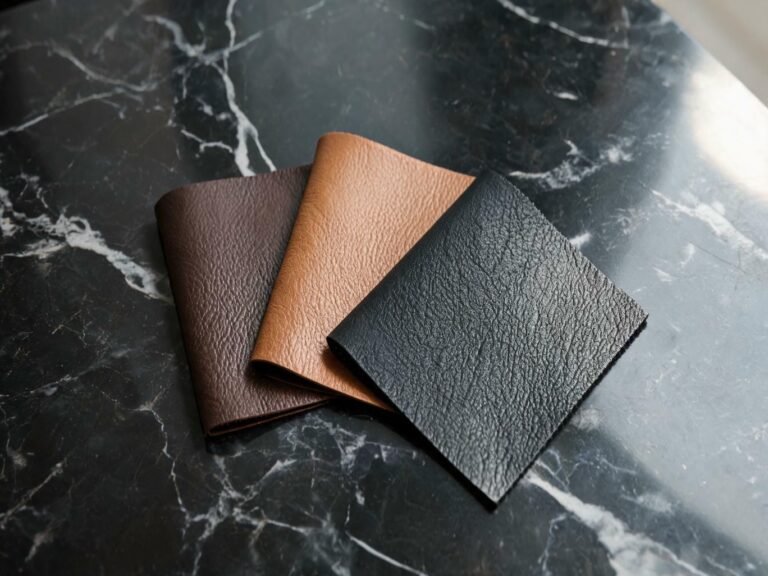
Layered soft leather samples — color variety with consistent hand feel across the silicone leather range
Frequently Asked Questions
How do you measure soft hand feel in faux leather fabric?
Hand feel is measured using a flexibility bending tester that records the force (in Newtons) required to fold a material sample 180 degrees. Lower force values indicate softer, more pliable material. Premium upholstery-grade faux leather typically registers 0.3-0.5N initially. The critical metric is not the day-one reading but the aged reading — how much that force increases after 10,000+ bending cycles or accelerated UV aging. Materials with stable aged flexibility values (like silicone leather) maintain their soft feel in real-world use; materials with rapidly increasing values (like PU and PVC) will feel stiff and brittle to end users within a few years.
Does faux soft leather fabric peel over time?
Peeling occurs when the surface coating separates from the fabric backing — a failure mode common in PU and PVC faux leather. The root cause is polymer degradation: UV breaks down PU molecular chains, while plasticizer loss in PVC causes the coating to shrink and delaminate. Silicone leather does not peel because the silicone polymer is UV-stable and requires no plasticizers. The coating and backing are bonded at the molecular level during the solvent-free manufacturing process, creating a unified material that cannot delaminate under normal conditions.
Specifying Softness That Lasts
The faux soft leather fabric market offers more options than ever, but not all softness is created equal. PU delivers immediate tactile appeal at low cost — then degrades. PVC offers budget pricing with even faster hardening. Silicone leather costs more upfront but provides the only solution where day-one softness and year-ten softness are the same number. For procurement teams managing multi-year contracts, the question is not which material feels softest today. It is which material will still feel soft when the warranty expires.
Get Side-by-Side Soft Leather Samples
About TOPSUN
TOPSUN engineers silicone leather with hand feel profiles matched to specific application requirements — from buttery-soft furniture upholstery to firm-yet-smooth automotive seating — using PDMS polymer technology that maintains tactile consistency for 10-15+ years without plasticizers or additives.
100+ texture options · Pantone/RAL custom matching · Martindale 100K-200K+ cycles · REACH & FDA compliant · Solvent-free production