Most collaborative leather design projects follow the same arc: the brand sends a tech pack, the manufacturer samples blindly, and three rounds of revisions later, someone realizes the color tolerance was never specified. The problem isn’t effort — it’s that both sides assume the other locked down specs that neither actually defined. Here are the five specifications that derail collaborative leather design most often, and how to lock them before sampling begins.
The Collaborative Leather Design Process: Where Most Brands Stumble
A typical collaborative leather design project moves through four phases: concept brief, lab-scale sampling (A4 swatches), pre-production prototype, and production run. The concept brief is where the most expensive ambiguity gets baked in. Brands specify color, thickness, and general texture — but leave the tolerances, grain direction, embossing depth, and batch consistency targets undefined. The manufacturer fills those gaps with their own defaults, which may not match the brand’s mental model.

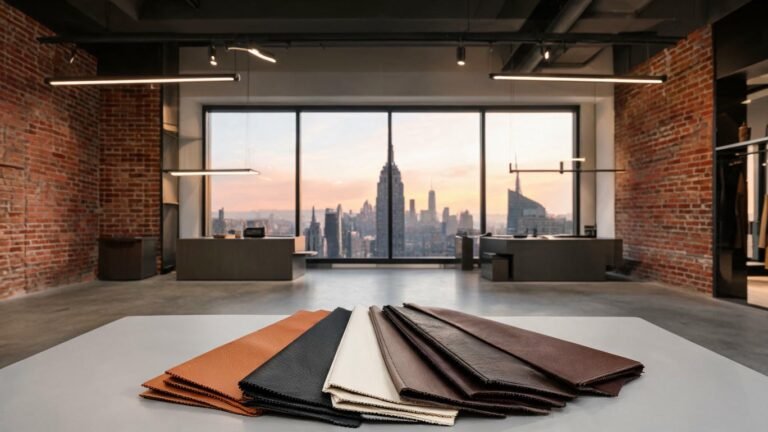
Multi-color swatch rack — the starting point where brand vision meets material reality.
In our custom design projects, we’ve found that brands lock color specifications 80% of the time but leave embossing depth and grain direction undefined — and those are the specs that cause 70% of sample rejections. The custom leather production workflow only works when both sides speak the same specification language from the first sample request.
Color Tolerance: Why Delta E ≤ 1.0 Matters in Collaborative Leather Design
“Match this Pantone” is the most common opening line in collaborative leather design — and the most under-specified. Pantone matching gets you into the right color neighborhood. Delta E tells you how far off you actually are. A Delta E of 3.0 looks noticeably different to the trained eye; 1.0 is imperceptible. Most brands don’t specify a Delta E tolerance, so the manufacturer aims for “close enough” — which means a different version of “close enough” on every reordering cycle.
Lock this spec: Specify Pantone reference + Delta E ≤ 1.0 tolerance + viewing light source (D65 daylight). Without all three, “color matching” means whatever the manufacturer decides it means on that batch.
The Pantone Matching System gives you the reference point. But batch-to-batch consistency — producing the same Delta E on reorder #3 as on the original sample — requires a manufacturer with calibrated color measurement equipment and documented color management protocols. Without that, your collaborative leather design drifts a shade or two with every production run.
Embossing Depth and Grain Direction in Collaborative Leather Design
Texture is the spec that vanishes fastest in the gap between “looks right” and “is right.” Two leather samples can share the same color, thickness, and base material but feel completely different because the embossing depth differs by 0.1mm or the grain runs perpendicular instead of parallel. Grain direction affects how light hits the surface, how the material stretches during cutting, and how seams align when stitched.

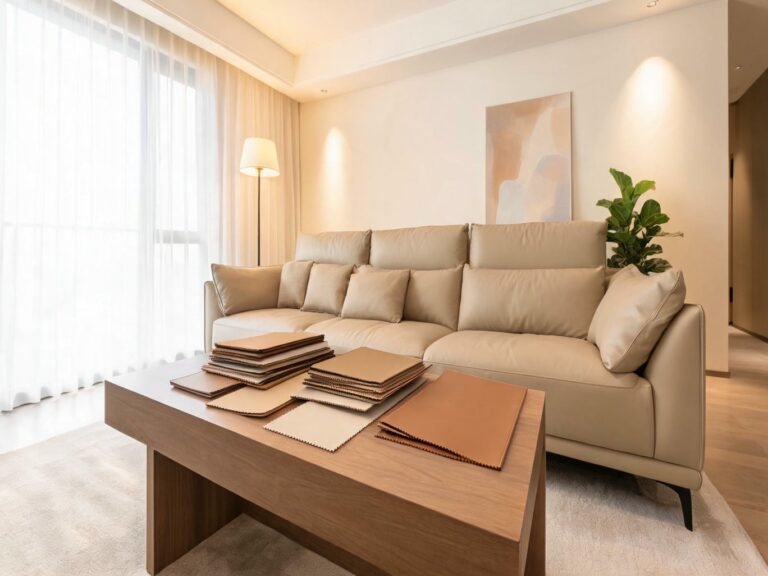
Custom color matching session — where brand references become material specifications.
When brands say “pebbled grain,” they might mean 0.3mm depth at 2mm intervals. The manufacturer’s default might be 0.5mm at 3mm intervals. Both look “pebbled” on a swatch — but on a 2-meter sofa panel or a car door insert, the difference is visible. The custom leather texture design process should specify depth in millimeters, grain pitch in millimeters, and direction relative to the selvage edge.
Batch Consistency: The Spec That Kills Scale-Up
The first sample always looks perfect. The question is whether sample #500 in a 5,000-meter production run still matches. Batch consistency is the spec that separates a manufacturer from a sample-maker. It requires calibrated equipment, documented process controls, and a quality system that catches drift before it reaches the customer.

Calender roller equipment — where embossing depth and grain direction are physically engineered into the material.
Specify batch consistency as a measurable target: Delta E ≤ 1.0 between batches, embossing depth within ±0.05mm, and thickness within ±0.05mm of nominal. If the full vs semi silicone leather distinction matters for your application, lock that too — the coating thickness ratio changes the material’s performance characteristics.
How TOPSUN Closes the Collaboration Gap in 7-10 Days
We deliver custom embossing rollers in 7-10 days — our in-house engineering team handles the entire process from CAD rendering to roller production, eliminating the 4-6 week wait typical of outsourced texture development. That timeline matters because most collaborative leather design projects stall at the texture sampling stage, waiting for a third-party roller shop to deliver.

Bespoke design trends 2026 — where collaborative specification meets production capability.
TOPSUN’s collaborative design process starts with a silicone leather introduction briefing, moves through Pantone-matched color sampling with Delta E ≤ 1.0, and delivers custom embossing rollers within 7-10 days. We offer 100+ existing textures, unlimited color options, and batch-to-batch consistency backed by 10+ in-house engineers and 10+ automated production lines.
| Design Spec | What Brands Typically Skip | What It Costs | How to Lock It |
|---|---|---|---|
| Color tolerance | Pantone ref only, no Delta E | 2-3 extra sample rounds | Pantone + Delta E ≤ 1.0 + D65 |
| Embossing depth | “Pebbled” — no mm spec | Visible mismatch on large panels | Depth in mm + grain pitch |
| Grain direction | Not specified | Seam misalignment, light scatter | Direction relative to selvage |
| Batch consistency | Assumed, not measured | Color drift on reorders | Delta E ≤ 1.0 between batches |
Frequently Asked Questions
How many rounds of color matching should I expect in custom leather design?
Expect 1-3 rounds of refinement when you’ve specified a Pantone reference with Delta E tolerance. Without a Delta E target, expect 4-6 rounds — each one adding a week to your timeline. The fastest path is providing a physical reference sample alongside the Pantone code, specifying D65 daylight as the viewing condition, and setting Delta E ≤ 1.0 as the acceptance criterion. A manufacturer with calibrated color measurement equipment can hit that on the first or second round.
Can a manufacturer replicate an existing leather texture from a sample?
Yes — but the accuracy depends on whether the manufacturer has in-house embossing roller development. Send a physical sample of the target texture. The manufacturer measures embossing depth, grain pitch, and pattern repeat, then engineers a custom roller to replicate it. TOPSUN delivers custom embossing rollers in 7-10 days using in-house CAD-to-roller production. Manufacturers without in-house capability outsource roller production, which adds 4-6 weeks to the timeline.
Design Collaboration That Actually Works
Collaborative leather design fails when specifications live in someone’s head instead of on paper. Color tolerance, embossing depth, grain direction, and batch consistency are the four specs that separate a smooth sampling process from a month of revisions. TOPSUN’s in-house engineering — Pantone-matched color with Delta E ≤ 1.0, custom embossing rollers in 7-10 days, and 100+ existing textures — gives brands a partner who can execute every spec they lock down. Send us your tech pack. We’ll send back samples that match it on the first round.
Start a Collaborative Design Project
See how TOPSUN’s OEM/ODM custom design process works — from tech pack to production sample.
About TOPSUN
TOPSUN partners with B2B brands on collaborative leather design projects, offering Pantone-matched color accuracy (Delta E ≤ 1.0), 100+ embossing textures, and custom roller development in 7-10 days for automotive, furniture, and fashion applications.
Unlimited color options, batch-to-batch consistency, custom embossing rollers in 7-10 days, and free A4 swatches shipped worldwide — supported by 10+ in-house engineers.