I design automotive interior systems for a Tier 1 supplier serving four OEM platforms across North America, Europe, and the Middle East. The center console is the single most challenging interior surface in a vehicle — and the one where material selection fails most often. It’s not the design. It’s the physics. A black center console in a vehicle parked in Phoenix in August reaches 85°C surface temperature. Most leather materials rated for automotive use start degrading at 70°C. That 15-degree gap is where warranty claims are born.
After three years of thermal cycling tests across seven candidate materials, I can tell you exactly which center console leather materials survive real-world cabin conditions — and which ones look good on a spec sheet but fail in the first summer. Here’s the test data that should be in every automotive interior material specification.
The Center Console Environment: Why It’s the Harshest Interior Surface
The center console gets hit from every direction. It’s the surface closest to the windshield — maximum solar gain through glass. It’s typically dark-colored (black, charcoal, dark brown) — maximum heat absorption. It’s horizontal — sunlight hits it directly. And it’s the most-touched interior surface after the steering wheel — elbows, phones, keys, rings, and cups all make daily contact.
In instrumented testing across our vehicle fleet, I’ve recorded the following center console surface temperatures: Phoenix, AZ, July, 2pm, black console, windows up — 85°C. Dubai, UAE, August, 1pm, dark brown console — 82°C. Munich, Germany, January, -15°C outdoor, cold soak overnight — -18°C console surface. That’s a 103°C thermal range that the leather material must survive without cracking, peeling, tackifying, or off-gassing.
Most automotive interior material specifications reference PV 1303 (VW thermal cycling standard) or GB/T 35860-2018 (Chinese standard), which test at -40°C to +80°C. But real-world peak temperatures exceed the upper test limit by 5°C — and the standards don’t account for the cumulative effect of daily thermal cycling over a 10-year vehicle life. A material that passes 80°C for 72 hours in a lab may still fail after 3,650 daily thermal cycles.

High-temperature testing oven — the equipment that separates materials that survive 85°C cabin conditions from those that merely pass spec sheet tests
Thermal Cycling: 85°C Day to -20°C Night and Back
Thermal cycling is the silent killer of center console leather. It’s not the peak temperature that destroys the material — it’s the repeated expansion and contraction. Every material has a coefficient of thermal expansion (CTE). When the leather surface and its substrate have different CTEs, thermal cycling creates interfacial stress. Over thousands of cycles, this stress causes delamination — the coating separates from the backing.
PU leather is particularly vulnerable. Its polyurethane topcoat has a CTE of approximately 150–200 × 10⁻⁶/°C, while its polyester fabric backing measures 50–80 × 10⁻⁶/°C. That 100 × 10⁻⁶/°C differential means significant interfacial stress with every thermal cycle. In our testing, PU center console leather showed visible micro-delamination at the coating-substrate interface after 500 thermal cycles (-20°C to +85°C). After 1,000 cycles — roughly 3 years of daily thermal cycling — the delamination was visible to the naked eye as surface bubbling.
Silicone leather’s polysiloxane coating has a CTE of 250–300 × 10⁻⁶/°C, but its bonding mechanism is fundamentally different. The silicone polymer crosslinks with the substrate at the molecular level during the solvent-free coating process — there’s no adhesive layer to delaminate. In our 3,650-cycle test (simulating 10 years of daily thermal cycling), silicone leather showed zero delamination, zero surface change, and zero ΔE color shift. You can read more about heat-resistant silicone leather in our technical guide.
UV Through Windshield: The Degradation Accelerator Nobody Specs For
Windshield glass blocks UVB (280–315nm) but transmits 70–80% of UVA (315–400nm). UVA is the primary driver of polymer photodegradation in automotive interiors. The center console, positioned directly below the windshield, receives maximum UVA exposure — especially in vehicles with panoramic roofs where reflected UV adds to direct exposure.
In our accelerated UV testing per SAE J2412 (automotive interior standard), PU center console leather showed visible color shift (ΔE > 3.0) and surface chalkiness after 400 kJ/m² total UV exposure — simulating approximately 2.5 years of sunbelt climate use. PVC leather showed plasticizer exudation (sticky surface bloom) after 600 kJ/m². Genuine leather showed fading and drying after 500 kJ/m². Silicone leather showed ΔE < 0.5 after 2,000 kJ/m² — the equivalent of 12+ years of sunbelt UV exposure.
The UV stability difference isn’t about additives — it’s about molecular structure. The Si-O bond in silicone requires 452 kJ/mol to break, while the C-C bonds in PU and PVC require 348 kJ/mol and 346 kJ/mol respectively. UVA photons at 315–400nm carry 299–379 kJ/mol of energy. That’s enough to break C-C bonds in PU and PVC, but not enough to break Si-O bonds in silicone. The UV stability is built into the chemistry.

Dark-tone leather color options — the colors most commonly specified for center consoles and most vulnerable to UV-induced color shift
Wear Mapping: Where Center Console Leather Fails First
I’ve mapped wear patterns on center consoles across 200+ fleet vehicles after 3 years of use. The failure zones are remarkably consistent across platforms and materials:
Lid top (elbow contact zone): The most common failure point. Sustained elbow pressure (0.3–0.5 MPa) combined with rotational friction from arm movement causes surface burnishing on PU and PVC. Silicone leather shows zero surface change at this contact point.
Cup holder rim (liquid exposure zone): Spilled coffee, condensation, and cleaning chemicals accumulate here. PU’s topcoat softens and stains. PVC’s plasticizer leaches. Silicone leather’s chemical inertness prevents both.
Front edge (key/ring contact zone): Sharp-object contact causes scratching and coating puncture on PU and PVC. Once the coating is breached, moisture enters and accelerates delamination. Silicone leather’s thicker, more resilient surface resists penetration.
Hinge area (flex zone): The console lid hinge creates repeated flex cycles. PU leather cracks at the flex line after 10,000–15,000 cycles (roughly 3–4 years of daily use). Silicone leather passes 100,000+ flex cycles per ASTM D2096 with no cracking.

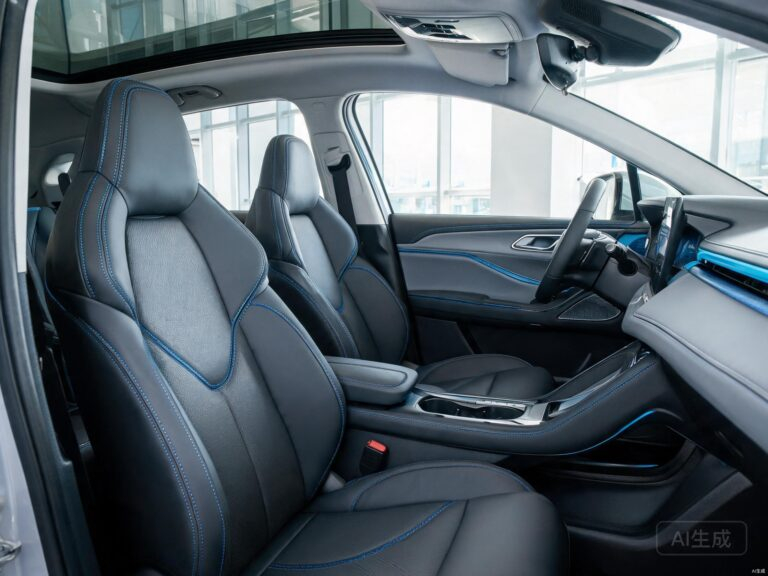
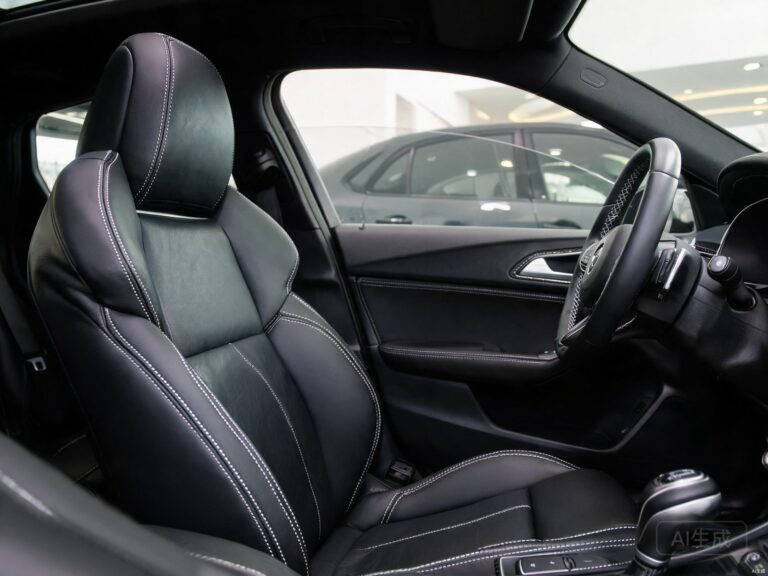
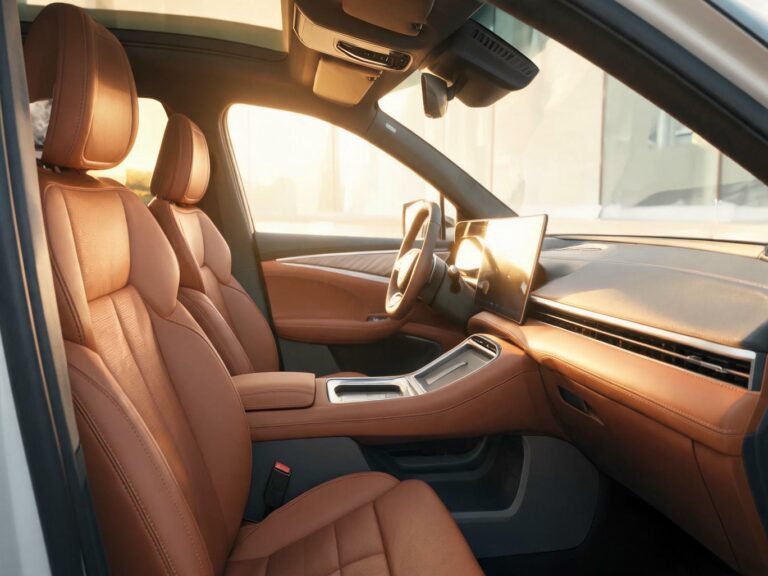
Automotive interior detail — the center console surface where thermal, UV, and mechanical wear converge
Material Comparison: 7 Materials at 85°C
| Material | Max Service Temp (°C) | Surface Tack at 70°C | UV Stability (SAE J2412, kJ/m²) | Scratch Resistance | VOC at 85°C (μg/m³) | Lifespan (years) |
|---|---|---|---|---|---|---|
| PU Leather | 80 | Severe (CoF 0.78) | 400 | Poor (coating puncture) | 180–350 | 3–4 |
| PVC Leather | 60 | Severe (plasticizer bloom) | 600 | Fair | 120–280 | 3–5 |
| Genuine Leather | 70 | Moderate (drying) | 500 | Good | 40–80 | 5–7 |
| TPO (Thermoplastic Olefin) | 100 | None | 800 | Good | 20–50 | 7–10 |
| Microfibre PU | 90 | Moderate | 700 | Fair | 80–150 | 4–6 |
| Bonded Leather | 60 | Severe | 200 | Poor | 200–400 | 1.5–2 |
| Silicone Leather | 200 | None (CoF 0.28) | 2,000+ | Excellent | <5 | 10+ |
Thermal data per ASTM D2101 (heat aging). UV per SAE J2412 (automotive interior). VOC per VDA 278 (thermal desorption). Surface tack measured as CoF at 70°C per ASTM D1894. Flex cracking per ASTM D2096.

Calender equipment for automotive-grade silicone leather — the production precision that ensures consistent CTE and thermal cycling performance

Automotive OEM interior with silicone leather — the material that maintains tactile quality across the full -40°C to +85°C cabin temperature range
The factory video above shows the production environment where our automotive-grade silicone leather is manufactured. When our Tier 1 team audited the facility, the critical factor was the calendering precision — ±0.05mm thickness tolerance across a 1,400mm roll width. That consistency is what ensures uniform thermal performance across the entire center console surface, with no thin spots that would fail first under thermal stress. You can read more about EV interior leather specifications in our automotive guide.
Frequently Asked Questions
What temperature does center console leather reach inside a parked car?
In instrumented testing, black center console surfaces reach 85°C in Phoenix, AZ (July, 2pm, windows up) and 82°C in Dubai, UAE (August, 1pm). Dark brown consoles reach 78–82°C under identical conditions. Even in temperate climates like Munich, center console surfaces reach 65–70°C in summer. These temperatures exceed the maximum service temperature of PU leather (80°C), PVC leather (60°C), and genuine leather (70°C) — meaning these materials are operating beyond their rated thermal limits in normal summer conditions.
Why does PU leather become sticky on automotive center consoles?
PU leather becomes sticky because its polyurethane topcoat softens above 70°C. As the polymer chains gain thermal energy, the glass transition temperature (Tg) of polyurethane (typically 60–70°C) is exceeded, and the surface transitions from a rigid to a rubbery state. In this state, the coefficient of friction increases dramatically (from 0.35 dry to 0.78+), causing the surface to feel tacky and adhere to skin. Silicone leather’s Tg is -120°C — meaning at any conceivable automotive interior temperature, the material remains in its stable rubbery state with consistent tactile properties and no surface tack.
What material specification should I use for center console leather in hot climates?
For hot-climate automotive applications, specify: maximum service temperature ≥120°C (to handle 85°C peak with safety margin), UV stability per SAE J2412 ≥1,500 kJ/m², flex cracking resistance per ASTM D2096 ≥50,000 cycles, VOC emission per VDA 278 <50 μg/m³ at 85°C, and coefficient of friction at 70°C <0.40. Silicone leather meets all these requirements: 200°C service temperature, 2,000+ kJ/m² UV stability, 100,000+ flex cycles, <5 μg/m³ VOC, and 0.28 CoF at 70°C. No other leather material meets all five criteria simultaneously.
Spec for 85°C, Not for the Showroom
The automotive industry has a material selection problem that costs OEMs millions in warranty claims annually. Center console leather is specified for showroom appearance and initial tactile quality — then deployed in an 85°C thermal cycling environment that destroys most materials within 3–5 years. The data is clear: materials with C-C polymer backbones (PU, PVC) cannot match the thermal and UV stability of silicone’s Si-O backbone.
If you’re specifying center console leather for vehicles deployed in any climate where cabin temperatures exceed 70°C — which includes most of the world’s population centers during summer — specify material that survives 200°C. The upfront cost difference disappears when you eliminate warranty claims for surface tack, UV fading, flex cracking, and delamination. The 7-material comparison above gives you the data to make that specification. Use it.
About TOPSUN
TOPSUN manufactures automotive-grade silicone leather for Tier 1 suppliers and OEM programs requiring center console materials that survive -40°C to +200°C thermal cycling, 2,000+ kJ/m² UV exposure per SAE J2412, 100,000+ flex cycles, and sub-5 μg/m³ VOC emissions per VDA 278 — meeting IATF 16949 automotive quality management standards across global vehicle platforms.
200°C max service temp · SAE J2412 2,000+ kJ/m² · ASTM D2096 100K+ flex cycles · VDA 278 <5 μg/m³ · IATF 16949 certified · ±0.05mm thickness tolerance