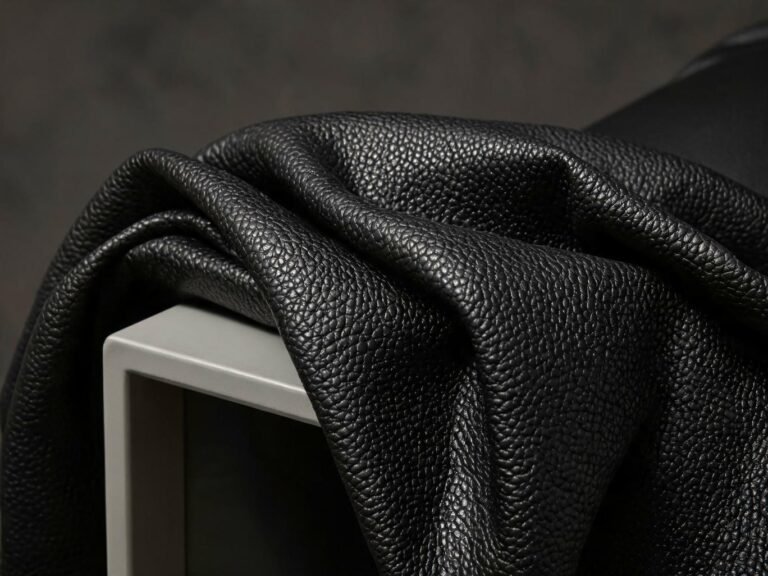
You specified black faux leather for a 200-unit furniture order. The samples looked perfect — smooth, consistent, professional. Eighteen months later, the callbacks started: peeling armrests, cracked seat cushions, flaking surfaces on pieces still under warranty. If this sounds familiar, you’re not alone. Most black faux leather fails within 36 months of commercial use — but the reason isn’t bad luck. It’s chemistry.
Why Black Faux Leather Peels: The Chemistry Nobody Explains
Faux leather peeling isn’t random — it’s the predictable failure of a plastic coating bonded to a fabric backing. The surface layer (PU or PVC) relies on adhesives and binders to stay attached to the textile substrate. Over time, heat, UV exposure, and humidity break down that adhesive bond. The coating loses flexibility, develops micro-cracks, and eventually flakes off in sheets. This is the root cause of faux leather cracking causes that suppliers rarely discuss.
The problem is structural, not cosmetic. You can’t condition your way out of adhesive delamination — no amount of leather conditioner will re-bond a separated coating. Faux leather peeling prevention starts at the specification stage: choosing a material where color and durability are integrated into the polymer matrix, not applied as a surface layer.
Key insight: Low-cost mass-produced black faux leather typically peels within 2-3 years. High-quality PU can resist peeling for a decade — but only if the bonding technique is sound. The difference isn’t visible in a swatch. It shows up in year two.
The 3 Faux Leather Types: PVC, PU, and Silicone
Not all faux leather is created equal. The PU vs PVC faux leather distinction matters enormously for contract durability:
- PVC faux leather — The cheapest tier ($2-5/yard). Plasticizer-heavy and brittle in cold environments. Cracks in geometric patterns rather than peeling. Increasingly restricted under environmental regulations.
- PU faux leather — The mid-range choice ($6-12/yard). Better flexibility and hand-feel than PVC, but the polyurethane coating still relies on adhesive bonding to the fabric backing. Hydrolysis-prone in humid climates — the coating absorbs ambient moisture and breaks down chemically over 6-8 weeks of accelerated testing.
- Silicone faux leather — Premium tier. The silicone polymer is cross-linked directly to the substrate during manufacturing — no separate adhesive layer to fail. Doesn’t hydrolyze, doesn’t rely on plasticizers, and maintains flexibility through 200,000 flex cycles at -30°C. If you’re new to the material, our silicone leather introduction covers the fundamentals.

Black lychee-texture faux leather rolls — surface quality varies dramatically by formulation
What Black Faux Leather Looks Like After 3 Years of Commercial Use
We ran accelerated aging tests on three black faux leather samples to simulate three years of commercial furniture use. The results map directly to what we see in field returns:
| Failure Mode | PVC Black | PU Black | Silicone Black |
|---|---|---|---|
| Peeling onset | ~12 months | ~24 months | Not observed |
| Cracking at flex points | ~8 months | ~18 months | None (200K flex cycles) |
| Color fading (UV) | Severe by month 12 | Moderate by month 18 | Class 4.5 after 1,500 hrs |
| Surface degradation | Chalking, flaking | Micro-peeling | Intact |

Flexibility bending test — simulating years of repeated stress on faux leather surfaces
In our testing, the ASTM D329 UV stability test proved the most reliable predictor of field performance. PVC samples began chalking after 200 hours of exposure; PU showed moderate fading by 500 hours; silicone maintained color integrity through 1,500 hours with no surface degradation. The ISO 105-X12 rubbing fastness test confirmed similar patterns — silicone achieved Class 5 (no color transfer), while PVC managed only Class 3-4.
How Silicone Chemistry Eliminates the Peeling Problem
Silicone faux leather solves the peeling problem at the molecular level. Unlike PU and PVC, which apply a separate coating layer onto fabric, silicone polymer chains cross-link directly with the substrate during the curing process. There is no adhesive layer to fail. The material is a single integrated structure — which is why it survives flex testing that destroys conventional faux leather.
This matters most in environments where faux leather durability is tested hardest: restaurant booths, cinema seating, hotel lobby furniture, and automotive interiors. These applications combine UV exposure, humidity, repeated flexing, and chemical cleaning — four stressors that accelerate adhesive breakdown in PU and PVC. For a deeper comparison, see our analysis of silicone vs PU leather.
Side-by-side durability comparison: PVC, PU, and silicone black faux leather under identical stress tests
Specifying Black Faux Leather That Actually Lasts
When writing specifications for black faux leather upholstery, include these minimum performance thresholds to filter out materials that will peel prematurely:
- Martindale abrasion: Specify minimum 50,000 cycles for residential, 100,000+ for commercial. Silicone achieves 150,000+.
- UV stability (ASTM D329): Require minimum 500 hours for indoor-only, 1,000+ for sun-exposed applications.
- Hydrolysis resistance: Demand test data showing minimum 8 weeks. Many suppliers skip this test entirely — that’s a red flag.
- Flex endurance (ISO 1764): Require documentation of 100,000+ cycles. If the supplier can’t produce this, their faux leather will crack at stress points.
For black faux leather upholstery in commercial contracts, the faux leather furniture durability data should be non-negotiable. Suppliers who can’t provide it are selling you a material they haven’t tested — which means you’re the one doing the testing, at your cost.

Color and texture variety in faux leather production — black variants at center
Frequently Asked Questions
How long does black faux leather last in commercial furniture?
Standard PVC faux leather lasts 1-2 years in commercial settings. Quality PU reaches 2-4 years. Silicone faux leather achieves 8-10+ years because it doesn’t rely on adhesive bonding that degrades. Always verify Martindale and hydrolysis test data before specifying.
Can you prevent faux leather from peeling?
You can delay it with proper care — avoiding direct sunlight, using gentle cleaners, maintaining humidity — but you can’t prevent adhesive degradation. The only genuine prevention is choosing a material without an adhesive layer, like silicone leather.
What’s the difference between faux leather and PU leather?
“Faux leather” is an umbrella term covering any synthetic leather — PVC, PU, and silicone all qualify. PU leather is a specific subtype. The difference between faux leather and PU matters because PU generally outperforms PVC but still has the same adhesive-bonding weakness.
The Swatch Won’t Show You Year Three
Every black faux leather looks identical on day one. The differences emerge in month 18, when PVC starts chalking, PU begins micro-peeling, and silicone still looks new. If your contract lifecycle extends beyond three years, the material you specify today determines whether you’re re-ordering furniture or collecting callbacks. Choose based on chemistry, not on the swatch — and demand the test data that proves the claim.

Black faux leather dining chairs — a common application where peeling failures occur
About TOPSUN
TOPSUN engineers silicone-based faux leather that eliminates the adhesive bonding failure responsible for peeling in conventional PU and PVC materials. Our black faux leather cross-links silicone polymer directly to the textile substrate during curing — creating a single integrated structure with no separate coating layer to delaminate.
150,000+ Martindale cycles, ISO 105-X12 Class 5 color fastness, 200,000 flex cycles at -30°C — verified by third-party test reports for every batch.