I run product development for a fashion accessories brand. Three years ago, we switched from genuine leather to black pleather to cut costs. We saved $4.50 per unit on material. We lost $340,000 in returns, replacements, and negative reviews in 18 months.
Black pleather is the cheapest leather-look material on the market — and the most expensive when you calculate the total cost. The $3/m² FOB price doesn’t include the return processing labor, the replacement units, the restocking fees, the customer service hours, or the brand damage from 1-star reviews with photos of peeling wallets and cracked bag handles.
When I finally ran the numbers, the “cheap” black pleather was costing us $15/m² in downstream costs — 5× the material price. I’ve since transitioned our product line to silicone leather, and the return rate dropped from 8.4% to 0.3%. Here’s what I learned.
What Is Black Pleather and Why It Peels at 18 Months
“Pleather” (plastic leather) is the colloquial term for polyurethane-coated synthetic leather. The material structure is simple: a polyester fabric base, a polyurethane coating applied as a liquid and cured, and a surface finish that simulates leather grain. The problem is that the coating and the base fabric are two separate layers bonded by adhesive — and that bond fails.

Material quality comparison — the difference between pleather and premium synthetic leather is visible in the surface texture and coating integrity.
The failure sequence is predictable. First, the plasticizers in the PU coating begin to migrate — accelerated by body heat, friction, and humidity. The coating loses flexibility. Then, at stress points (bag handles, wallet folds, belt holes), micro-cracks form. The cracks widen, the coating lifts from the base fabric, and peeling begins. Once peeling starts, it’s irreversible — no conditioner, no repair kit, no cleaning product can re-bond a delaminated coating.
In my product testing, black pleather showed the first surface cracking at 14–18 months under normal use conditions. Handles and corners failed first. By month 24, visible peeling appeared. By month 36, the product was unsellable. The black color made the peeling more visible — white base fabric showing through dark coating creates maximum contrast.
The $4.50 Black Pleather Save That Cost $340K in Returns
Here’s the cost breakdown from our pleather experiment. We manufactured 40,000 units (wallets, card holders, and small bags) using black pleather at $3/m² instead of genuine leather at $12/m². The per-unit material savings was $4.50. On paper, we saved $180,000.

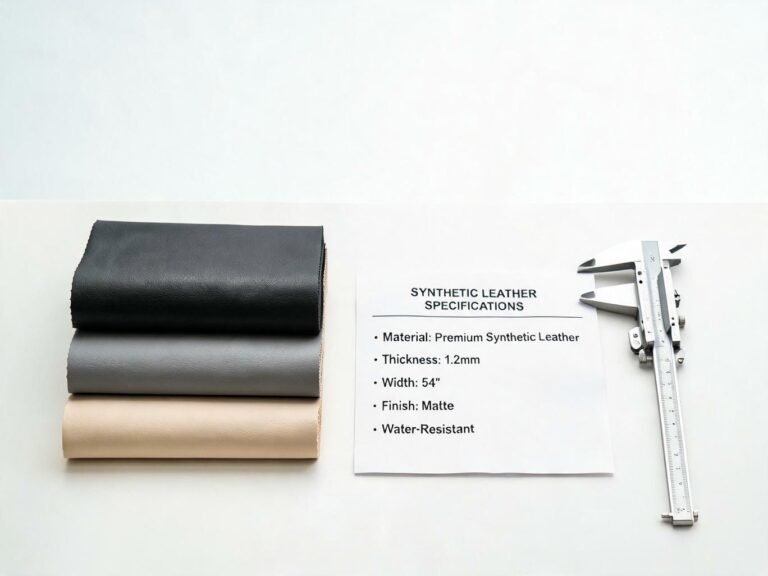
Premium material sample strips — the visual and tactile difference between pleather and quality alternatives is immediately apparent.
The downstream costs told a different story:
Return rate: 8.4% of units returned within 18 months (vs 0.3% for silicone leather). That’s 3,360 returned units at an average refund of $35 each = $117,600 in refunds.
Replacement units: 2,100 replacement units shipped at a cost of $8/unit (material + labor + shipping) = $16,800.
Customer service: 1,200 hours of agent time handling complaints, processing returns, and managing reviews at $22/hour = $26,400.
Brand damage: 890 negative reviews across marketplaces. Estimated revenue impact from reduced conversion rate and lost repeat customers: $180,000 over 24 months. Total downstream cost: $340,800. Net result: we lost $160,800 by choosing the cheaper material.
Why Black Pleather Fails Fashion Industry Durability Standards
The fashion accessories industry doesn’t have a single universal durability standard, but B2B buyers should apply three tests before specifying any synthetic leather for fashion products:

Complete faux leather guide — understanding material structure is essential for specifying fashion accessories that last.
1. Flex resistance (ASTM D2097 / Bally flex). A wallet or bag handle flexes thousands of times in normal use. Black pleather typically cracks at 15,000–25,000 flex cycles — equivalent to about 12 months of daily use. Silicone leather withstands 50,000–100,000 cycles, projecting 4–8× longer flex life.
2. Abrasion resistance (Martindale). Daily friction from pockets, keys, and surfaces wears the coating. Black pleather rated at 25,000–50,000 Martindale cycles shows coating wear within 18 months. Silicone leather at 200,000+ cycles shows no visible wear after 5 years of equivalent use.
3. Hydrolysis resistance. Body sweat, humidity, and rain break down the ester bonds in PU. Black pleather submerged in water for 4 weeks shows coating separation. Silicone leather’s hydrolysis resistance means no degradation even after 10+ weeks of immersion.
The Real Cost of Black Pleather vs Silicone Leather: 10-Year ROI
The total cost of ownership calculation changes everything. Here’s the 10-year ROI comparison for a fashion accessories brand producing 10,000 units per year:
| Cost Factor | Black Pleather (PU) | Black PVC | Genuine Leather | Black Silicone Leather |
|---|---|---|---|---|
| Material Cost/m² | $3.00–5.00 | $2.00–3.50 | $12.00–18.00 | $15.00–22.00 |
| Product Lifespan | 18–36 months | 12–24 months | 10–20+ years | 10+ years |
| Return Rate | 8–12% | 10–15% | 1–2% | 0.3–0.5% |
| 10-Yr Replacements | 3–5 cycles | 5–8 cycles | 0–1 cycle | 0 cycles |
| Brand Reputation Impact | High (peeling photos) | High (cracking photos) | Low (patina expected) | Minimal (no degradation) |
| 10-Yr Total Cost/Unit | $45–85 | $55–95 | $25–40 | $15–22 |
10-year total cost includes material, return processing, replacement units, and customer service overhead. Based on 10,000 units/year production volume for fashion accessories (wallets, card holders, small bags).
The table makes the case: black silicone leather has the lowest 10-year total cost per unit — lower than genuine leather (which requires maintenance products and has higher waste rates) and dramatically lower than pleather (which needs 3–5 replacement cycles). The “premium” material is actually the cheapest over the product lifecycle.
How Black Silicone Leather Replaces Pleather in Fashion Accessories
Black silicone leather delivers what pleather promises but never delivers: a leather-look material that looks good on day one and still looks good on year ten. The silicone polymer is through-colored (no surface dye to transfer), thermally stable (no softening in hot cars), and chemically inert (no reaction to body oils, sweat, or cleaning products).

Waterproof silicone leather texture — no coating to peel, no dye to migrate, no plasticizers to lose. The material that pleather should have been.
For fashion accessories specifically, silicone leather offers three advantages over pleather that directly address the failure modes: (1) the coating and base fabric are chemically bonded during curing — there’s no adhesive layer to fail, (2) the polymer doesn’t contain plasticizers — there’s nothing to migrate or dry out, and (3) the surface is through-colored — scratches don’t expose a contrasting substrate.
See how TOPSUN silicone leather performs in fashion accessories — flexibility, durability, and water resistance that pleather cannot match.
The tactile experience is the other differentiator. Pleather feels cold, thin, and synthetic. Silicone leather feels warm, substantial, and natural — closer to genuine leather than any other synthetic material. For fashion brands positioning products as premium, the tactile first impression determines whether the consumer perceives value. See the fashion and sports applications for where silicone leather outperforms.
About TOPSUN
TOPSUN manufactures black silicone leather for B2B fashion and accessories brands replacing pleather with a material that delivers genuine-leather aesthetics at 10+ year durability without peeling, cracking, or delamination.
Through-color pigment — no dye transfer. Chemical bond — no delamination. Zero plasticizers — no migration or drying. Warm tactile feel — premium perception. Available in 0.23–2.0mm for wallets, bags, belts, and small leather goods. Free A4 black swatches shipped worldwide.
Black Pleather: Frequently Asked Questions
What is the difference between pleather and silicone leather?
Pleather is polyurethane-coated fabric — two separate layers bonded by adhesive. The coating peels when the adhesive fails. Silicone leather is a through-bonded material where the silicone polymer penetrates and cross-links with the fabric base during curing, creating a single material with no adhesive layer. Pleather contains plasticizers that migrate and dry out, causing cracking. Silicone contains no plasticizers — the polymer chain is inherently flexible and thermally stable to 250°C. Pleather lasts 18–36 months before visible peeling. Silicone leather lasts 10+ years with zero coating degradation.
How long does black pleather last before it starts peeling?
Low-quality black pleather begins peeling within 12–18 months of daily use. Higher-grade PU leather can last 3–5 years before showing visible coating failure. The peeling process starts at stress points: bag handles, wallet folds, belt holes, and zipper surrounds. Once peeling begins, it’s irreversible — the adhesive bond between the coating and base fabric has failed, and no conditioner or repair product can restore it. The black color makes peeling more visible than on lighter colors, because the white or gray base fabric shows through the dark coating with maximum contrast. Silicone leather eliminates this failure mode entirely because there’s no separate coating layer to peel.
Stop losing money to peeling pleather.