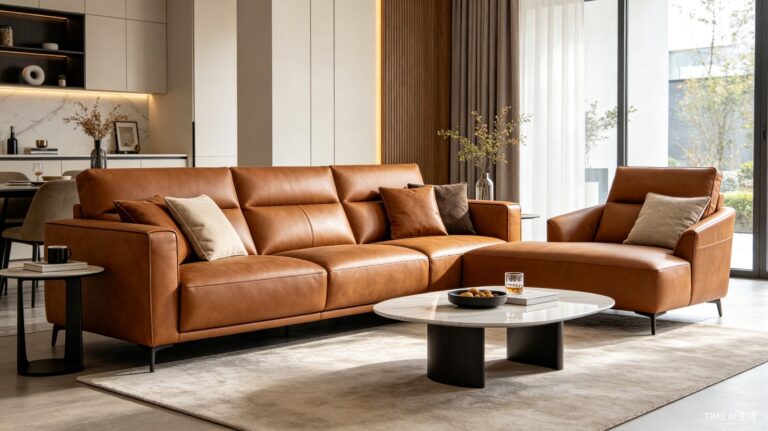
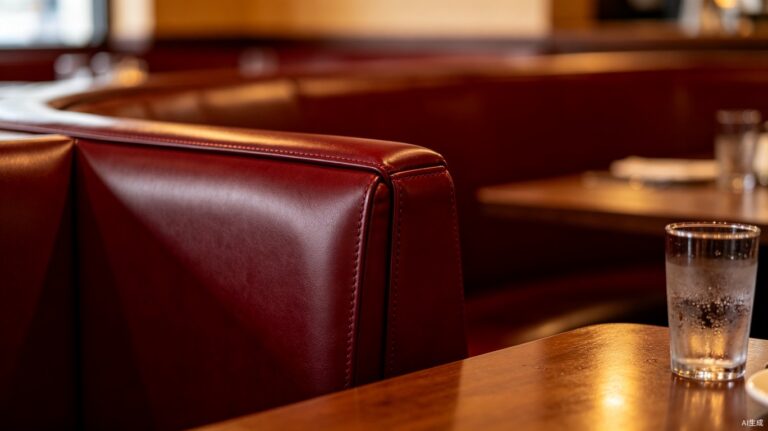
A restaurant owner installs PU leather bench seating for a 60-seat dining room. The material looks premium on opening day. Six months later, the front edge of every bench — where thighs press hardest when sliding in and out — shows visible cracking and coating wear. By month 18, three benches have surface tears at the seat-to-back transition. The replacement cost: $8,000. The material that was supposed to last 5 years didn’t survive 18 months of real restaurant traffic. The problem isn’t the leather grade or the manufacturing quality. It’s that bench seat leather faces a unique combination of stresses — sliding friction, body weight concentration, food spills, and commercial cleaning chemicals — that most materials simply aren’t engineered to handle. For a detailed look at restaurant booth seating material selection, that guide covers the hospitality specification framework.
Request Bench Seat Leather Samples
Why Bench Seat Leather Fails at the Front Edge
Bench seating creates a stress pattern that individual chairs don’t. When a diner slides into a bench seat, their body weight transfers across the front edge of the seat in a horizontal motion — not a vertical sit-down like a chair. That sliding friction, repeated 200-500 times per day in a busy restaurant, concentrates wear on a 2-inch band at the seat edge. The coating at that edge experiences more abrasion in one month than the center of the seat experiences in a year.
Body weight adds the second stress. A 180-pound diner sitting on a bench applies approximately 2.5 psi of downward pressure across the seat surface — but at the front edge, where thighs create a fulcrum, the localized pressure can reach 8-12 psi. That pressure, combined with the flexing that occurs as the diner shifts position during a 45-minute meal, creates mechanical stress that accelerates coating breakdown. PU leather, which already has marginal adhesion between the polyurethane coating and the fabric backing, simply can’t maintain integrity under this combined friction-pressure-flex cycle.

Flexibility bending test — simulating the repeated flex that destroys bench seat edges
In our testing of restaurant bench seat failures, we see a consistent pattern: PU leather shows front-edge coating breakdown at 6-12 months, PVC leather shows hardening and cracking at 8-14 months, and genuine leather shows surface wear and color loss at 12-24 months. The failure mechanism is different for each material, but the failure location is always the same — the front edge where sliding friction meets concentrated body weight. For more on cleaning and maintenance requirements, that guide covers what each material demands.
The 4 Bench Seat Leather Materials: Restaurant Test Results
We tested four materials commonly specified for restaurant bench seating against the three forces that destroy them: sliding friction (front-edge abrasion), liquid exposure (food and beverage spills), and chemical exposure (commercial cleaning). The results separate materials that look good on day one from materials that still look good on day 1,000.

Water droplet test — the difference between a material that repels spills and one that absorbs them
| Material | Front-Edge Wear | Crack Resistance | Stain Resistance | Cleanability | Service Life (Restaurant) |
|---|---|---|---|---|---|
| PU Leather | Poor (6-12 mo) | Low (flex cracking) | Moderate | Chemical-sensitive | 1-2 years |
| PVC Leather | Poor (8-14 mo) | Low (plasticizer loss) | Good | Moderate | 1.5-3 years |
| Genuine Leather | Moderate (12-24 mo) | Moderate (conditioning needed) | Poor (absorbs stains) | Specialized products only | 3-8 years (with care) |
| Silicone Leather | Excellent (200K+ cycles) | None (-40 to 250°C) | Excellent (non-porous) | Bleach-safe, alcohol-compatible | 10+ years |
The verdict is clear: no PU, PVC, or genuine leather material delivers the combination of front-edge durability, stain resistance, and chemical cleanability that restaurant bench seating demands. For restaurant booth upholstery specifications, the cleaning chemical compatibility column is often overlooked — and it’s the one that causes the most premature failures.
Cleaning Chemicals: The Hidden Bench Seat Killer
Restaurant bench seats don’t just face diners — they face cleaning crews. Commercial sanitizers, bleach solutions, degreasers, and disinfectant wipes are applied to bench seating surfaces 1-3 times per day in a typical restaurant. These chemicals are formulated to kill bacteria and dissolve food residue — which means they’re also formulated to break down organic polymers.
PU leather is particularly vulnerable. The polyurethane coating is an organic polymer that commercial degreasers and alcohol-based sanitizers can dissolve. Repeated exposure thins the coating, accelerates cracking, and causes the embossing pattern to flatten. A bench seat that looks fine after evening cleaning can show measurable coating thinning after 90 days of daily chemical exposure — well before the mechanical stress would have caused failure on its own.
One of our restaurant clients was replacing PU bench seating every 14 months. We tested the failed material and found that 60% of the surface degradation came from cleaning chemicals, not from diner traffic. The material was rated for 25,000 Martindale cycles — but nobody tested it against the quaternary ammonium sanitizer the cleaning crew used twice daily.
Genuine leather is even more chemical-sensitive. Commercial sanitizers strip the natural oils from the leather surface, causing rapid drying and cracking. Restaurant-grade leather conditioners exist, but they require application frequency that most restaurant operations can’t accommodate — and they leave a residue that attracts dirt. For hydrolysis-resistant silicone leather, the non-porous surface is inherently resistant to chemical cleaning — no special products required.
Silicone Bench Seat Leather: Surviving 10 Years of Service
Silicone leather solves all three bench seat failure modes through its polymer chemistry. The non-porous surface repels liquids — wine, coffee, oil, and sauces bead up and wipe off without staining. The chemical-inert surface tolerates bleach, alcohol disinfectants, and commercial degreasers without coating degradation. And the 200,000+ Martindale abrasion cycles handle the front-edge sliding friction that destroys PU and PVC within months.

Restaurant booth seating — where 500 daily sittings, food spills, and commercial cleaning determine material survival
One of our hospitality clients specified silicone leather for a 200-seat restaurant renovation. After 3 years of continuous service — an estimated 540,000 diner sittings — the bench seats showed no visible surface degradation. The front edges, the failure point for every previous PU material they had used, looked identical to the center of the seats. The material specification for furniture sofa applications in hospitality environments had finally matched the operational reality.
The antimicrobial properties add a dimension that no PU or PVC material offers. Silicone leather inherently inhibits bacteria, mold, and mildew without chemical additives — a critical food-safety advantage for restaurant bench seating where food residue and moisture create ideal microbial growth conditions. The material is FDA 21 CFR 177.2600 food-contact compliant and ISO 10993-5 biocompatibility certified, making it suitable for direct food-contact-adjacent surfaces.
Frequently Asked Questions
How long does PU bench seat leather last in a restaurant?
PU bench seat leather typically lasts 12-18 months in a restaurant with 200+ daily covers. The front edge of the seat — where sliding friction and concentrated body weight meet — is the first failure point, showing coating breakdown within 6-12 months. Commercial cleaning chemicals accelerate the failure, with daily exposure to sanitizers and degreasers thinning the polyurethane coating and accelerating cracking. Total replacement is usually needed within 18 months, though the center of the seat may still appear intact. Silicone leather, by comparison, lasts 10+ years in the same environment with no surface degradation.
What is the best leather for restaurant bench seating?
Silicone leather is the best material for restaurant bench seating, based on test data across the three failure modes that destroy conventional materials: sliding friction (200,000+ Martindale cycles vs PU’s 25,000), chemical cleaning (bleach-safe and alcohol-disinfectant compatible), and food/beverage spills (non-porous surface repels stains). Genuine leather offers better aesthetics but requires conditioning and is chemical-sensitive. PU and PVC leather fail at the front edge within 12-18 months. Silicone leather is the only material that combines restaurant-grade durability with premium aesthetics, antimicrobial properties, and zero maintenance — and it’s FDA food-contact compliant for food-service environments.
The Bench Seat Specification That Matches the Traffic
Restaurant bench seating is one of the most demanding upholstery applications in the furniture industry. The material must simultaneously survive sliding friction at the front edge, concentrated body weight across the seat, food and beverage spills, commercial cleaning chemicals, and microbial growth — all while maintaining the premium appearance that restaurant design demands. PU fails at the front edge. PVC fails through plasticizer loss. Genuine leather fails at the cleaning-chemical interface. Silicone leather is the material that was engineered for this environment: non-porous, chemically inert, abrasion-resistant, antimicrobial, and food-contact certified. For restaurants that can’t afford to replace bench seating every 18 months, the material specification is the difference between an $8,000 replacement cycle and a 10-year service life.
Request Bench Seat Leather Samples
About TOPSUN
TOPSUN manufactures silicone leather for restaurant bench seating that survives 500+ daily sittings, commercial cleaning chemicals, and food/beverage spills without cracking, staining, or degrading — for hospitality groups and furniture manufacturers who need upholstery that outlasts the warranty period.
200,000+ Martindale cycles (ISO 12947-2) | Bleach-safe and alcohol-disinfectant compatible | FDA 21 CFR 177.2600 food-contact compliant | Intrinsic antimicrobial (ISO 22196) | ISO 10993-5 biocompatibility certified | 10+ year service life | 500,000+ m monthly capacity