If a synthetic leather can survive automotive interior specifications, it can survive almost any application on Earth. Automotive OEMs impose the most demanding material qualification gauntlet in the coated fabrics industry — FMVSS 302 flammability, SAE J2412 UV aging, DIN 75201 fogging, VDA 270 odor, and Martindale abrasion resistance — all tested under conditions that simulate years of Arizona sun, subzero winters, and daily wear from drivers and passengers.
Most synthetic leather suppliers fail at least one of these tests. PVC leather passes flammability but fails fogging and VOC. PU leather feels soft but cracks under UV and heat aging. Genuine leather meets aesthetic expectations but requires chemical treatments that conflict with REACH and ELV directives. This article breaks down the five OEM specification gates that automotive upholstery materials must clear — and which materials actually pass all of them.
Request Automotive Leather Samples

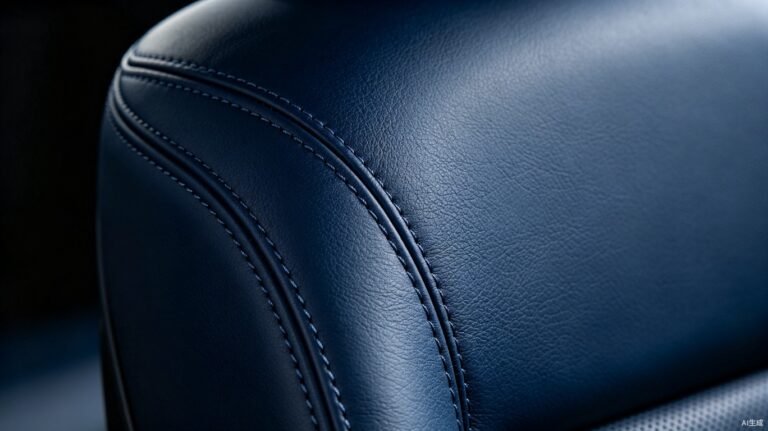
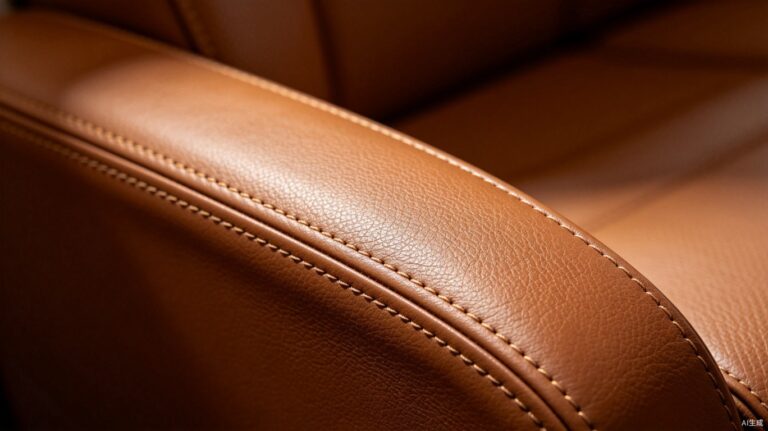
Automotive upholstery material samples — only materials passing all five OEM specs reach this stage
Gate 1: FMVSS 302 Flammability — The Non-Negotiable Baseline
FMVSS 302 (Federal Motor Vehicle Safety Standard No. 302) is the mandatory U.S. regulation governing flammability of all interior materials in motor vehicle occupant compartments. Codified at 49 CFR §571.302, it requires that materials self-extinguish with a horizontal burn rate not exceeding 102 mm per minute. This applies to seat covers, door trim, headliners, and any material within the passenger cabin — including stitching thread.
Most PVC and PU synthetic leathers pass FMVSS 302 by incorporating flame retardant additives — typically halogenated compounds (brominated or chlorinated) or phosphorus-based chemicals. These additives work, but they introduce secondary problems: halogenated flame retardants release toxic smoke when burned, and many are restricted under the EU ELV Directive (2000/53/EC) and REACH Annex XVII. So a material can pass FMVSS 302 while simultaneously failing European end-of-life vehicle requirements.
Silicone leather passes FMVSS 302 through inherent flame retardancy — no additives required. The silicone polymer (polysiloxane) is self-extinguishing by nature. When exposed to flame, it forms a silica ash layer that inhibits further combustion. This means the same material that passes U.S. flammability requirements also meets EN 13773 Class 4 (European highest flame retardant grade) and FAR 25.853 (aviation interior flammability) without any chemical modification. For automotive programs targeting both U.S. and EU markets, this dual compliance is critical.
Compliance trap: A supplier offering “FMVSS 302-compliant PU leather” may be using halogenated flame retardants that fail ELV Directive substance restrictions. Always request the flame retardant chemical disclosure alongside the FMVSS 302 test report — if they can’t identify the additive, assume it’s a restricted substance.
Gate 2: SAE J2412 UV Aging — Simulating 3–5 Years of Arizona Sun
SAE J2412 is the automotive industry standard for accelerated UV exposure of interior materials. It uses a xenon arc lamp to simulate the full solar spectrum through automotive glass, with elevated temperature and humidity cycling. The standard test duration is 1,000+ hours — roughly equivalent to 3–5 years of real-world sun exposure in a high-radiation climate like Arizona or the Middle East.
Acceptance criteria vary by OEM, but the common threshold is ΔE ≤ 3.0 after 1,000 hours — meaning the total color shift must be less than what the human eye can clearly distinguish. Premium programs (BMW, Mercedes, Tesla) typically specify ΔE ≤ 2.0. The material must also show no cracking, crazing, or gloss change beyond specified limits.
PVC leather typically fails at 200–400 hours. The plasticizers that make PVC flexible migrate and evaporate under UV and heat, causing the surface to stiffen, crack, and yellow. PU leather lasts longer — 400–600 hours before visible degradation — but the ester bonds in the polyurethane polymer chain undergo photo-oxidation, leading to gloss loss, color shift, and eventually surface cracking. Genuine leather performs well when properly pigmented and topcoated, but the topcoat itself degrades under sustained UV, requiring reconditioning.
Silicone leather’s Si-O polymer backbone is inherently UV-stable — the bond energy of Si-O (approximately 452 kJ/mol) exceeds the energy of UV-A and most UV-B photons that penetrate automotive glass. In our testing, silicone leather shows ΔE ≤ 1.5 after 1,000+ hours of SAE J2412 exposure with no surface degradation. For more on our testing protocols, see the technical data sheet page.

Xenon arc testing chamber — where SAE J2412 separates materials that age gracefully from materials that don’t
Gate 3: DIN 75201 Fogging — The Test Most Suppliers Don’t Talk About
Fogging is the condensation of volatile compounds from interior materials onto the windshield — the haze that appears on the inside of automotive glass. DIN 75201 measures two values: the reflectometric fogging value (percentage of light reflected through the fogged glass) and the gravimetric fogging value (mass of condensable components in milligrams). OEM specifications typically require ≥ 90% reflectometric value and ≤ 2 mg gravimetric value.
PVC leather is the worst fogging offender — plasticizers (phthalates, adipates) volatilize at elevated cabin temperatures (which can exceed 80°C in a parked car in summer) and condense on the coolest surface available: the windshield. PU leather also fogs due to residual solvents and unreacted monomers in the polyurethane coating. Even “low-VOC” PU formulations can fail DIN 75201 if the production process doesn’t fully cure the polymer.
Silicone leather is produced through a solvent-free dry coating process — no solvents, no plasticizers, no unreacted monomers to volatilize. The silicone polymer itself is thermally stable up to 250°C, meaning it doesn’t release volatiles even at temperatures far exceeding real-world cabin conditions. This is why silicone leather consistently achieves the highest DIN 75201 fogging values — typically ≥ 95% reflectometric, ≤ 0.5 mg gravimetric — without any post-treatment or ventilation measures.
Gate 4: VDA 270 Odor and VDA 277 VOC — The Cabin Air Quality Standards
VDA 270 (Verband der Automobilindustrie — German Automotive Industry Association) is the odor evaluation standard used by European OEMs including BMW, Mercedes, Volkswagen, and Audi. Trained panelists rate material samples on a 1–6 scale (1 = imperceptible, 6 = intolerable). Most OEM specifications require ≤ 3.0 for interior trim materials — meaning the odor must be “clearly noticeable but not disturbing.”
VDA 277 measures total VOC emissions from interior materials using headspace gas chromatography. OEM thresholds vary but typically require ≤ 50 μg C/g for non-metallic materials. This is where many synthetic leathers fail — residual solvents (DMF, toluene, methyl ethyl ketone) from the coating process continue to off-gas for months or years after production.
Silicone leather’s solvent-free production process means there are no residual solvents to off-gas. VDA 270 odor rating: ≤ 2.0 (noticeable but not disturbing). VDA 277 VOC: well below 50 μg C/g threshold. Combined with ISO 16000-6 compliance for VOC emissions and EU E1 formaldehyde compliance, silicone leather meets the strictest cabin air quality requirements currently in force. For OEM programs targeting premium market segments where interior air quality is a differentiator, this is decisive.
Gate 5: Martindale Abrasion — The Daily Wear Threshold
Automotive seating surfaces experience continuous abrasion from clothing, seat belts, entry/exit friction, and child seats. OEM specifications typically require 50,000–100,000 Martindale cycles without visible wear-through for seat surfaces, and 25,000–50,000 cycles for door panels and trim. Some premium programs demand 100,000+ cycles for high-contact zones like seat bolsters.
PVC leather typically achieves 15,000–30,000 Martindale cycles before the plasticized surface shows cracking. PU leather reaches 10,000–30,000 cycles — the softer the PU formulation, the lower the abrasion resistance, creating a trade-off between hand feel and durability. Genuine leather varies widely depending on the hide grade and finish, ranging from 30,000 to 80,000+ cycles.
Silicone leather exceeds 200,000 Martindale cycles — 2–4× the highest OEM requirement. The abrasion resistance comes from the inherent toughness of the silicone polymer and the cross-linked network structure of the coating. Unlike PU, silicone leather’s soft hand feel doesn’t come at the expense of abrasion resistance — the material maintains a Shore A hardness range of 40–80 while delivering the highest abrasion performance in the synthetic leather category.

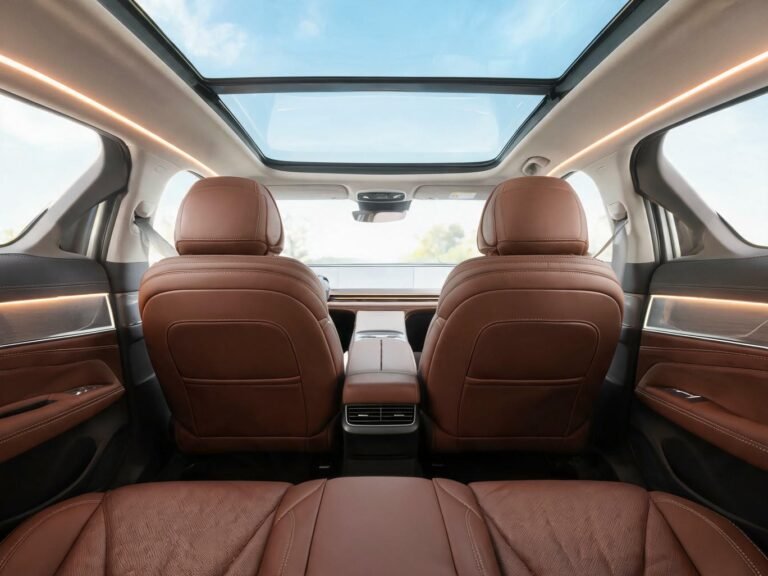
Automotive interior detail — every visible surface must pass all five OEM specification gates
Material Comparison: Which Automotive Upholstery Materials Pass All Five Gates?
| Material | FMVSS 302 | SAE J2412 (UV) | DIN 75201 (Fog) | VDA 270/277 | Martindale |
|---|---|---|---|---|---|
| PVC leather | Pass (with additives) | Fail (200–400 hrs) | Fail (plasticizer fog) | Fail (VOC) | 15–30k cycles |
| PU leather | Pass (with additives) | Fail (400–600 hrs) | Marginal | Marginal | 10–30k cycles |
| Genuine leather | Pass (treated) | Pass (topcoated) | Pass | Marginal (tanning chem.) | 30–80k cycles |
| Silicone leather | Pass (inherent) | Pass (ΔE ≤ 1.5) | Pass (≥ 95%) | Pass (VOC ≤ threshold) | 200k+ cycles |
Only genuine leather and silicone leather pass all five gates. But genuine leather’s compliance depends on chemical treatments (chrome tanning, aldehyde tanning, topcoat finishes) that may conflict with REACH, ELV, and increasingly stringent OEM chemical management policies. Silicone leather is the only material that passes all five gates through inherent material properties — no additives, no treatments, no chemical management risk. For a deeper comparison, see our analysis of car upholstery materials and the silicone vs PU technical comparison.
Automotive certifications overview — how silicone leather meets OEM specification requirements
EV Interiors: Why Automotive Upholstery Materials Are Getting Harder
Electric vehicles are raising the bar for automotive interior materials. Three EV-specific trends are reshaping material selection:
• Lightweighting: EV manufacturers need thinner, lighter interior materials to maximize range. Silicone leather is available in thicknesses from 0.23mm — thinner than typical PU automotive leather (0.8–1.2mm) while maintaining superior abrasion resistance. Less material weight per vehicle translates to measurable range improvement.
• Premium cabin perception: EVs are marketed as technology products first, vehicles second. Interior material quality must match the premium positioning — no plasticizer smell, no fogging on the windshield, no visible material degradation over the vehicle’s warranty period. See our EV interior materials analysis for more detail.
• Sustainability mandates: EV programs are the vanguard of automaker sustainability commitments. Materials must be recyclable, free from restricted substances, and ideally produced with minimal environmental impact. PVC and PU leather face increasing scrutiny under these mandates — silicone leather’s solvent-free production, 100% recyclability, and zero VOC profile align directly with EV sustainability requirements. For real-world examples, see our BMW case study and Mercedes case study.
FAQ: Automotive Upholstery Materials
What material is used for car seat upholstery?
The four dominant automotive upholstery materials are genuine leather, PVC (vinyl) leather, PU (polyurethane) synthetic leather, and silicone leather. Each must pass FMVSS 302 flammability, SAE J2412 UV aging, DIN 75201 fogging, VDA 270/277 VOC, and Martindale abrasion tests to achieve OEM approval. Most materials pass some but not all — silicone leather is the only synthetic that passes all five through inherent material properties without chemical additives.
Can PU leather be used in automotive interiors?
Yes — PU leather is widely used in mid-tier automotive interiors. However, it typically fails SAE J2412 UV aging at 400–600 hours (OEM threshold is 1,000+), and its fogging and VOC performance depends heavily on production quality. PU leather in automotive applications has a practical service life of 3–5 years before visible degradation, compared to 10+ years for silicone leather in identical conditions.
Specify for All Five Gates — Not Just One
The most common procurement mistake in automotive upholstery materials is specifying a material that passes one OEM gate while failing others. A supplier showing an FMVSS 302 pass certificate doesn’t mean their material also passes SAE J2412 or DIN 75201. Require test reports for all five gates — with batch numbers matching your PO — before approving any material for automotive interior production. For applications where all five gates must be cleared simultaneously without chemical trade-offs, silicone leather is the specification that automotive engineers are increasingly writing by name. For more on specific automotive applications, see our car door panel materials guide and gear shift boot leather specifications.
Get Automotive-Grade Leather Samples
About TOPSUN
TOPSUN manufactures silicone leather that passes all five automotive OEM specification gates — FMVSS 302 inherent flame retardancy, SAE J2412 UV aging ΔE ≤ 1.5, DIN 75201 fogging ≥ 95%, VDA 270/277 VOC compliance, and 200,000+ Martindale abrasion cycles — through inherent material properties without chemical additives, for automotive OEM and tier-1 suppliers.
FMVSS 302 compliant · EN 13773 Class 4 · FAR 25.853 aviation · ΔE ≤ 1.5 after 1,000 hrs · 200k+ Martindale · Solvent-free · Zero VOC · ELV compliant · 100% recyclable · 500,000+ m monthly capacity